WUT Meaning in Text: Origin, Who Uses It, and How to Reply
What Does WUT Mean in Text?
WUT meaning in text stands for “What,” a phonetic, deliberately informal spelling that people type to express confusion, disbelief, or a genuine request for clarification depending entirely on what comes before it. Same word. Different energy from the standard spelling.
You will see it after something surprising, something confusing, or something so unexpected that a plain “what” feels too composed for the moment. WUT carries attitude that “what” does not, and everyone who reads it knows exactly what kind of reaction the sender is having.
Origin and Cultural Footprints
WUT meaning in text emerged from internet culture’s long tradition of phonetic respelling as personality expression. Early online communities on forums, chat rooms, and gaming platforms began spelling common words differently not out of ignorance but as deliberate tone signals. WUT replaced “what” the same way “kewl” replaced “cool” and “teh” replaced “the.”
The spelling spread through gaming communities, meme culture, and social media platforms where expressing a specific emotional register mattered more than conventional spelling. WUT carried a particular flavor of exasperated or theatrical confusion that the standard spelling could not match, which explains why it survived every platform shift from early internet culture to modern Gen Z communication.
Other Meanings of WUT
WUT carries a few alternate readings worth knowing depending on the community and context:
- Warwick University Technology — An academic abbreviation used in certain British university and technology program contexts. Appears in academic documentation, student forums, and institutional communications with no connection to casual text slang.
- Phonetic expression of stunned silence — Some people use WUT specifically to represent the sound someone makes when they are too surprised to form a proper response. In this reading it functions less as a question and more as a reaction sound written out.
- Wuthering — An extremely niche literary abbreviation occasionally used in classic literature discussion communities and academic shorthand. Rare outside of very specific educational contexts and completely disconnected from everyday texting.
Why Does WUT Have Multiple Meanings?
WUT sits in a category where the alternate meanings are so niche and context-specific that they almost never create genuine confusion in everyday conversation. The phonetic “what” reading dominates so completely that virtually every person who sends or receives WUT in a text message means exactly that and nothing else.
The other meanings belong to closed communities that announce themselves through platform, tone, and surrounding subject matter before the abbreviation even registers. A British university student and a teenager reacting to surprising news both type WUT but they exist in such different conversational spaces that the meanings never meaningfully collide.
Who Uses It Most?
WUT belongs to people who communicate with expressive, theatrical energy and want their spelling to reflect the intensity of their reaction. The groups that reach for it most tend to be those whose communication style prioritizes personality over precision.
Here is a clear breakdown of which groups use WUT most and how each group deploys it:
| Group | How They Use WUT | Why It Works |
|---|---|---|
| Gen Z | Reacting to surprising or confusing statements in DMs | The unconventional spelling signals genuine emotional reaction |
| Gamers | Responding to unexpected in-game events and announcements | Fast, expressive, and universally understood in gaming culture |
| Meme communities | Captioning confused reactions and disbelief moments | Carries the exact visual energy that meme formats require |
| Teenagers | Reacting to anything that genuinely catches them off guard | Matches the high-energy, reactive communication style of teen texting |
Real Conversation Examples Using WUT
- Reacting to surprising news Context: A friend announces something completely unexpected in a group chat. Sender: “I just got offered a job in another country and I think I am going to take it.” Reply: “Wut. When did this happen?” How to respond: Give the full story from the beginning because that reply deserves context.
- Genuine confusion about a statement Context: Someone sends a message that makes no sense without more information. Sender: “The thing with the situation from before came back.” Reply: “Wut are you talking about, which situation?” How to respond: Clarify exactly which situation before the conversation can move forward.
- Theatrical disbelief at a price or fact Context: A friend shares an absurdly high price for something ordinary. Sender: “This coffee shop is charging twenty dollars for a latte.” Reply: “Wut. Absolutely not.” How to respond: Validate the disbelief and suggest leaving immediately.
- Reacting to an unexpected plot twist in a show Context: Two people watching the same series message each other mid-episode. Sender: “Did that character just do what I think they did?” Reply: “WUT I screamed out loud.” How to respond: React fully and get into the discussion because the episode clearly delivered.
- Responding to early morning chaos Context: Someone wakes up to a string of dramatic messages and responds immediately. Sender: “Everything has completely fallen apart since last night.” Reply: “Wut happened, I was asleep for eight hours.” How to respond: Catch them up from the very beginning without skipping anything.
Usage of WUT in Different Contexts
In personal texting, WUT works as a reaction that lands harder than a plain “what” because the spelling choice signals genuine surprise rather than casual curiosity. Someone sends unexpected information and the WUT that comes back tells them the news actually landed with force. That emotional feedback keeps conversation authentic.
In meme and internet culture contexts, WUT functions as a visual reaction format that represents a specific kind of confused disbelief. A face paired with WUT in a meme conveys the entire emotional experience of being completely bewildered by something without needing any additional text. The spelling does the tonal work that a standard word cannot.
How Gen Z Uses WUT Today
Gen Z treats WUT as a precision reaction tool where the specific spelling communicates the intensity of the confusion. A lowercase “wut” signals mild bewilderment with a comedic edge. “WUT” in full caps signals genuine shock that the sender wants to make sure registers clearly. That tonal calibration through capitalization is a Gen Z communication signature.
The wut meaning in text also gets ironic treatment in Gen Z spaces where the theatrical confusion gets applied to something the sender already fully understands. Someone explains something simple and the reply is “wut” purely for comedic effect. The joke works because everyone knows the sender understood perfectly and chose theatrical bewilderment as the funnier response.
Does WUT Mean Something Offensive?
No. WUT is a phonetic spelling of “what” and carries no offensive meaning in any cultural or community context. The concern occasionally arises because the spelling looks unusual to people who have not encountered it before, which can make it feel like internet slang with hidden meaning. It does not have any.
The only way WUT can come across as rude is through tone, not through meaning. A very blunt “wut” as a one-word reply to something someone worked hard on can feel dismissive if the relationship does not support that kind of casual directness. The word itself is neutral. The context around it determines whether it lands as playful or inconsiderate.
Meaning Across Social Media
| Platform | WUT Meaning | How It’s Used |
|---|---|---|
| Twitter / X | What (surprised or confused) | Reactions to announcements, takes, and news that genuinely catches people off guard |
| TikTok Comments | What (disbelief reaction) | Reacting to plot twists, surprising reveals, and genuinely confusing video content |
| Telegram | What (confusion or clarification) | Group chat reactions and personal message clarification requests |
| Tumblr | What (theatrical disbelief) | Reaction posts, reblog commentary, and dramatic responses to fandom content |
| BeReal | What (genuine surprise) | Comment reactions to unexpected real-time posts from close contacts |
| What (confused reaction) | Comment thread reactions to surprising stories and unexpected information |
Common Confusions and Wrong Interpretations
- WUT confused with WHU — WHU means “Who” and asks about a person’s identity. WUT means “What” and asks about the nature or content of something. Both signal confusion but they request completely different types of information.
- WUT read as aggressive — Some people receive WUT as a one-word reply and interpret it as dismissive or confrontational. In most cases the sender means genuine surprise or playful confusion rather than hostility. The surrounding conversation confirms which one applies.
- WUT confused with WTF — WTF carries stronger emotional intensity and is considered more profane in register. WUT is lighter, more playful, and appropriate in a wider range of conversational contexts. Treating them as interchangeable misses a meaningful difference in emotional intensity.
- WUT read as a typo — Some people assume WUT is a misspelling of “what” rather than an intentional phonetic choice. The sender almost always typed exactly what they intended and the unconventional spelling carries deliberate expressive purpose.
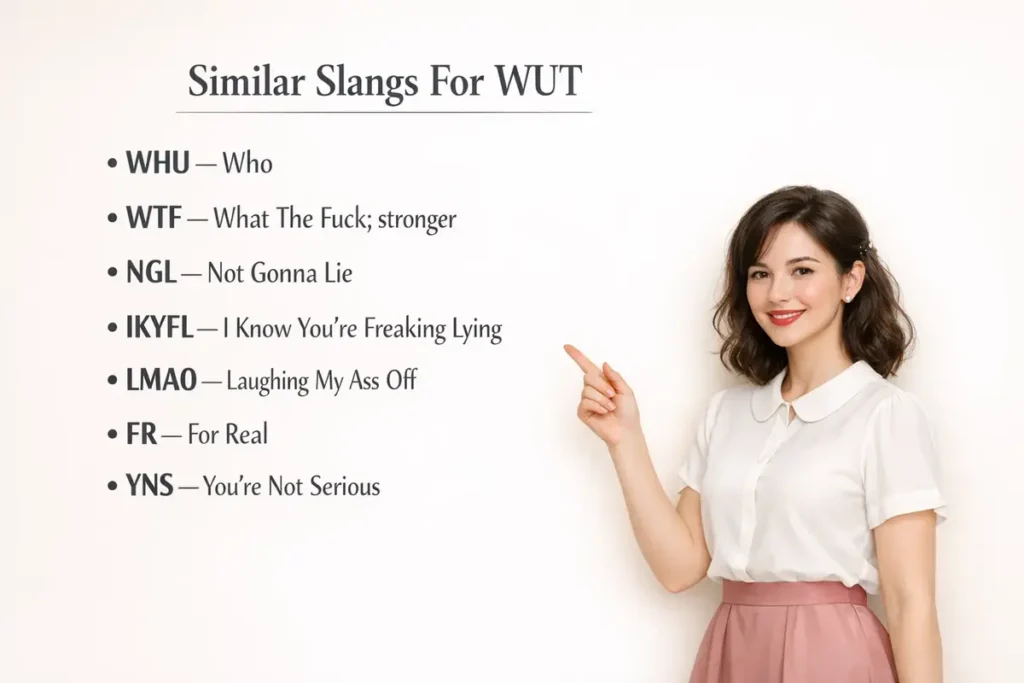
Related Slang Terms
- WHU — Who
- WTF — What The F***; stronger
- NGL — Not Gonna Lie
- IKYFL — I Know You’re Freaking Lying
- LMAO — Laughing My Ass Off
- FR — For Real
- YNS — You’re Not Serious
How to Reply When Someone Says WUT
If someone sends WUT after something you said, give them the context, explanation, or clarification they clearly need. “Okay let me explain from the beginning” or “yeah I know, here is what happened” treats their reaction as the genuine request for information it almost always is. Most people who send WUT want the full story, not a shorter version of the confusing thing you already said.
If the WUT reads more theatrical than genuinely confused, match the energy and keep the conversation light. “I know, I could not believe it either” or “right? Completely out of nowhere” validates the reaction and extends the moment naturally. Reading whether the WUT signals real confusion or performative disbelief takes one look at what you said that prompted it.
Conclusion
WUT meaning in text is one word spelled differently and it carries more personality because of it. It means what, it signals confusion or disbelief, and the spelling tells you exactly how strongly the sender felt that reaction in the moment. Simple, expressive, and impossible to misread in context.
Three letters. One clear reaction. The spelling says everything the word alone cannot.
FAQs
WUT means “What” spelled phonetically for extra attitude and emphasis. Same word, more personality.
Yes, WUT appears constantly in casual texting, meme culture, and gaming communities. It signals genuine surprise or theatrical confusion.
LOL WUT combines laughter and confusion into one reaction. It means something is so absurd it is both funny and baffling at the same time.
“What” is neutral and standard. WUT carries more expressive energy and signals stronger surprise or disbelief.
Not usually. WUT reads as playful in most conversations, though a blunt one-word WUT reply can feel dismissive if the relationship does not support that casual tone.

GenZ Slang Writer & Internet Culture Expert Layla Brooks has spent 2+ years tracking how GenZ slang evolves across TikTok, Twitter, and everyday conversations. From decoding viral phrases to explaining what words actually mean in real life, Layla writes content that feels native to the culture, not forced. If a word is trending, Layla already knows what it means and why it matters.