YWA Meaning in Text: Mostly Used By UK Girls
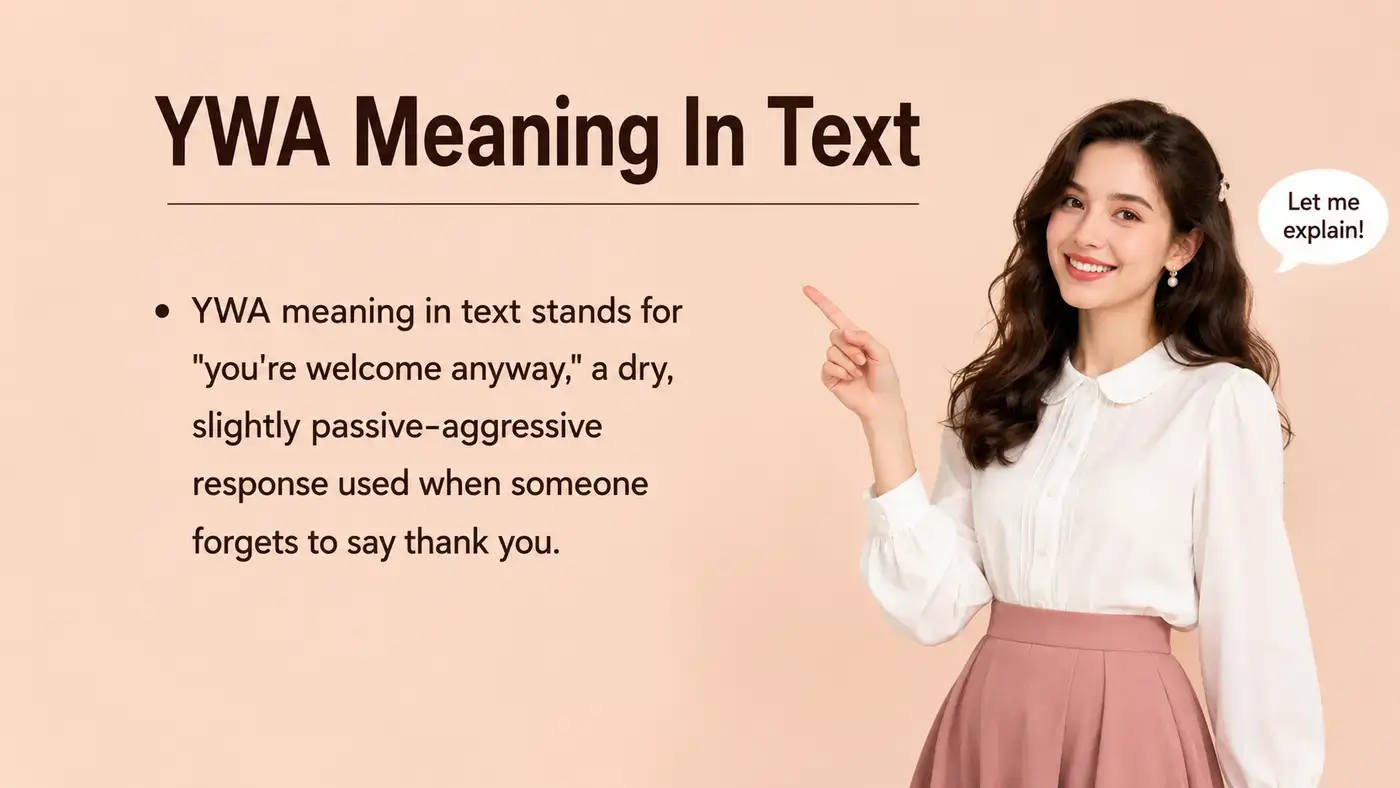
YWA meaning in text stands for “you’re welcome anyway,” a dry, slightly passive-aggressive response used when someone forgets to say thank you.
It’s that moment when you hold the door open for someone and they just walk through. YWA is how that interaction looks in a text conversation. Low-key pointed. Impossible to misread.
Origin and Cultural Footprints
YWA meaning in text grew out of the broader culture of sarcastic internet responses that exploded on Twitter and Tumblr in the early 2010s. As dry humor became the dominant online communication style, abbreviations that carried a passive-aggressive edge became genuinely useful.
The phrase “you’re welcome anyway” already existed in everyday spoken English as a pointed response to being ignored. Compressing it into three letters made it faster, sharper, and easier to drop into a conversation without starting a whole conflict.
By the mid-2010s YWA had filtered into group chats and DMs as a quick reaction for situations where someone expected acknowledgment and didn’t get it. It spread because the feeling it captures is universal. Everyone has been on both sides of that exchange at some point.
Other All Meanings of YWA
YWA doesn’t carry a single fixed meaning across all online communities. A couple of alternate readings exist and show up in specific contexts.
- YWA = You’re Welcome Anyway — The dominant texting meaning. A dry, mildly passive-aggressive acknowledgment used when gratitude was expected but never came.
- YWA = Yeah Whatever Alright — A dismissive, unbothered response used to shut down a conversation or signal complete indifference to what was just said.
The “yeah whatever alright” meaning surfaces in more casual, throwaway contexts. The “you’re welcome anyway” meaning carries more emotional weight and tends to appear in conversations where something genuinely went unacknowledged.
Why Does YWA Have So Many Different Definitions
Three letters with no inherent meaning create space for multiple communities to fill them independently. YWA got claimed by people needing a passive-aggressive response and separately by people needing a dismissal signal, without either group coordinating with the other.
The overlap happens because both meanings carry a similar emotional undertone: mild irritation with a surface-level calm on top. That emotional family resemblance is why the two meanings coexist without creating massive confusion in most conversations.
Who Uses It Most
YWA isn’t as universally known as LOL or NGL but it carries strong recognition among specific groups who rely on dry, understated communication.
| Group | Common Meaning | Typical Context |
|---|---|---|
| Gen Z | You’re welcome anyway | DMs, texts, passive-aggressive replies |
| Millennials | You’re welcome anyway | Group chats and personal conversations |
| Social media users | Yeah whatever alright | Comment replies and dismissive responses |
| Content creators | You’re welcome anyway | Audience interactions and caption humor |
Gen Z uses YWA most naturally in situations where someone expected acknowledgment and didn’t receive it. The dry delivery fits perfectly into their broader communication style.
Real Conversation Examples Using YWA
Here are two real-style conversations showing how YWA lands across different situations.
1. Friend forgets to say thank you after a favor Two friends texting after one picked up the other’s package A: “Hey your package is on your doorstep, I grabbed it for you.” B: “Oh nice, I’ll get it later.” A: “YWA by the way.” B: “Oh my gosh I’m so sorry, thank you genuinely.” A: “That’s all I needed lol.” Context: Gentle but pointed reminder that acknowledgment was missing. How to reply: Apologize immediately and mean it. YWA here is a soft nudge, not a full confrontation.
2. Dismissive response to someone being difficult Two people in a group chat after an argument got resolved A: “Fine, I’ll just do it myself then.” B: “YWA honestly, that works better for everyone.” A: “Okay then.” B: “Exactly.” Context: “Yeah whatever alright” meaning, used to close down a conversation that’s going nowhere productive. How to reply: Let it end. YWA in this context is a hard stop signal.
Usage of YWA in Different Contexts
In personal texting YWA works as a soft accountability tool. It flags the missing “thank you” without blowing the situation into a full argument.
“I stayed an extra hour to help you finish that and you didn’t even respond. YWA.” That sentence does real emotional work in three letters at the end.
In casual social media exchanges the dismissive “yeah whatever alright” version carries more weight. It signals checked-out energy, someone who’s done engaging and wants the conversation closed immediately.
How Gen Z Uses YWA Today
Gen Z has turned YWA into a precision instrument for calling out social oversights without causing drama. It’s specific enough to signal irritation but understated enough to maintain plausible deniability.
That balance between saying something and technically not saying much is very much a Gen Z communication specialty. They use it to hold people accountable while keeping the emotional temperature low.
There’s also a humor dimension. Between close friends who understand each other’s communication style, YWA becomes a running joke, a way of performing mild offense that both people know isn’t serious. That ironic layer is very intentional.
Does YWA Mean You’re Welcome Always
Some people read YWA as “you’re welcome always,” which flips the meaning from mildly passive-aggressive to warmly generous. That’s a complete reversal of the actual intent.
“You’re welcome always” signals open, unconditional goodwill. YWA signals that the goodwill existed but went unacknowledged. Reading one as the other in a conversation will send the exact wrong signal to whoever receives your reply.
The word “anyway” is doing all the work here. Remove it and the tone changes completely. Keep it and the pointed subtext stays fully intact.
Meaning Across Social Media
| Platform | YWA Meaning | How It’s Used |
|---|---|---|
| iMessage / SMS | You’re welcome anyway | Personal passive-aggressive reactions |
| Twitter/X | You’re welcome anyway | Dry reply humor and call-outs |
| TikTok | You’re welcome anyway | Comment replies and creator responses |
| Yeah whatever alright | Dismissive DM and comment replies | |
| Snapchat | You’re welcome anyway | Friend group banter and reactions |
| Discord | Yeah whatever alright | Server conversations and dismissals |
Twitter carries YWA most effectively as a public passive-aggressive tool. The brevity lands harder in that format than almost anywhere else.
Common Confusions and Wrong Interpretations
YWA creates a few specific misreads that come up often enough to address directly.
- YWA vs. YW — YW simply means “you’re welcome,” a clean positive acknowledgment. YWA adds the pointed “anyway” that changes the entire emotional register of the message.
- YWA as positive — Some people read YWA as a warm response. It isn’t. The “anyway” carries mild passive-aggression that distinguishes it from a genuine you’re welcome.
- YWA vs. NP — NP means “no problem,” a completely neutral and positive reply. YWA signals the opposite: there was a problem, specifically that the thanks never came.
Related Slang Terms
- YW — You’re welcome (genuine, positive acknowledgment)
- NP — No problem (neutral and warm response)
- SMH — Shaking my head (disappointment reaction, often paired with YWA energy)
- TY — Thank you (what someone should have sent before YWA became necessary)
- IKR — I know right (agreement after a shared frustration)
- NGL — Not gonna lie (honesty signal, sometimes precedes a YWA moment)
- BYE — Hard conversational exit, similar energy to the dismissive YWA meaning
- ISTG — I swear to God (frustration intensifier used before or after YWA)
How to Reply When Someone Says YWA
If you’re on the receiving end of a “you’re welcome anyway” YWA, the only right move is immediate acknowledgment. Don’t defend yourself. Don’t explain why you forgot. Just say thank you and mean it.
A genuine “I’m sorry, truly thank you for that” closes the loop cleanly and restores the balance. YWA is almost always a second chance to get it right, not a full shutdown.
If YWA came as a dismissive “yeah whatever alright” in a tense conversation, let it be the final word. Pushing back keeps something alive that clearly wants to end. Match the checked-out energy and let the conversation close on its own terms.
Conclusion
YWA meaning in text is one of those abbreviations that says more in three letters than most people say in three sentences. It calls out what was missing without making it a whole event.
Recognize it, respond correctly, and you’ll handle it right every single time.
FAQs
YWA usually means you’re welcome anyway. It is often used jokingly or after someone forgets to say thanks.
YWA is used in comments or chats to respond playfully after helping someone. It is common in casual conversations.
When someone texts YWA, they usually mean you’re welcome anyway. It can sound friendly, sarcastic, or playful depending on tone.
The full form of YWA is you’re welcome anyway. It is mostly used in texting and online slang.
YWA in text means you’re welcome anyway. People use it when they feel unappreciated or want to joke around.
WYA stands for where you at. It is used to ask someone about their location or what they are doing.

GenZ Slang Writer & Internet Culture Expert Layla Brooks has spent 2+ years tracking how GenZ slang evolves across TikTok, Twitter, and everyday conversations. From decoding viral phrases to explaining what words actually mean in real life, Layla writes content that feels native to the culture, not forced. If a word is trending, Layla already knows what it means and why it matters.