YNS Meaning in Text: Origin, Usage, And Examples
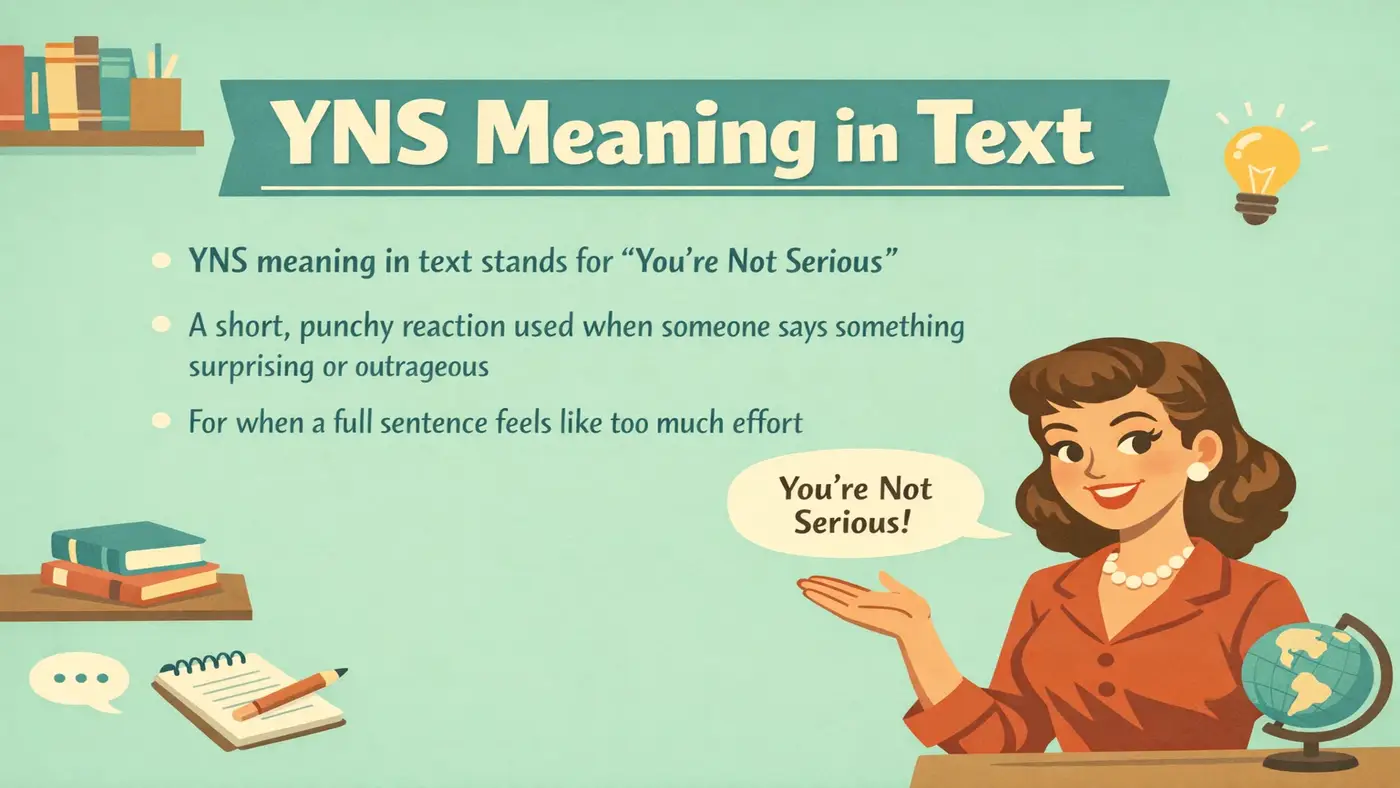
YNS meaning in text stands for “You’re Not Serious” — a short, punchy reaction used when someone says something so surprising, outrageous, or hard to believe that a full sentence feels like too much effort. It’s disbelief, compressed into three characters.
You’ll see it after someone drops unexpected news, shares a genuinely absurd situation, or says something that makes you stop and stare at your phone screen. YNS does the work of “wait, are you actually being serious right now?” without any of the filler. That efficiency is exactly why it caught on.
Origin and Cultural Footprints
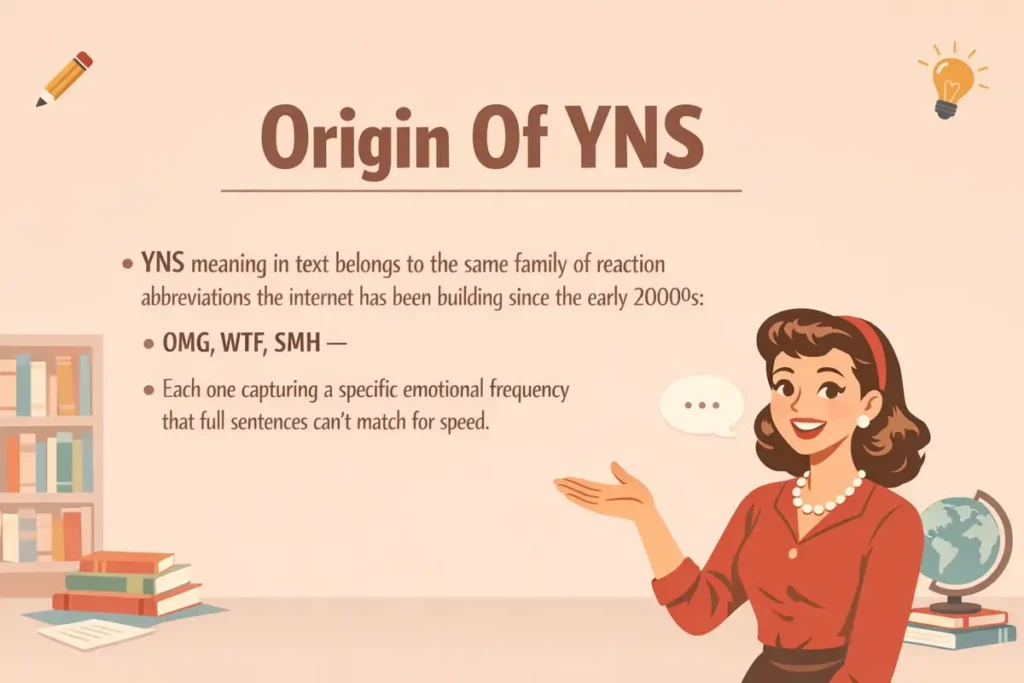
YNS meaning in text belongs to the same family of reaction abbreviations the internet has been building since the early 2000s — OMG, WTF, SMH — each one capturing a specific emotional frequency that full sentences can’t match for speed. YNS filled a particular gap: the stunned, semi-disbelieving response that sits right between shock and amusement, where neither word quite covers it alone.
It spread through the usual routes — Twitter, Snapchat, WhatsApp group chats — carried by the same logic that makes all good slang travel fast. It’s short, it sounds right when you say it out loud, and it maps onto a feeling everyone recognizes the second they encounter it. No explanation needed on arrival. That’s the mark of an abbreviation built to last.
Other Definitions of YNS
Outside of reaction culture, YNS carries a few alternate meanings worth knowing:
- “You Never Said” — Used in arguments or disputes when someone pushes back on a claim the other person allegedly didn’t make. Confrontational rather than expressive. Common in older forum threads and debate-heavy group chats.
- “Your Neighborhood Services” — An institutional acronym used by certain regional organizations, municipal bodies, and community service providers. Completely separate from any texting context.
- “Youth and Neighbourhood Support” — Appears in social work, education, and charity sectors in the UK and parts of Europe. Again, no overlap with informal text usage whatsoever.
If you’re reading YNS in a group chat after someone shares wild news, none of these institutional meanings are in play. Context sorts it out instantly — but it’s worth knowing the alternatives exist, especially if you encounter it in a formal document or a heated argument thread.
Who Uses It Most?
YNS belongs to people who communicate in reactions. It’s not an opener and it’s not a farewell — it’s a response, which means it only shows up in conversations already moving fast. The people who reach for it most are those who text in short bursts and expect the same energy back.
Here’s a breakdown of which groups use it most and why it works for each:
| Group | How They Use YNS | Why It Works |
|---|---|---|
| Gen Z | Reacting to shocking or absurd news in group chats | Matches their high-speed, high-reaction communication style |
| Teenagers | Snapchat and iMessage exchanges with close friends | Fast enough to keep up with rapid-fire texting |
| Twitter / X users | Quote-tweeting or replying to outrageous takes | Efficient reaction that reads clearly without extra words |
| Gamers | Discord DMs after surprising in-game moments | Low-effort response when the moment doesn’t need more |
| Pop culture fans | Fan group chats reacting to celebrity news or plot twists | Perfect for the collective “wait, what?” moment |
| Close friend groups | Any platform where conversation moves quickly | Shared familiarity means no decoding required |
Usage of YNS in Different Contexts
In personal texting between close friends, YNS functions as pure reaction — the text equivalent of looking at someone with wide eyes and saying nothing. Someone sends a screenshot of an outrageous situation at work, and the reply is simply “YNS.” That’s a complete conversational turn. It validates the shock, signals full engagement, and keeps the thread moving without any filler.
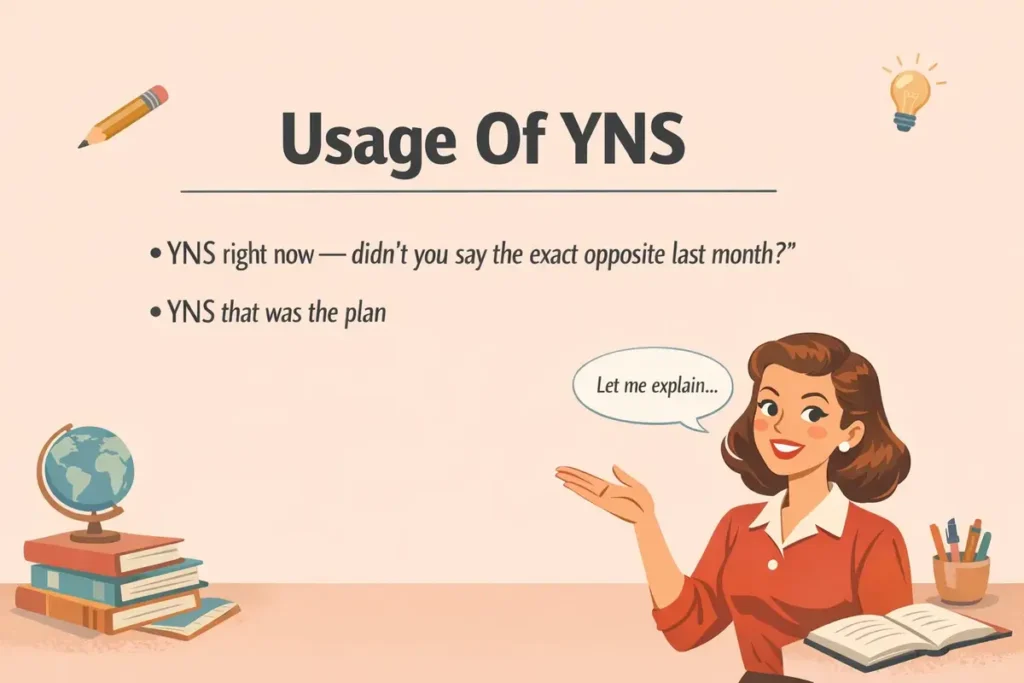
In social media contexts, YNS gets deployed as a direct response to public posts, viral tweets, or announcements that genuinely catch people off guard. When someone contradicts something they said publicly, or reveals news nobody saw coming, the replies fill up fast. “YNS right now — didn’t you say the exact opposite last month?” lands as quick, pointed pushback — skeptical, slightly amused, and not looking for a fight so much as an explanation.
How Gen Z Uses YNS Today
For Gen Z, YNS carries tonal layers that older abbreviations tend to flatten. It can be genuine disbelief, or it can be performative disbelief — the kind where someone is actually delighted by the news but expressing that through mock shock. Reading which one is in play requires knowing the person and reading the room. Same three letters. Completely different energy depending on the context.
There’s also a deadpan quality to how Gen Z deploys it that other generations don’t always catch. Someone ending a chaotic story with “and then my professor moved the exam to tomorrow. YNS.” isn’t asking a real question — they’re venting with surgical precision. The YNS meaning in text shifts from a genuine question to a statement of exhausted disbelief. The abbreviation stays identical. The emotional weight underneath it changes entirely based on what came before it.
Does YNS Mean “You Never Said”?
This alternate meaning is real — it’s not invented — but in everyday text conversations, it’s a distant second to the “You’re Not Serious” reading. “You Never Said” surfaces in specific argumentative contexts, usually when someone is disputing a claim or correcting what they believe the record to be. Outside of those narrow situations, it almost never appears.
The confusion mostly catches people off guard in long, heated threads where intent isn’t obvious from the message alone. “YNS that was the plan” could mean “You’re Not Serious — that was actually the plan?” or “You Never Said that was the plan” — and those two readings point in opposite directions. When in doubt, look at the two or three messages before it. Surprising news before it means disbelief. A contested claim before it means dispute. The surrounding conversation does the disambiguation every single time.
Meaning Across Social Media
| Platform | YNS Meaning | How It’s Used |
|---|---|---|
| Snapchat | You’re Not Serious | Quick reaction to shocking news; sent between close contacts |
| Twitter / X | You’re Not Serious | Reply or quote-tweet reacting to outrageous takes or surprising announcements |
| You’re Not Serious | Group chat reactions to unexpected news or wild screenshots | |
| Instagram DMs | You’re Not Serious | Close-friends thread reactions to posts, stories, or celebrity updates |
| Discord | You’re Not Serious / You Never Said | Personal DMs and small servers; meaning depends on conversation context |
| TikTok Comments | You’re Not Serious | Reacting to plot-twist videos, absurd life updates, unexpected reveals |
| You Never Said (occasionally) | Argument threads where someone disputes a prior claim |
Common Confusions & Wrong Interpretations
- YNS read as aggressive when it’s affectionate — In close friendships, YNS after good news is basically “oh my god, shut up, that’s incredible.” But if the relationship isn’t that close, receiving it can feel like skepticism or dismissiveness. The abbreviation is neutral. The relationship around it determines whether it lands as playful or pointed.
- Mixing up the two core meanings — “You’re Not Serious” and “You Never Said” look identical on screen and both appear in text conversations. The context almost always separates them, but in ambiguous messages, people genuinely misread which one was intended.
- Confusing YNS with similar reaction abbreviations — YNS, NGL, and SMH all live in the same emotional neighborhood but they’re not interchangeable. YNS signals disbelief at what someone said or did. SMH leans toward disappointment. NGL announces honesty before a blunt statement. Swapping them carelessly shifts the tone of a message more than most people realize.
- Platform mismatch — In older forum spaces and gaming communities, YNS occasionally still surfaces as “You Never Said” in argument threads, while younger audiences on TikTok and Snapchat almost exclusively read it as “You’re Not Serious.” Same abbreviation, different defaults depending on where you are.
Similar Terms, Alternatives & Related Slang
- OMG — Oh My God; broader expression of shock, less specific in register than YNS
- NGL — Not Gonna Lie; signals honesty before a blunt statement, not pure reaction
- SMH — Shaking My Head; leans toward disappointment rather than disbelief
- WTF — What The F***; stronger and more visceral than YNS, less conversational in tone
- No way — Written-out version of the same disbelief; slightly softer and more casual
- Deadass? — Gen Z expression meaning “are you being completely serious?”; closest cousin to YNS
- FR? — For Real?; questions sincerity in exactly the same space YNS operates in
- BRO — Standalone reaction to disbelief; tone-dependent and highly context-sensitive
How to Reply When Someone Sends You YNS
If someone sends you YNS after you’ve shared something surprising, they want confirmation and almost certainly more detail. “Yes, fully serious” followed by whatever context you haven’t shared yet is the natural move. They’re not dismissing what you said — they’re signaling that you’ve got their full attention and they want the rest of the story. Keep going.
If the YNS reads more skeptical than curious — especially if it follows a claim rather than a story — the best response is calm clarification rather than defensiveness. “I know it sounds unlikely but here’s exactly what happened” resets the tone without escalating anything. Getting defensive about a three-letter response tends to turn a small moment into a bigger conversation than either person wanted. YNS is rarely a full stop. It’s almost always an invitation.
Conclusion
YNS meaning in text is one of those abbreviations that clicks instantly once you know it — and then you start noticing it everywhere. Three letters, one clear emotional beat, zero ambiguity when the context does its job. That’s a tightly built piece of language.
It means someone is genuinely reacting to what you said. That’s worth something.
FAQs
YNS means “You’re Not Serious” — people drop it in comments when something genuinely shocks or surprises them. It fits TikTok’s fast, reactive comment culture perfectly.
It depends on the moment. Between friends it reads as playful disbelief, but in an argument it can land as straight-up dismissal.
YNS replaces a whole sentence of shock or disbelief with just three letters. It tells the other person their news or opinion genuinely caught you off guard.
YNS meaning in text stands for “You’re Not Serious” — a quick reaction to something surprising or hard to believe. Short, punchy, and gets the point across instantly.
On dating apps, YNS usually pops up when someone shares something unexpected about themselves. It signals genuine surprise and keeps the conversation moving forward.

GenZ Slang Writer & Internet Culture Expert Layla Brooks has spent 2+ years tracking how GenZ slang evolves across TikTok, Twitter, and everyday conversations. From decoding viral phrases to explaining what words actually mean in real life, Layla writes content that feels native to the culture, not forced. If a word is trending, Layla already knows what it means and why it matters.