WHU Meaning in Text: Who Uses It, and How to Reply
What Does WHU Mean in Text?
WHU meaning in text stands for “Who,” a phonetic, shorthand spelling people type when they want to ask about a person’s identity quickly without bothering with standard spelling. Three letters that replace one word and somehow feel more urgent doing it.
You will see it in fast-moving conversations where someone drops a name, a reference, or a vague “they said something” and the natural response is WHU before any other question gets asked. Direct, immediate, and completely clear in context.
Origin and Cultural Footprints
WHU meaning in text belongs to the phonetic spelling tradition that gave texting “wut” for what, “cuz” for because, and “ngl” for not gonna lie. As mobile communication prioritized speed over accuracy, people started spelling words the way they sound rather than the way grammar books dictate. WHU followed that same logic.
The spelling spread through Snapchat, Twitter, and iMessage culture where the pace of conversation rewards whoever types fastest and most expressively. WHU carried an energy that the standard “who” did not have on its own. The unconventional spelling signals engagement, urgency, and genuine curiosity all at once, which explains why it traveled so quickly through Gen Z communication spaces.
Other Meanings of WHU
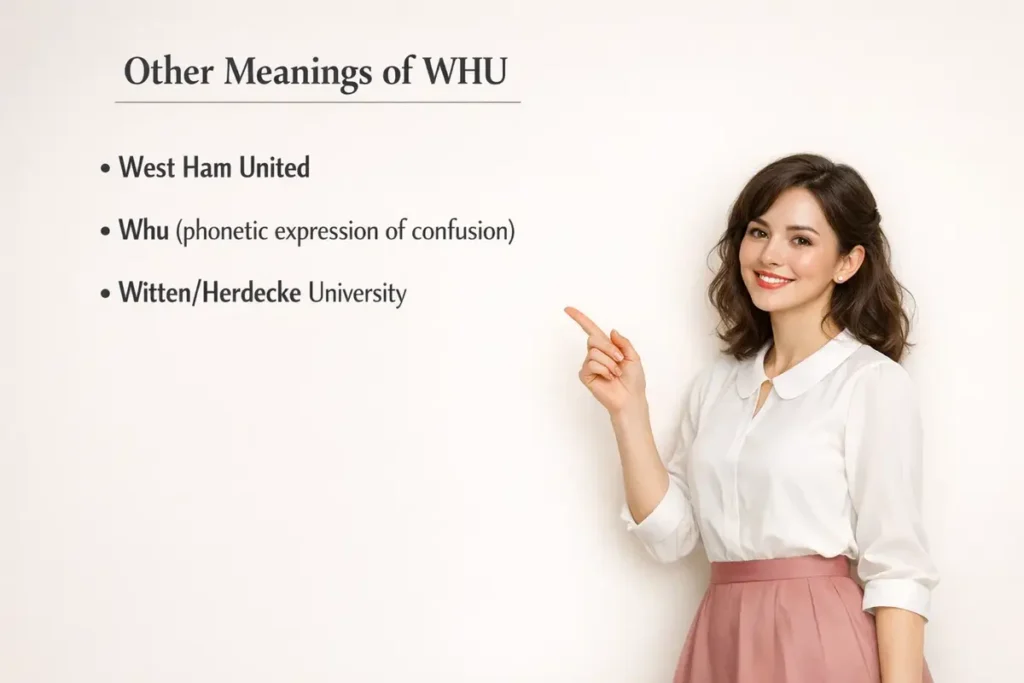
WHU carries a few alternate meanings worth knowing depending on the platform and context:
- West Ham United: In British football culture and sports communities globally, WHU serves as the recognized abbreviation for West Ham United Football Club. You will see it in match discussions, sports Twitter, fantasy football leagues, and supporter communities with no connection to text slang.
- Whu (phonetic expression of confusion): Some people use WHU as a written representation of a confused sound, similar to “huh” but with slightly different phonetic emphasis. It signals genuine bewilderment rather than a question about a specific person.
- Witten/Herdecke University: A private German university abbreviated as WHU in academic and European higher education contexts. Appears in admissions discussions, academic forums, and European business school rankings with zero connection to casual texting.
Why Does WHU Have Multiple Meanings?
WHU sits in a category of short abbreviations where the same letters point in genuinely different directions depending entirely on who types them and where. A football fan in London typing WHU means West Ham United without a second thought. A teenager in Chicago typing WHU in a group chat after someone mentions a name means “who is that person.”
That divergence happens because short letter combinations get claimed simultaneously by different communities for different purposes. The texting slang meaning and the football abbreviation developed independently and coexist without meaningful overlap because the contexts that produce each reading never share the same space.
Who Uses It Most?
WHU belongs to people who ask questions fast and expect fast answers. The groups that reach for it most tend to communicate in short bursts where full sentences feel unnecessarily slow.
Here is a clear breakdown of which groups use WHU most and how each group deploys it:
| Group | How They Use WHU | Why It Works |
|---|---|---|
| Teenagers | Asking about unfamiliar names dropped in conversation | Fastest possible way to request identification |
| Gen Z | Reacting to vague references in DMs and group chats | Signals engaged curiosity without writing a full question |
| Football fans | Referring to West Ham United in sports discussions | Recognized abbreviation across the global football community |
| Close friend groups | Any fast-moving thread where a name needs clarification | Shared communication style means no decoding required |
Real Conversation Examples Using WHU
- Asking about an unfamiliar person Context: A friend mentions someone the other person does not know in a group chat. Sender: “Jake told me the whole story by the way.” Reply: “Whu is Jake?” How to respond: “Oh Jake is my coworker from the night shift, been friends for years.”
- Reacting to a vague reference Context: Someone drops a pronoun without any context in a DM. Sender: “She actually said that to my face.” Reply: “Whu said what now?” How to respond: Give the full story with names and context this time.
- West Ham United discussion Context: A football group chat discussing upcoming fixtures. Sender: “Did you see the WHU lineup for Saturday?” Reply: “Yes, interesting choices from the manager.” How to respond: Share your opinion on the team selection.
- Expressing confusion about a situation Context: Someone receives an unexpected message from an unknown number. Sender: “Got a message from a random number saying they know me.” Reply: “Whu is contacting you like that?” How to respond: “No idea, the number is not saved anywhere.”
- Identifying someone in a photo Context: A friend posts a group photo and someone wants to know who is in it. Sender: “Great photo from last night.” Reply: “Whu is the person on the left?” How to respond: “That is my cousin, she came to visit for the weekend”.
Usage of WHU in Different Contexts
In personal texting, WHU drops into a conversation the moment someone mentions a person, place, or thing without enough context attached. The question lands immediately after the confusing reference and keeps the conversation honest. Nobody has to pretend they know who someone is when WHU exists to ask directly.
In group chats, WHU serves a slightly different function as a group-wide clarification request. One person mentions a name, WHU comes in from multiple directions simultaneously, and the original sender realizes they need to provide more context before the conversation can move forward. Three letters that audit a message for missing information in real time.
How Gen Z Uses WHU Today
Gen Z treats WHU as an expression of engaged attention rather than pure confusion. Sending WHU tells the other person that you are following the conversation closely enough to notice when something does not add up. It signals investment rather than disengagement, which is the opposite of how a question might feel in other communication styles.
The whu meaning in text also gets ironic treatment in Gen Z exchanges where the question goes out in response to something completely self-explanatory. “My mom said hi” answered with “whu is your mom” uses the clarifying question format as a joke that only works because the answer is so obvious. Gen Z finds that specific humor extremely reliable and returns to it constantly.
Does WHU Mean “What”?
This mix-up happens regularly because WHU and WUT occupy similar conversational positions and both signal that something needs clarification. WUT means “What” and asks about the nature or content of something. WHU means “Who” and asks about the identity of a person. They both express confusion but they target completely different kinds of information.
Sending WHU when you mean WUT produces a response that answers the wrong question entirely. Someone who sends WHU after a confusing statement gets a name. Someone who sends WUT gets an explanation. Knowing which one you need before you type it saves a round of follow-up messages that the conversation did not require.
Meaning Across Social Media
| Platform | WHU Meaning | How It’s Used |
|---|---|---|
| Snapchat | Who | Quick identity questions in DMs when someone drops an unfamiliar name |
| Twitter / X | Who or West Ham United | Identity questions in replies and sports community abbreviation in football threads |
| iMessage | Who | Personal text clarification questions in fast-moving conversations |
| Telegram | Who | Group chat identity checks when someone gets mentioned without context |
| TikTok Comments | Who | Asking about people referenced in videos without enough context provided |
| Who | Comment thread identity questions in personal story and relationship subreddits |
Common Confusions and Wrong Interpretations
- WHU confused with WUT — WUT asks about what something is. WHU asks about who someone is. Both signal confusion but they request completely different types of information from the sender.
- WHU confused with HUH — HUH expresses general bewilderment without asking a specific question. WHU asks specifically about a person’s identity. They overlap in tone but differ in what they actually request.
- West Ham United confusion in non-football contexts — A football fan who sees WHU in a non-sports conversation might briefly process the club abbreviation before context overrides it. Platform and subject matter separate the two readings immediately.
- WHU read as a typo — Some recipients see WHU and assume the sender made a keyboard error rather than an intentional phonetic spelling. The message that follows almost always confirms the intent without any need for clarification about the spelling itself.
Related Slang Terms
How to Reply to WHU
If someone sends you WHU after you dropped a name or reference without enough context, give them the full picture without making them ask twice. “Oh that is my friend from university, we have known each other for about three years” answers the question completely and keeps the conversation moving. Most people who send WHU want a real answer rather than another half-explanation.
If WHU arrives after something genuinely confusing that even you cannot fully explain, saying so directly works better than guessing. “Honestly whu knows at this point” or “I have no idea either” matches the energy of the question and keeps the exchange honest. Not every WHU expects a complete answer. Sometimes it just asks another person to sit in the same confusion for a moment.
Conclusion
WHU meaning in text is a three-letter question that asks the most human thing possible: who are you talking about? Direct, fast, and built for conversations that move faster than full sentences allow. Two letters doing the work of a complete question without losing any of the meaning.
Three letters. One clear ask. The answer always follows.
FAQs
WHU means “Who” — a phonetic, informal spelling used when someone wants to quickly ask about a person’s identity.
WBU means “What About You”, a quick way to return a question back to the person you are talking to.
Not inherently. WHU is a neutral curiosity question, though context and timing can give it a flirtatious edge.
WHU came from SMS-era phonetic spelling culture where dropping vowels and respelling words for speed became the norm.
She wants to know who you are talking about. Just answer directly and keep it natural.

GenZ Slang Writer & Internet Culture Expert Layla Brooks has spent 2+ years tracking how GenZ slang evolves across TikTok, Twitter, and everyday conversations. From decoding viral phrases to explaining what words actually mean in real life, Layla writes content that feels native to the culture, not forced. If a word is trending, Layla already knows what it means and why it matters.