ALV Meaning in Text: Who Uses It, and How to Reply
What Does ALV Mean in Text?
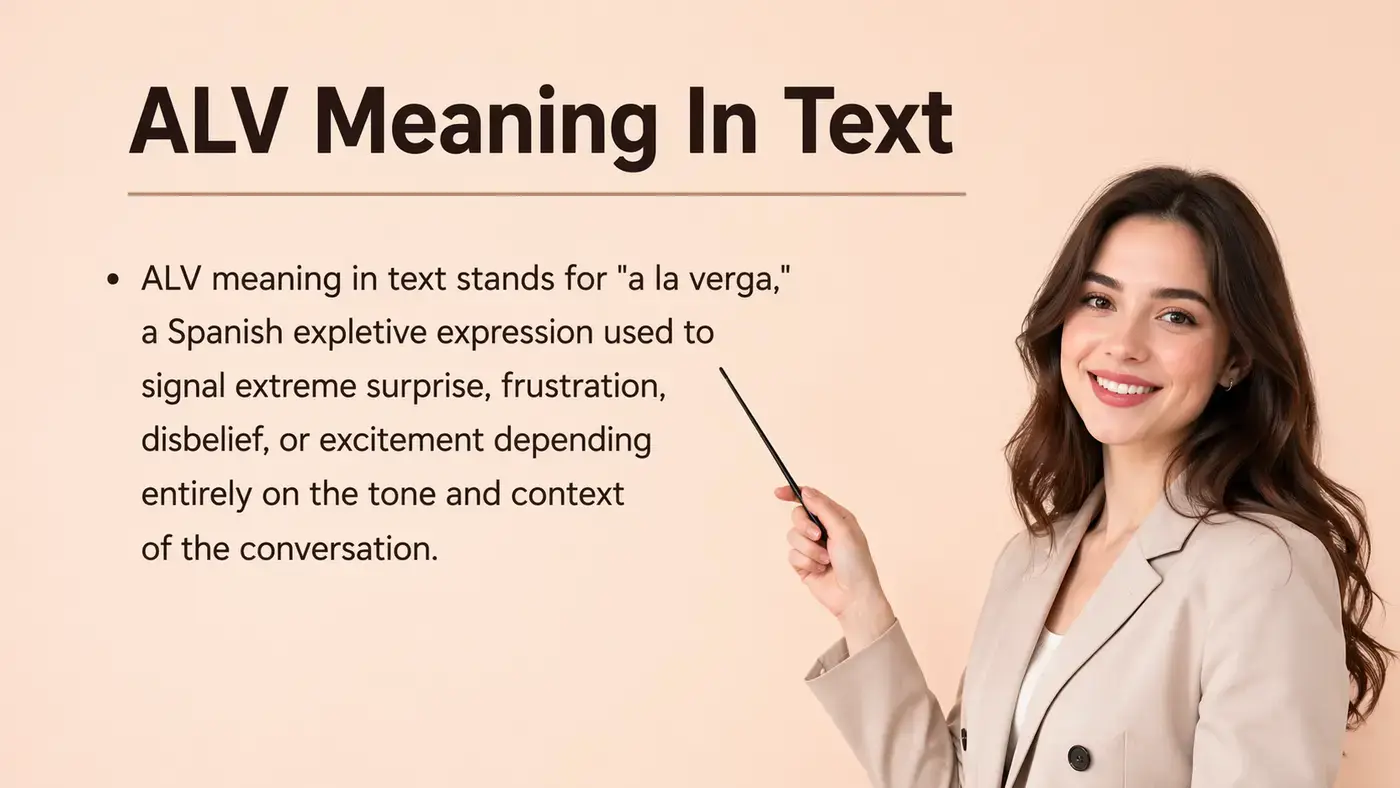
ALV meaning in text stands for “a la verga,” a Spanish expletive expression used to signal extreme surprise, frustration, disbelief, or excitement depending entirely on the tone and context of the conversation. It is the Spanish equivalent of a strong English expletive reaction — raw, immediate, and emotionally unfiltered.
You will see it across bilingual and Spanish-speaking online communities, though it has crossed into mainstream Gen Z vocabulary through TikTok and social media. Three letters that carry a full emotional explosion without any softening applied.
Origin and Cultural Footprints
ALV meaning in text comes directly from Mexican Spanish slang where “a la verga” functions as a versatile expletive covering shock, excitement, anger, and disbelief depending on tone. The phrase has deep roots in Mexican street language and informal culture long before internet communication gave it a compressed digital form.
The abbreviation spread through Mexican and Latin American social media communities before crossing into bilingual Gen Z spaces on TikTok, Twitter, and Instagram. As Spanish slang increasingly travels into English-dominant online spaces through content creators and cultural exchange, ALV landed in mainstream awareness and search volume started climbing across US English-speaking audiences who encountered it without context.
Other Meanings of ALV
ALV carries a few alternate meanings worth knowing depending on the community and context:
- Alive — A phonetic compression used occasionally in casual English texting where someone types ALV as a shorthand for “alive.” Appears in check-in messages and survival humor contexts without any Spanish language connection.
- Alternate Life Version — An occasional usage in creative writing, fanfiction, and online storytelling communities where ALV describes an alternate version of a character or situation. Niche, specific, and clearly contextual in those creative spaces.
- Automatic Lung Ventilator — A medical and respiratory care abbreviation used in clinical documentation and healthcare professional discussions. Institutional, technical, and entirely disconnected from casual social media or texting environments.
Why Does ALV Have Multiple Meanings?
ALV sits in a category where a Spanish slang abbreviation, a phonetic English compression, and a medical term all share the same three letters without any awareness of each other. Each meaning developed independently in a completely separate cultural and professional space.
The Spanish expletive reading dominates in social media and texting contexts because it generates the most search volume from people who encountered it in content and needed a definition. The other meanings belong to closed communities that announce themselves clearly through surrounding language before any confusion develops. Context resolves the correct reading before any real ambiguity takes hold.
Who Uses It Most?
ALV belongs to bilingual communities and Spanish-speaking Gen Z users primarily, though its reach has expanded significantly through TikTok content and cross-cultural social media interaction. The groups that use it most tend to be those whose communication moves between Spanish and English naturally.
Here is a clear breakdown of which groups use ALV most and how each group deploys it:
| Group | How They Use ALV | Why It Works |
|---|---|---|
| Mexican and Latin American Gen Z | Reacting to surprising, funny, or frustrating situations | Culturally native expression that carries immediate recognized weight |
| Bilingual US Gen Z | Code-switching between Spanish and English in casual texts | Natural part of bilingual communication style |
| TikTok and social media users | Reacting to viral content and surprising moments | Absorbed through content exposure without prior Spanish fluency |
| Latino content creators | Authentic cultural expression in audience interaction | Signals genuine cultural identity and community belonging |
Real Conversation Examples Using ALV
Example 1 — Reacting to surprising news Context: A friend shares completely unexpected information in a group chat. Sender: “I just got offered the job in New York, they called this morning.” Reply: “ALV no way, when did this happen?” How to respond: Share the full story immediately because that reaction deserves the details.
Example 2 — Expressing frustration Context: Someone shares a situation that went badly at the worst possible moment. Sender: “My phone died right before the interview started and I had no charger.” Reply: “ALV that is genuinely terrible timing.” How to respond: Explain what happened after since the other person clearly wants the rest of the story.
Example 3 — Reacting to something funny Context: A friend sends a clip that is genuinely hilarious and unexpected. Sender: “Watch this, you will not believe what happens.” Reply: “ALV I was not ready for that at all.” How to respond: Send the clip forward because that reaction means it needs to be shared.
Example 4 — Disbelief at a price or situation Context: Someone reveals how much something cost or how extreme a situation became. Sender: “The repair ended up being eight hundred dollars.” Reply: “ALV that is outrageous, what are you going to do?” How to respond: Explain the plan since the question was genuine and the concern is real.
Example 5 — Excited reaction to good news Context: A close friend shares exciting personal news they have been waiting to announce. Sender: “We are finally getting the apartment, we signed today.” Reply: “ALV finally, I have been waiting for this update all week.” How to respond: Celebrate properly because ALV in this context means pure genuine excitement.
Usage of ALV in Different Contexts
In personal texting between bilingual friends, ALV functions as an emotionally authentic reaction that Spanish-dominant communication styles already recognize immediately. Using ALV rather than an English equivalent tells the other person the reaction came from a genuine, unfiltered place rather than a composed response.
In social media comment sections, ALV appears as a collective reaction to content that genuinely lands hard, whether through humor, shock, or genuine emotional weight. A creator posts something unexpected and the comment section fills with ALV reactions from Spanish-speaking and bilingual viewers who express what they felt in the most immediate language available to them.How Gen Z Uses ALV Today
Gen Z, particularly bilingual and Latino Gen Z, treats ALV as a cultural identity signal as much as a reaction word. Using ALV rather than its English equivalent tells the audience something about who you are and which cultural spaces you belong to. That identity signaling matters in online communities where cultural authenticity carries real social value.
The alv meaning in text also gets absorbed by non-Spanish-speaking Gen Z through content exposure on TikTok and Instagram, where the reaction appears frequently enough that people start using it without fully understanding its linguistic roots. That cultural osmosis is how Spanish slang consistently enters English-dominant Gen Z vocabulary without any formal introduction.
Does ALV Mean “Always Love You”?
This alternate expansion appears in some English-language slang databases and it fits the letters, but it does not reflect how ALV actually functions in any real-world text conversation. “Always Love You” as an intended meaning for ALV has no meaningful presence in actual sent messages where the Spanish expletive reading dominates entirely.
When ALV appears mid-conversation as a reaction to surprising or emotional news, it carries the expletive Spanish meaning without exception. The surrounding emotional register of the conversation confirms the correct reading immediately. The “Always Love You” expansion belongs to slang lists rather than actual usage patterns that generate real search volume.
Meaning Across Social Media
| Platform | ALV Meaning | How It’s Used |
|---|---|---|
| TikTok | A la verga (Spanish expletive) | Comment reactions to surprising, funny, or shocking video content |
| Twitter / X | A la verga (Spanish expletive) | Bilingual reaction tweets and replies to unexpected news or takes |
| A la verga (Spanish expletive) | Comment section reactions and DM responses between bilingual users | |
| Snapchat | A la verga (Spanish expletive) | Personal reaction snaps and DM responses to surprising updates |
| A la verga (Spanish expletive) | Group chat reactions in Spanish-speaking and bilingual friend groups | |
| A la verga or Alive | Reaction comments in Latino community subreddits and occasional English phonetic use |
Common Confusions and Wrong Interpretations
- ALV confused with “Always Love You” — This alternate expansion exists in English slang databases but has no real-world usage pattern. In any conversation where ALV appears as a reaction, it carries the Spanish expletive meaning.
- ALV read as an English abbreviation by non-Spanish speakers — People who encounter ALV without Spanish language context sometimes try to decode it as an English acronym and land on incorrect expansions. Knowing the Spanish origin immediately resolves the meaning.
- ALV confused with ALV in medical contexts — Someone with a respiratory care background might briefly process the ventilator abbreviation before context overrides it. A personal message using ALV as a reaction has nothing to do with clinical equipment.
- Tone confusion across platforms — ALV can signal excitement, frustration, or shock depending entirely on tone. Reading the surrounding message before deciding how to respond prevents responding to the wrong emotional register.
Related Slang Terms
- NGL — Not Gonna Lie
- WTF — What The F***
- DMN — Damn
- No mames — Spanish expletive meaning “no way” or “you’re kidding,” closest Spanish cousin to ALV
- OMG — Oh My God
- FR — For Real
- YNS — You’re Not Serious
How to Reply When Someone Says ALV
If someone sends you ALV after surprising news you shared, keep going with the story. They reacted genuinely and that reaction signals they want more information. “Right? I know, here is what happened after” gives them the continuation their ALV was clearly asking for without making them request it explicitly.
If ALV arrives as their reaction to something you did or said that frustrated them, give them space to say what is actually bothering them. A calm “what happened, talk to me” opens the real conversation that the expletive reaction was pointing toward. ALV in a frustrated context almost always has a fuller sentence behind it waiting to come out.
Conclusion
ALV meaning in text is three letters of genuine, unfiltered emotional reaction that carries full expressive weight in both Spanish and bilingual Gen Z communication spaces. It means surprise, it means frustration, it means excitement, and the surrounding context tells you which one arrived in your chat. Raw, fast, and immediately understood by anyone who knows its roots.
Three letters. One complete emotional release. That is all ALV ever needs to be.
FAQs
ALV is a Spanish slang abbreviation for “A La Verga,” which is a strong vulgar expression. It is mainly used to show shock, anger, or frustration.
On Instagram, ALV is used in captions or comments to react strongly or dramatically. It is informal and often appears in memes or edgy posts.
In Spanish slang, ALV comes from “A La Verga,” which is considered offensive. It is commonly used in Mexico in emotional or reaction-based speech.
ALV is not flirty at all. It is usually vulgar or expressive, depending on the situation and tone.
ALV comes from Mexican Spanish internet slang and became popular through memes and social media. It spread as a quick shorthand for strong emotional reactions.

GenZ Slang Writer & Internet Culture Expert Layla Brooks has spent 2+ years tracking how GenZ slang evolves across TikTok, Twitter, and everyday conversations. From decoding viral phrases to explaining what words actually mean in real life, Layla writes content that feels native to the culture, not forced. If a word is trending, Layla already knows what it means and why it matters.