LWK Meaning in Text: Every Thing Explained (2026)
LWK meaning in text stands for “lowkey,” used to express something subtle, understated, or quietly felt without making a big deal out of it.
Picture this: your friend texts you “lwk I’ve been thinking about quitting my job” and you immediately know they mean it but they’re not ready to shout it from the rooftops yet. That’s exactly the energy LWK carries in every conversation it lands in.
Origin and Cultural Footprints
LWK meaning in text grew directly out of “lowkey,” a word that had been part of Black American vernacular for decades before the internet ever existed. It meant keeping something quiet, understated, or on the down-low in spoken conversation.
When Twitter and Tumblr became the dominant spaces for youth culture in the early 2010s, “lowkey” exploded into mainstream online vocabulary. Abbreviating it to LWK was the natural next step as texting culture pushed everyone toward shorter, faster expressions.
By the mid-2010s LWK was everywhere. It traveled through Instagram captions, Snapchat messages, and TikTok comments until it became one of the most instinctive qualifiers in Gen Z communication. Three letters doing the work of an entire emotional disclaimer.
Related Slangs: 1) Snowball Kiss Meaning in Text: Feels Cold But Hot
2) TF Meaning in Text: Agencies Secret Slangs
Other Meanings of LWK
LWK is one of the more loyal abbreviations in texting culture. Its meaning doesn’t fracture dramatically across communities, but a couple of variations are worth knowing.
- LWK = Lowkey — The dominant meaning across all platforms. Used to soften a statement, admit something quietly, or signal understated emotion without full commitment.
- LWK = Like Whatever, Kind of — A loose, informal reading some users apply when LWK appears in a very casual, dismissive context. Less common but it surfaces occasionally in certain online spaces.
The “lowkey” meaning holds firm across virtually every platform and age group that uses it. The alternative readings are minor and situational at best.
Why Does LWK Have So Many Different Definitions
LWK doesn’t actually carry many competing definitions compared to most abbreviations. It’s one of the more stable pieces of texting slang because “lowkey” itself is emotionally specific enough to resist being pulled in different directions.
The small variations that exist come from people trying to decode the abbreviation without enough context rather than from genuine community-based meaning shifts. Three letters with a clear emotional function tend to stay put. LWK is a good example of that stability in action.
Who Uses It Most
LWK travels widely but Gen Z and Millennial users carry it hardest in everyday conversation.
| Group | How They Use It | Typical Context |
|---|---|---|
| Gen Z | Emotional qualifier | Texts, DMs, TikTok comments |
| Millennials | Understated admission | Group chats and social posts |
| Content creators | Relatable caption tool | Instagram and Twitter content |
| General texters | Soft disclaimer | Everyday personal messaging |
Gen Z owns LWK more than any other group. For them it’s not just a word, it’s a tone setter that shapes how the entire sentence lands on the reader.
Real Conversation Examples Using LWK
Here are five real-style conversations showing exactly how LWK plays out across completely different situations.
1. Admitting feelings without full vulnerability
- Context: Two people in the early stages of talking romantically over iMessage.
- Sender: “lwk I’ve been looking forward to talking to you all day.”
- Receiver: “That’s actually really sweet, lwk same honestly.”
- Sender: “Okay good, I was nervous to say that.”
- Receiver: “Don’t be nervous, I appreciate that you did.”
- Sender: “We should just talk more then.”
- Receiver: “Agreed, starting now.”
- How to reply: Match the vulnerability gently. They opened a door, walk through it warmly without making it a bigger deal than they intended.
2. Expressing mild frustration in a group chat
- Context: Friends in a group chat after a plan falls apart.
- Sender: “lwk annoyed this got cancelled again.”
- Receiver 1: “Same, this is the third time.”
- Receiver 2: “We need to just stop making plans honestly.”
- Sender: “lwk yes, spontaneous only from now on.”
- Receiver 1: “That actually works better for everyone.”
- Receiver 2: “Agreed, no more scheduled disappointments.”
- How to reply: Validate the frustration lightly. They’re venting, not looking for a solution, so matching their energy keeps the vibe right.
4. TikTok comment reaction
- Context: Comment left under a relatable life advice video.
- Sender: “lwk this video just described my entire situation.”
- Receiver: “You’re not alone, same.”
- Sender: “Why does a stranger on the internet understand me better than people I know.”
- Receiver: “That’s just TikTok doing its thing.”
- Sender: “Lwk saving this for every bad day going forward.”
- Receiver: “Smart move, bookmark it.”
- How to reply: Agree and build on the shared feeling. LWK in comment sections almost always invites connection over the relatable moment.
Usage of LWK in Different Contexts
In personal texting LWK works as an emotional safety net. It lets people say something real without the full weight of a direct, unqualified statement sitting on top of it.
“lwk I’ve been struggling lately” is so much easier to type than “I’ve been struggling lately” because the LWK creates just enough distance to make the honesty feel manageable.
In social media captions and public posts, LWK signals authenticity without oversharing. Creators use it to make statements feel personal and relatable rather than polished and performative.
“lwk this might be my favorite thing I’ve ever made” reads like a real thought, not a branded announcement.
How Gen Z Uses LWK Today
Gen Z has made LWK one of their most essential emotional qualifiers. It shows up before admissions, opinions, compliments, complaints, and confessions. The word does different emotional work every single time depending on what follows it.
What makes LWK distinctly Gen Z is how it manages vulnerability. They grew up communicating online where everything is permanent and visible, so having a word that softens a statement without canceling it became genuinely useful in ways older generations didn’t need as urgently.
There’s also an ironic use that surfaces regularly. Saying “lwk obsessed with this” about something they’re completely, obviously, fully obsessed with is a Gen Z classic. The understatement is the joke, and everyone in on the culture gets it immediately.
Does LWK Mean the Same as Literally
Some people read LWK as a synonym for “literally” because both words appear as casual intensifiers at the start of sentences in Gen Z texting. That’s a misread worth correcting.
“Literally” emphasizes truth or exaggerates for effect. LWK softens and qualifies. They do opposite jobs grammatically and emotionally. Swapping one for the other changes the entire meaning and register of a sentence.
“I literally love this” hits completely differently from “lwk love this.” The first is emphatic. The second is understated. If you’ve been using them interchangeably, it’s worth separating them going forward.
Meaning Across Social Media
| Platform | LWK Meaning | How It’s Used |
|---|---|---|
| iMessage / SMS | Lowkey | Personal emotional qualifier in texts |
| Twitter/X | Lowkey | Opinion softener and relatable takes |
| TikTok | Lowkey | Comments and video captions |
| Lowkey | Captions and DM conversations | |
| Snapchat | Lowkey | Casual daily conversations |
| Discord | Lowkey | Gaming chats and server conversations |
TikTok and Twitter are where LWK gets the most creative use. Instagram captions with LWK tend to perform well because the understated tone reads as genuine rather than promotional.
Common Confusions and Wrong Interpretations
LWK trips people up in a few specific ways that are worth addressing directly.
- LWK vs. HWK — HWK means “highkey,” the direct opposite of LWK. Highkey signals open, unrestrained enthusiasm or admission. Mixing these two up flips the emotional register of your entire message.
- LWK vs. NGL — NGL means “not gonna lie” and signals honesty before a statement. LWK signals emotional understatement. They can appear in the same sentence but they serve completely different functions.
- LWK as a negative — Some people read LWK as inherently negative or dismissive because it softens things. It’s not. LWK works equally well before positive and negative statements. The tone comes from what follows it, not the word itself.
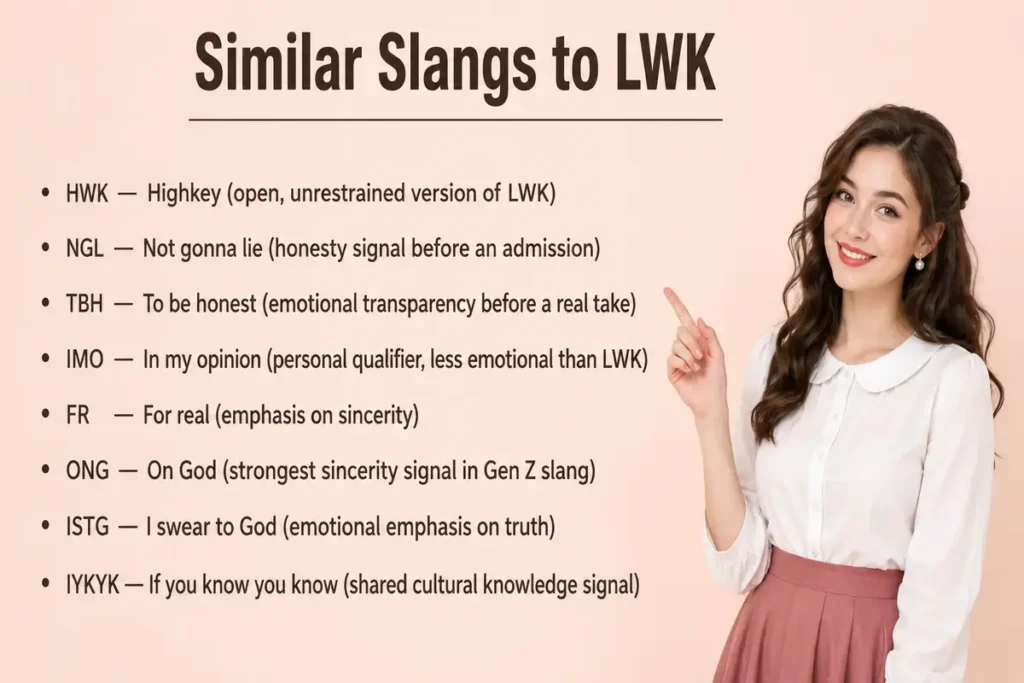
Related Slang Terms
- HWK — Highkey (open, unrestrained version of LWK)
- NGL — Not gonna lie (honesty signal before an admission)
- TBH — To be honest (emotional transparency before a real take)
- IMO — In my opinion (personal qualifier, less emotional than LWK)
- FR — For real (emphasis on sincerity)
- ONG — On God (strongest sincerity signal in Gen Z slang)
- ISTG — I swear to God (emotional emphasis on truth)
- IYKYK — If you know you know (shared cultural knowledge signal)
How to Reply When Someone Says LWK
When someone leads with LWK before something personal or vulnerable, meet them at that level. Don’t amplify it into a bigger deal than they made it. A calm, warm acknowledgment keeps the conversation exactly where they wanted it to stay.
Something like “that makes sense honestly” or “I get that completely” matches the understated energy they came with.
If LWK shows up before a complaint or frustration, validate without escalating. They’re expressing something real but quietly, which means they want to be heard without the whole thing blowing up into a full emotional conversation. Read the temperature and stay in that range with your reply.
Conclusion
LWK meaning in text is one of the cleanest emotional tools in modern texting. It says something real while keeping the volume low.
Know how to read it and you’ll always understand exactly what someone is actually trying to say.
FAQs
LWK means lowkey and it’s used to express something subtly or without making a big deal. It often softens opinions or feelings so they sound casual and less intense.
The full form of LWK is lowkey. It comes from casual slang where vowels are dropped to make texting faster and shorter.
LMK means let me know and it’s used when you want someone to update or inform you. It keeps the tone friendly while asking for a response or decision.
IMK usually means in my knowledge in texting. People use it to share information they believe is correct but not 100 percent certain.
Yes, LWK is fine in casual chats like texting friends or social media. Avoid using it in formal writing or professional communication where clarity matters more.

GenZ Slang Writer & Internet Culture Expert Layla Brooks has spent 2+ years tracking how GenZ slang evolves across TikTok, Twitter, and everyday conversations. From decoding viral phrases to explaining what words actually mean in real life, Layla writes content that feels native to the culture, not forced. If a word is trending, Layla already knows what it means and why it matters.