SMD Meaning in Text: Sounds Innocent But Very Flirty
SMD meaning in text stands for “Suck My D*,” a crude, aggressive expression people send when they are dismissing someone, expressing contempt, or responding to perceived disrespect with maximum bluntness. It sits firmly at the harsh end of the insult spectrum.
You will see it in heated arguments, competitive gaming trash talk, and moments of pure frustration where someone has run completely out of patience for a conversation. Three letters that communicate total dismissal without any softening applied.
Origin and Cultural Footprints
SMD meaning in text traces back to the early 2000s internet forum and gaming culture where aggressive trash talk developed its own compressed vocabulary. Platforms like early Xbox Live, AOL chat rooms, and gaming forums in the mid-2000s were environments where insults flew fast and abbreviated forms developed organically to match the pace.
The specific abbreviation gained wider traction through hip-hop culture, where blunt, confrontational language already held cultural currency, and through Black Twitter in the late 2000s and early 2010s where abbreviated insults traveled fast through viral exchanges. By the time Snapchat and Instagram DMs became primary communication platforms for Gen Z, SMD had been part of internet vocabulary for nearly a decade and arrived fully formed into those new spaces.
Other Meanings of SMD
SMD carries a few alternate meanings worth knowing in professional and technical contexts:
- Surface Mount Device — A widely used electronics and engineering abbreviation referring to components mounted directly onto a printed circuit board surface. Engineers, technicians, and electronics hobbyists use SMD constantly in technical documentation, product specifications, and manufacturing discussions completely separate from text slang.
- Structural Mechanical Design — An engineering and architecture abbreviation used in construction documentation, project planning, and technical specification writing. Institutional, professional, and entirely disconnected from any social media context.
Why Does SMD Have Multiple Meanings?
SMD sits in a category where a widely used technical abbreviation and an aggressive slang expression happen to share the same three letters without any relationship to each other. Engineers adopted SMD for Surface Mount Device decades before internet slang culture assigned it an entirely different meaning in completely separate communication spaces.
The slang reading dominates in casual texting and social media because it generates more search volume from people who encountered it in conversation and needed a definition. The technical meanings belong to professional spaces that announce themselves clearly through platform, tone, and surrounding content. Nobody receiving SMD in a heated group chat argument is thinking about circuit boards.
Who Uses It Most?
SMD belongs to heated, confrontational, or darkly humorous exchanges where blunt language is already part of the established communication dynamic. The groups that reach for it most tend to be those whose communication style does not filter aggression through social politeness norms.
Here is a clear breakdown of which groups use SMD most and how each group deploys it:
| Group | How They Use SMD | Why It Works |
|---|---|---|
| Gamers | Trash talk during competitive matches and post-game reactions | Established part of competitive gaming insult vocabulary |
| Gen Z | Blunt dismissals in arguments and comedic exchanges | Direct, unfiltered, and immediately understood by peers |
| Hip-hop and urban communities | Expressing contempt or dismissal in confrontational situations | Culturally established aggressive expression with recognized weight |
| Close friend groups using dark humor | Ironic insults as a form of affectionate banter | Works when mutual understanding of the ironic intent exists |
Real Conversation Examples Using SMD
Example 1 — Competitive gaming trash talk Context: Two players exchanging insults after a competitive match where one dominated the other. Sender: “You played terribly, I owned you the entire game.” Reply: “SMD, you got lucky and you know it.” How to respond: Either escalate the banter or let it go depending on whether the rivalry is fun or hostile.
Example 2 — Dismissing an unwanted opinion Context: Someone offers unsolicited criticism that the recipient finds completely unreasonable. Sender: “You really should not have done it that way, honestly.” Reply: “SMD, nobody asked for your input.” How to respond: Either back off the criticism or double down depending on how much the relationship can handle.
Example 3 — Ironic use between close friends Context: Two friends with an established pattern of crude humor exchange insults as a greeting. Sender: “You are genuinely the worst, I cannot believe you forgot to text back.” Reply: “SMD, I was busy and you know it.” How to respond: Laugh it off because in this context the insult is functioning as affection.
Example 4 — Reacting to an unfair call in a game Context: A player reacts to a game decision they find completely unjust. Sender: “How was that not a foul, that call ruined everything.” Reply: “SMD ref, that was obvious.” How to respond: Share the frustration and move on because dwelling on bad calls never helps.
Example 5 — Dismissing an annoying persistent message Context: Someone has been repeatedly messaging about a topic the recipient is done discussing. Sender: “I am just saying you should reconsider, one more time.” Reply: “SMD, I have given my final answer.” How to respond: Stop messaging about the topic because that response means the conversation is closed.
Usage of SMD in Different Contexts
In competitive gaming environments, SMD functions as standard trash talk vocabulary that most players encounter and deliver without attaching serious hostility to it. The gaming community has normalized blunt insult exchanges as part of competitive culture, and SMD sits within that established vocabulary as a recognized expression of competitive frustration or dominance.
In personal confrontational texting, SMD carries significantly more weight because it lands outside the established trash talk context where its impact gets softened by shared norms. Sending SMD to someone in a genuine argument rather than a competitive joke exchange signals serious contempt and the recipient reads it that way. Context and relationship determine whether SMD is banter or a genuine insult every single time.
How Gen Z Uses SMD Today
Gen Z uses SMD with clear tonal awareness across different contexts. In established friend groups where crude humor is part of the communication culture, SMD functions as an exaggerated dismissal that both parties understand as comedic rather than hostile. The same three letters in a stranger’s DM carry an entirely different charge and Gen Z calibrates that distinction automatically.
The smd meaning in text also gets ironic deployment in Gen Z spaces where the aggressive insult gets directed at inanimate objects, situations, or abstract concepts rather than actual people. “SMD alarm clock” at 6am on a Monday morning uses the blunt expression as frustrated dark humor about a situation rather than a genuine attack on anyone. That misdirection of aggression toward non-people is a recognized comedic pattern.
Does SMD Mean “So Much Drama”?
This alternate expansion appears in some online slang databases and makes surface-level sense as three letters that fit a common phrase. But “So Much Drama” has essentially zero real-world usage as SMD in actual text conversations. People who want to express that something involves too much drama write it out, use DRAMA, or reach for other established abbreviations.
When SMD appears in a heated exchange, an argument, or competitive banter, it carries the crude insult meaning without exception. The emotional register of the surrounding conversation announces the correct reading immediately. The “So Much Drama” expansion belongs to slang lists rather than any real usage pattern that generates genuine search volume or appears in authentic messages.
Meaning Across Social Media
| Platform | SMD Meaning | How It’s Used |
|---|---|---|
| Twitter / X | Suck My D*** | Aggressive dismissals in heated replies and competitive banter threads |
| Snapchat | Suck My D*** | Personal DM insults in arguments or crude friend group humor |
| Discord | Suck My D*** | Gaming server trash talk and competitive community banter |
| Suck My D*** | Heated comment thread exchanges in competitive and argument-heavy subreddits | |
| TikTok Comments | Suck My D*** | Aggressive comment reactions to content that provokes strong negative responses |
| iMessage | Suck My D*** | Personal argument text exchanges and close-friend crude humor |
Common Confusions and Wrong Interpretations
- SMD confused with SMH — SMH means “Shaking My Head” and signals disappointed disbelief. SMD signals aggressive contempt or dismissal. Both appear in frustrated communication contexts but they carry completely different emotional registers and intents.
- Surface Mount Device confusion in casual contexts — Someone with an electronics background who sees SMD in a personal argument might briefly process the technical meaning before context overrides it. A heated personal message using SMD has nothing to do with circuit board manufacturing.
- SMD read as playful when it is serious — In gaming and close-friend contexts, SMD often functions as humor. In unfamiliar relationship dynamics, the same three letters carry genuine hostility. Relationship context determines the correct register every time.
- So Much Drama alternate reading — As covered above, this expansion exists in databases but not in real messaging patterns. The crude insult meaning covers virtually all real-world SMD usage.
Related Slang Terms
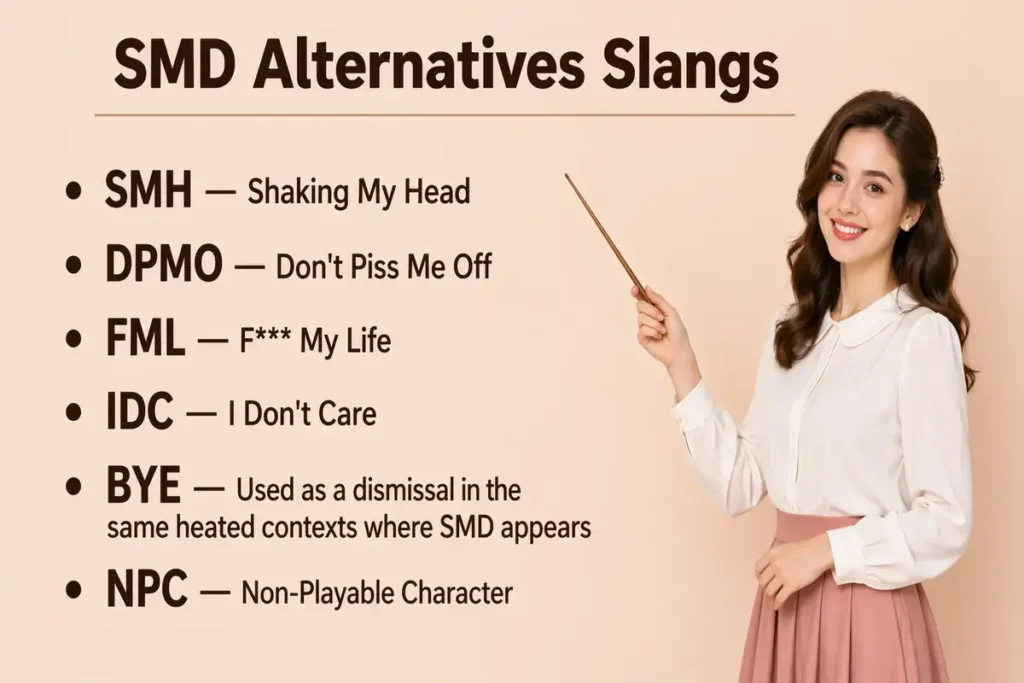
- SMH — Shaking My Head
- DPMO — Don’t Piss Me Off
- FML — F*** My Life
- IDC — I Don’t Care
- BYE — Used as a dismissal in the same heated contexts where SMD appears
- NPC — Non-Playable Character
- L — Loss
- Ratio — Twitter-specific dismissal signal, similar social function to SMD in public argument contexts
How to Reply When Someone Sends You SMD
If someone sends you SMD in a genuine argument context and the hostility feels real, the cleanest move is either to disengage entirely or respond with equal directness without escalating further. “We are done here” or simply not responding closes the exchange without feeding more energy into something that has already gone past productive. Most conversations that end in SMD did not have much left to salvage anyway.
If SMD arrived as part of established banter between close friends or in a gaming context where trash talk is the shared language, match the energy or one-up it depending on how the dynamic usually works. “Right back at you” or a sharper comeback keeps the banter going at the level both parties set from the start. Reading the relationship before deciding which response applies takes about two seconds and saves a lot of unnecessary friction.
Conclusion
SMD meaning in text is three letters of blunt, unfiltered dismissal that land hard in serious contexts and function as crude humor in playful ones. The surrounding relationship and conversation determine which version arrived in your chat. Direct, aggressive, and always clear when the context does what it needs to do.
Three letters. One complete dismissal. The conversation is officially over.
FAQs
SMD usually means “Suck My D*.”** It is a rude and explicit slang used to insult or show anger.
SMD is not appropriate in polite or professional settings. It can easily offend people and damage communication.
Online, SMD is used in arguments or toxic chats as an insult. It often appears in gaming chats or social media fights.
SMD is not naturally flirty. In most cases it is aggressive, though rarely it may be used jokingly between close people.
In text messages, SMD carries the same explicit insulting meaning. Always check tone because it can come off very harsh.

GenZ Slang Writer & Internet Culture Expert Layla Brooks has spent 2+ years tracking how GenZ slang evolves across TikTok, Twitter, and everyday conversations. From decoding viral phrases to explaining what words actually mean in real life, Layla writes content that feels native to the culture, not forced. If a word is trending, Layla already knows what it means and why it matters.