ICL Meaning in Text: The Three Letters That Signal Pure Honesty
ICL meaning in text stands for “I can’t lie,” used to signal that what someone’s about to say is completely honest, unfiltered, and straight from the heart.
You know that moment when a friend texts you “icl that hurt a little” and you feel the full weight of that admission? That’s exactly what ICL does. It strips away the social padding and signals that what follows is the real thing.
Origin and Cultural Footprints
ICL meaning in text grew out of Black American internet culture in the early 2010s, following the same path as TBH, NGL, and FR. These phrases all share the same cultural DNA: honesty qualifiers that prepare the listener for something unfiltered.
The phrase “I can’t lie” had already been part of spoken American slang for years before it made it online. People used it in real conversation to signal they were about to say something they’d normally soften or hold back.
Twitter and Vine carried ICL into mainstream digital vocabulary around 2013 to 2015. By the time TikTok became the dominant platform for youth culture, ICL was already fully embedded in everyday texting as a natural, instinctive signal for emotional honesty.
Other Meanings of ICL
ICL is fairly stable in the texting world, but outside of slang it carries completely different meanings in professional and technical spaces.
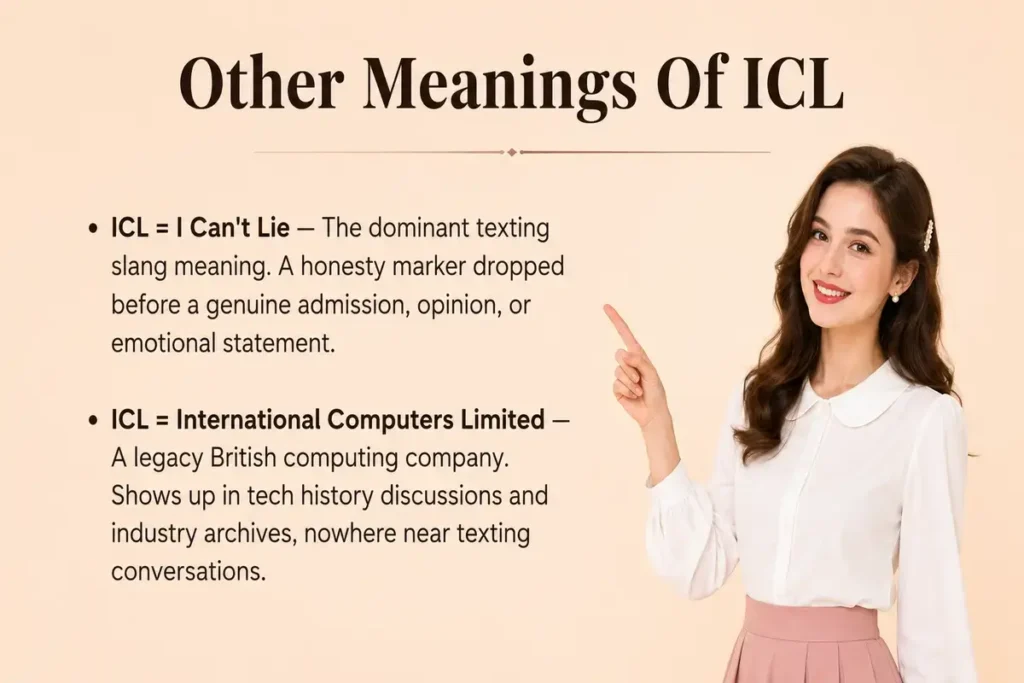
- ICL = I Can’t Lie — The dominant texting slang meaning. A honesty marker dropped before a genuine admission, opinion, or emotional statement.
- ICL = International Computers Limited — A legacy British computing company. Shows up in tech history discussions and industry archives, nowhere near texting conversations.
In medical contexts ICL also stands for Implantable Collamer Lens, a type of corrective eye surgery procedure. That meaning lives entirely in healthcare spaces and has zero overlap with how people use it in text conversations.
Why Does ICL Have So Many Different Definitions
Short abbreviations attract multiple meanings because different industries and communities claim the same letters independently. ICL got picked up by texters, tech historians, and medical professionals without any of those groups knowing or caring what the others were doing.
The texting meaning wins in everyday conversation every single time because volume and frequency dominate. When millions of people use ICL daily to signal honesty in texts, the other meanings don’t stand a chance in casual communication contexts.
Who Uses It Most?
ICL travels across age groups but Gen Z and Millennials carry it hardest in everyday digital communication.
| Group | How They Use It | Typical Context |
|---|---|---|
| Gen Z | Emotional honesty signal | DMs, texts, TikTok comments |
| Millennials | Genuine admission qualifier | Group chats and social posts |
| Content creators | Relatability tool | Captions and comment replies |
| General texters | Soft truth signal | Everyday personal conversations |
Gen Z deploys ICL the most naturally and frequently. For them it functions less as a formal disclaimer and more as a conversational rhythm, a beat before something real gets said.
Real Conversation Examples Using ICL
Here are three real-style conversations showing exactly how ICL lands across different situations.
1. Admitting feelings to someone you’re into
- Context: Two people in the early stages of talking romantically, texting late at night over iMessage.
- Sender: “icl I’ve been looking forward to your texts all day.”
- Receiver: “That honestly just made my night, icl same.”
- Reply tip: Match the vulnerability without making it heavier than they intended. They opened a door quietly, so walk through it at the same pace.
2. Honest reaction in a friend group chat
- Context: Friends discussing a movie they just watched together on a group Snapchat chat.
- Sender: “icl that ending completely destroyed me, I wasn’t ready.”
- Receiver: “Same, I had to sit in silence for like ten minutes after.”
- Reply tip: Agree and build on it. ICL in a shared reaction moment is an invitation to bond over the same feeling, so lean in.
3. Calling out a situation honestly without being harsh
- Context: Close friends texting after a slightly awkward hangout with a wider group.
- Sender: “icl the vibe was a little off tonight, felt like something was wrong.”
- Receiver: “I noticed too, didn’t want to say anything but yeah.”
- Reply tip: Validate their read calmly. ICL here means they’ve been holding that observation and finally feel safe saying it. Honor that trust with a measured, honest reply.
Usage of ICL in Different Contexts
In personal texting ICL works as an emotional unlock before something the person has been sitting on. It signals that what follows isn’t a throwaway comment but something they actually mean and want you to hear properly.
“icl I’ve been feeling really disconnected lately” carries ten times more weight than the same sentence without those three letters in front of it.
In social media captions and public posts, ICL signals authenticity to an audience. Creators drop it before opinions, reviews, and personal takes to signal they’re not performing, they’re genuinely speaking their mind.
“icl this might be the best album released this year” reads like a real human thought rather than a sponsored endorsement.
How Gen Z Uses ICL Today
Gen Z has turned ICL into one of their cleanest tools for emotional honesty without full vulnerability. It lets them say something real while the three letters absorb some of the exposure that comes with total openness.
That balance between honesty and self-protection is very much a Gen Z communication signature. They grew up in an era where everything typed is permanent, so having a qualifier that softens the delivery without weakening the message became genuinely useful.
There’s also a performance layer when ICL shows up in public spaces like TikTok comments. Using it signals emotional intelligence and self-awareness to everyone watching, which carries real social currency in communities that value authenticity above almost everything else.
Does ICL Mean I Can’t Leave
Some people read ICL as “I can’t leave,” especially when it shows up in emotionally loaded conversations about relationships or difficult situations. That’s a misread that flips the meaning entirely.
ICL has never carried “I can’t leave” as a mainstream texting meaning. That interpretation comes from people trying to decode the abbreviation based on emotional context rather than the actual letters and their established meaning.
If someone texts you ICL and you respond as though they said “I can’t leave,” the conversation is going to get confusing fast. The letters stand for honesty, not attachment. Read them correctly every time.
Meaning Across Social Media
| Platform | ICL Meaning | How It’s Used |
|---|---|---|
| iMessage / SMS | I can’t lie | Honesty signal in personal texts |
| Twitter/X | I can’t lie | Opinion drops and honest takes |
| TikTok | I can’t lie | Comments and relatable video reactions |
| I can’t lie | DMs and caption honesty moments | |
| Snapchat | I can’t lie | Casual daily admissions |
| Discord | I can’t lie | Server conversations and gaming chats |
TikTok is where ICL gets the most creative use as a public honesty signal. Twitter carries it as a sharp, no-nonsense qualifier before takes that might ruffle some feathers.
Common Confusions and Wrong Interpretations
ICL causes a few specific misreads that come up consistently enough to address directly.
- ICL vs. NGL — NGL means “not gonna lie” and carries almost identical energy to ICL. They’re near-synonyms but NGL feels slightly more defensive while ICL feels more emotionally open. The difference is subtle but real in tone.
- ICL vs. TBH — TBH means “to be honest” and sits in the same honesty-qualifier family. TBH often precedes opinions while ICL tends to precede emotional admissions. Context usually makes the distinction clear.
- ICL as a negative signal — Some people read ICL as a warning that something bad is coming next. It’s neutral. ICL works equally well before positive and negative statements. The tone lives in what follows it, not in ICL itself.
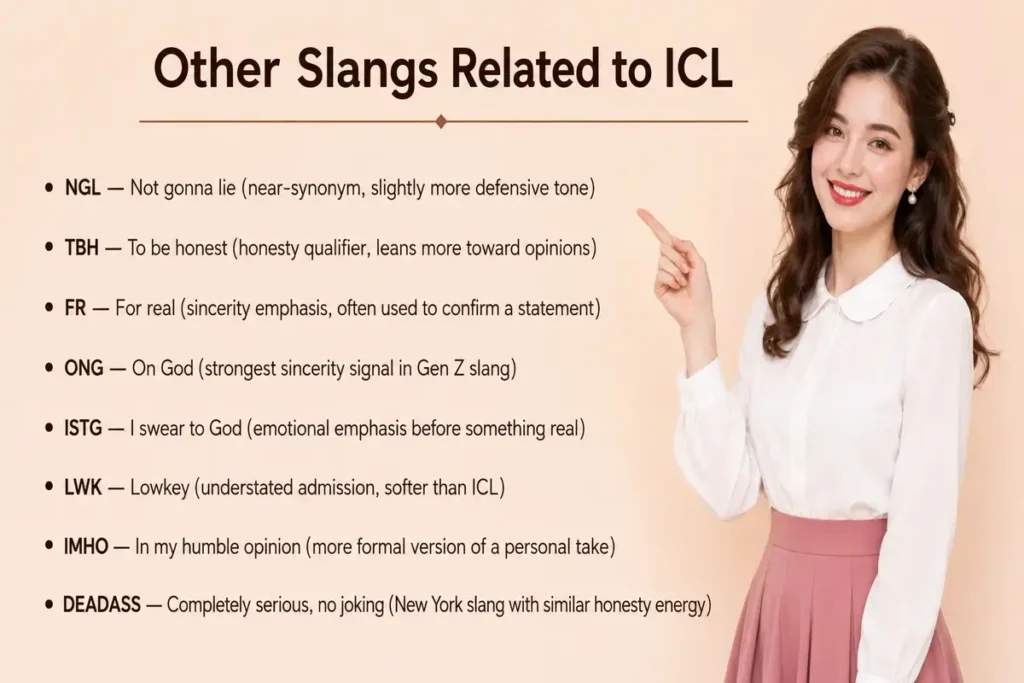
Related Slang Terms
- NGL — Not gonna lie (near-synonym, slightly more defensive tone)
- TBH — To be honest (honesty qualifier, leans more toward opinions)
- FR — For real (sincerity emphasis, often used to confirm a statement)
- ONG — On God (strongest sincerity signal in Gen Z slang)
- ISTG — I swear to God (emotional emphasis before something real)
- LWK — Lowkey (understated admission, softer than ICL)
- IMHO — In my humble opinion (more formal version of a personal take)
- DEADASS — Completely serious, no joking (New York slang with similar honesty energy)
How to Reply When Someone Says ICL
When someone leads with ICL before something personal or vulnerable, meet them at that level without amplifying it. They chose an understated opener on purpose. A warm, calm acknowledgment keeps the conversation in the space they created.
Something as simple as “I appreciate you saying that” or “that makes a lot of sense” does the job without turning their quiet honesty into a bigger emotional event than they intended.
If ICL comes before a critique or a hard truth about a shared situation, don’t get defensive. They’re being honest with you because they trust you enough to be. Engage with the substance of what they said rather than the delivery, and the conversation will go somewhere genuinely useful.
Conclusion
ICL meaning in text is one of the most human things you’ll find in modern messaging. Three letters that say: this is real, this is honest, and I mean every word of it.
Recognize it, respect it, and always give it the reply it deserves.
FAQs
ICL usually means “I Can’t Lie,” used to show honesty or admit something in a casual text.
On Snapchat, ICL commonly stands for “I Can’t Lie,” often used before sharing a real or blunt opinion.
ICL stands for “I Can’t Lie,” though in some contexts it can have different meanings based on the conversation.
In Gen Z slang, ASL often means “As Hell,” used to add emphasis like “funny asl” meaning very funny.
ICL generally means “I Can’t Lie,” and is used to keep a statement honest, real, or slightly blunt.

GenZ Slang Writer & Internet Culture Expert Layla Brooks has spent 2+ years tracking how GenZ slang evolves across TikTok, Twitter, and everyday conversations. From decoding viral phrases to explaining what words actually mean in real life, Layla writes content that feels native to the culture, not forced. If a word is trending, Layla already knows what it means and why it matters.