IMO Meaning in Text: Origin, Common Confusions, and Usage
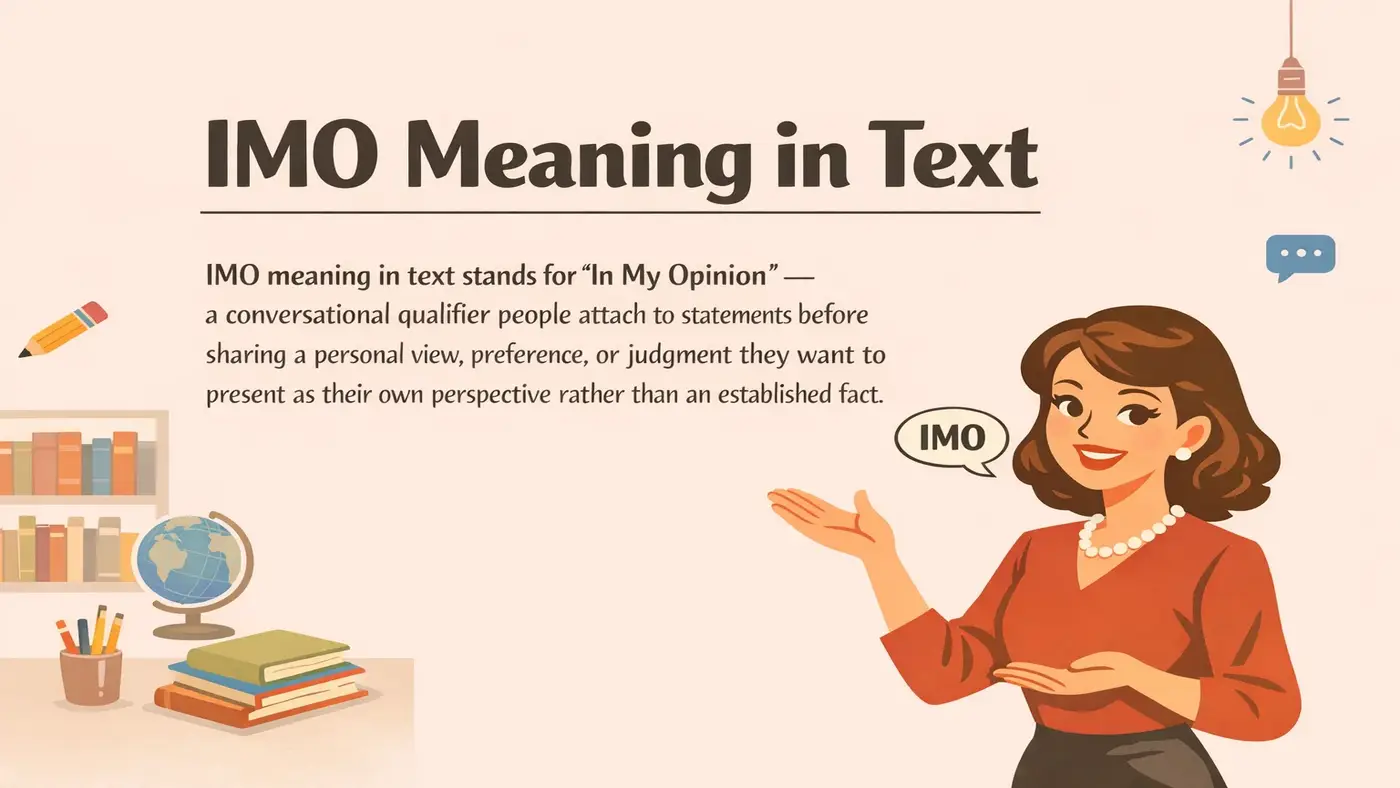
IMO meaning in text stands for “In My Opinion” — a conversational qualifier people attach to statements before sharing a personal view, preference, or judgment they want to present as their own perspective rather than an established fact. It signals humility without sacrificing directness.
People reach for it when they want to say something with confidence but without sounding like they are declaring universal truth. It is the textual equivalent of saying “take this from me, not from a textbook.” Short, practical, and immediately understood by everyone who reads it.
Origin and Cultural Footprints
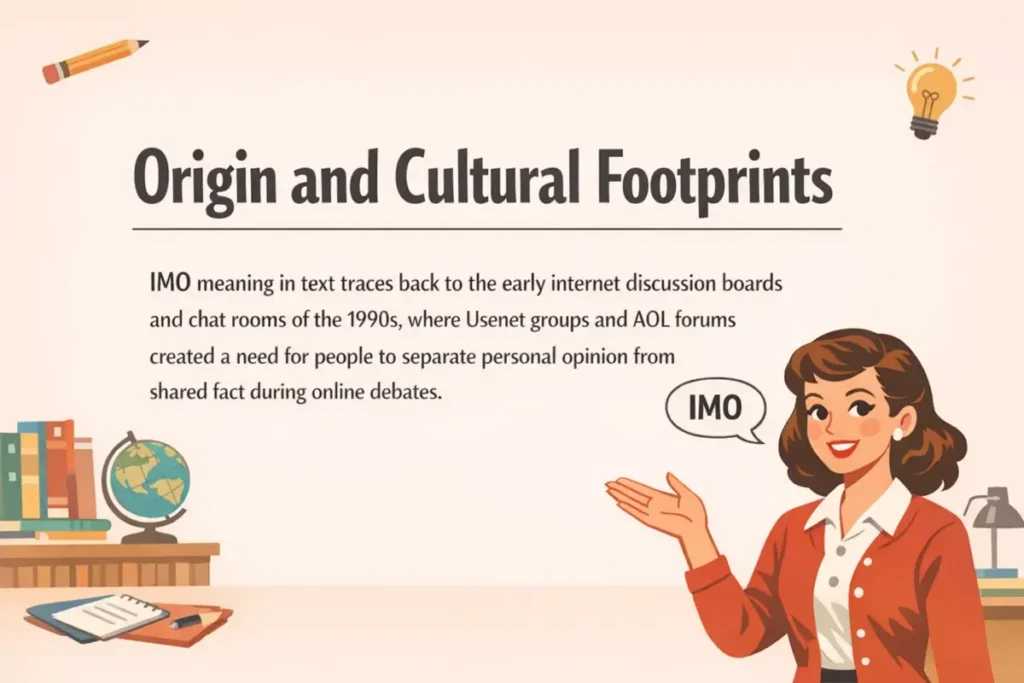
IMO meaning in text traces back to the early internet discussion boards and chat rooms of the 1990s, where Usenet groups and AOL forums created a need for people to separate personal opinion from shared fact during online debates. In those spaces, arguments escalated fast, and IMO gave people a way to flag subjectivity before anyone misread a personal take as a stated truth.
From Usenet threads to MSN Messenger, from forum posts to Twitter replies and Discord servers, IMO traveled across every platform shift without losing relevance. The reason is simple: the need to distinguish opinion from fact never goes away. Every generation of internet communication requires the same social tool, and IMO fills that role with three characters that require no decoding.
Other Definitions of IMO
Outside of casual text slang, IMO carries a few distinct alternate meanings in professional and institutional contexts:
- International Maritime Organization — The United Nations agency responsible for regulating international shipping. In maritime law, logistics, environmental policy, and global trade discussions, IMO refers exclusively to this body. You will see it in news coverage, government documents, and industry publications with no connection to texting slang.
- In My Own (opinion) — A minor variation sometimes written as IMO but intended to distinguish a uniquely personal perspective from a more general one. The distinction between “in my opinion” and “in my own opinion” rarely changes how the abbreviation reads in practice, but some users intend the more emphatic version.
- International Meteor Organization — Used in astronomy communities and scientific publications tracking meteor showers and celestial events. Specific, niche, and entirely separate from anything you would encounter in a group chat.
Who Uses It Most?
IMO belongs to people who share opinions regularly and want to frame them correctly. It shows up most in spaces where debate, recommendation, and personal perspective sit at the center of the conversation.
Here is a clear breakdown of which groups reach for IMO and why it works for each:
| Group | How They Use IMO | Why It Works |
|---|---|---|
| Gen Z | Sharing takes on culture, music, and social situations | Allows confident opinions without sounding preachy |
| Millennials | Online debates, reviews, and recommendation threads | A familiar qualifier that softens strong positions naturally |
| Content creators | Comment replies and opinion-based captions | Signals authenticity and personal voice to audiences |
| Gamers | Strategy discussions, game reviews, tier lists | Separates personal preference from objective game knowledge |
| Reddit and forum users | Discussion threads, advice posts, recommendation requests | Standard qualifier in long-form opinion exchanges |
| Professionals | Informal Slack messages and internal team chats | Softens directness in low-stakes collegial conversation |
Usage of IMO in Different Contexts
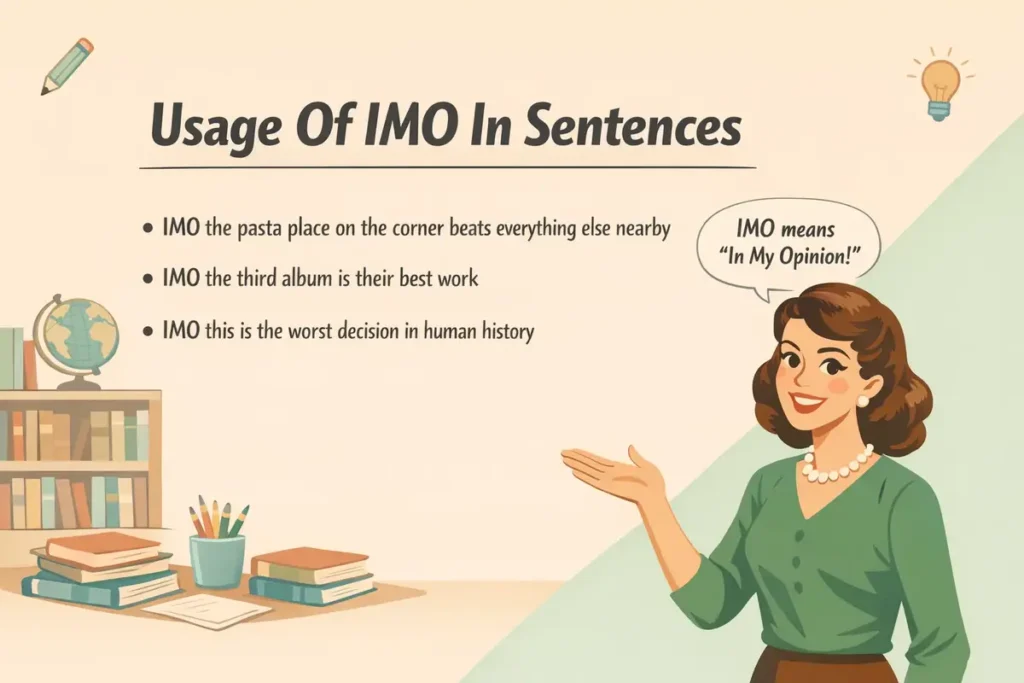
In personal texting and friend group conversations, IMO functions as a social softener that keeps opinions from landing as verdicts. Someone asking for a restaurant recommendation gets “IMO the pasta place on the corner beats everything else nearby” as a response that invites agreement or pushback without demanding either. The qualifier does real conversational work by keeping the exchange collaborative rather than declarative.
In online debate spaces like Reddit threads, Twitter replies, and Discord servers, IMO marks the boundary between personal take and shared consensus. Posting “IMO the third album is their best work” in a music discussion thread frames the opinion correctly from the start and signals to other users that counterpoints are welcome. Without that qualifier, the same sentence reads as a claim looking for a fight rather than a perspective opening a conversation.
How Gen Z Uses IMO Today
Gen Z uses IMO with full awareness of what it signals socially. Dropping IMO before a take tells the audience that the person knows their opinion is one perspective among many, and that self-awareness matters in online spaces where confidence without humility reads as arrogance. In that sense, IMO functions as a social intelligence marker as much as a grammatical qualifier.
The ironic version also exists and Gen Z runs it constantly. Sending “IMO this is the worst decision in human history” about something completely trivial, like a streaming platform removing a show, plays on the gap between the weight of the qualifier and the absurdity of the claim. The IMO meaning in text stays technically accurate while the sentence around it delivers the joke. That layered usage is exactly how Gen Z keeps older abbreviations feeling current and flexible.
Does IMO Mean the Same as IMHO?
This is the most common point of confusion and it deserves a clear answer. IMHO stands for “In My Humble Opinion” and the “humble” component carries real meaning. IMHO softens a statement further than IMO does, adding a layer of deference that signals the person holds their view lightly and wants to avoid coming across as overbearing.
IMO is more neutral. It marks a statement as personal opinion without the added humility signal. Using IMHO when you mean IMO makes a statement sound slightly more deferential than intended. Using IMO when you mean IMHO removes a softening layer that some conversational contexts genuinely need. They overlap significantly but they are not identical, and swapping them carelessly changes the tone of a message in ways most people pick up on even if they cannot immediately name why.
Meaning Across Social Media
| Platform | IMO Meaning | How It’s Used |
|---|---|---|
| Twitter / X | In My Opinion | Framing takes, hot opinions, and personal positions in debate threads |
| In My Opinion | Standard qualifier in advice threads, reviews, and discussion posts | |
| In My Opinion | Personal and group chat recommendations and opinion sharing | |
| Discord | In My Opinion | Opinion framing in server debates, game discussions, and community chats |
| In My Opinion | Caption opinions, comment replies, DM conversations about preferences | |
| TikTok Comments | In My Opinion | Reacting to creator content with personal takes and counterpoints |
| In My Opinion | Opinion posts, comment section debates, group discussion threads |
Common Confusions & Wrong Interpretations
- IMO confused with IMHO — As covered above, these two abbreviations are related but not identical. IMHO adds humility. IMO stays neutral. Mixing them up shifts the register of a message in ways that are subtle but real.
- IMO read as dismissive — In some conversational contexts, leading with IMO can accidentally signal that the person thinks their opinion outweighs others rather than sits alongside them. The intent is humility but the read depends entirely on who receives it and what comes after those three letters.
- IMO mistaken for the International Maritime Organization — In professional and academic contexts where maritime policy appears, IMO almost always refers to the UN agency. Sending a message about shipping regulations and adding “IMO” at the end creates genuine confusion about whether you mean the organization or the qualifier.
- IMO dropped in formal writing — Some people carry IMO from casual texting into professional emails, reports, or formal documents where it reads as too informal and undermines the credibility of the statement it is meant to qualify. Platform and register awareness matters here more than with most abbreviations.
Similar Terms, Alternatives & Related Slang
- IMHO — In My Humble Opinion; adds a deference layer that IMO does not carry
- TBH — To Be Honest; signals candor rather than opinion, slightly more confessional in tone
- NGL — Not Gonna Lie; functions similarly to TBH with a casual honesty signal before a statement
- For me — Written-out personal qualifier; warmer and more conversational than IMO
- Personally — Adverb that frames an opinion as individual without using an abbreviation
- JMO — Just My Opinion; a variation of IMO that emphasizes the personal nature of the view further
- FWIW — For What It’s Worth; qualifies a statement by downplaying its authority rather than framing it as opinion
- IDK but — Informal opener that signals uncertainty before a personal take; softer than IMO
How to Reply When Someone Sends You IMO
If someone shares an opinion framed with IMO and you agree, the simplest response confirms that alignment and adds something of your own. “Yeah same, I’ve thought that for a while” or “100%, especially considering what happened recently” keeps the conversation moving and builds on what they offered. Agreement after an IMO invitation reads as genuine engagement rather than passive nodding.
If you disagree with what someone shared using IMO, the framing they provided already opens the door to a counter-opinion. “Fair enough, but for me it’s the opposite because…” respects the way they framed their view and introduces yours at the same register. Most people who use IMO genuinely want the exchange to be two-directional. Taking them up on that by sharing a different perspective usually produces better conversation than either flat agreement or combative pushback.
Conclusion
IMO meaning in text does one thing and does it well: it places a personal flag on a statement before that statement goes out into the world. Three letters that separate opinion from fact, preference from verdict, and personal take from shared consensus. That function will never go out of style.
Simple qualifiers hold conversations together. IMO has done that job across every platform for thirty years.
FAQs
IMO meaning in text stands for “In My Opinion” — a quick way to flag that what follows is a personal take, not a fact. People use it to share views without sounding like they are declaring absolute truth.
On TikTok, IMO works the same way — creators and commenters drop it before sharing a hot take or personal reaction to a video. It keeps opinions feeling conversational rather than confrontational in fast-moving comment sections.
Gen Z uses IMO to frame confident opinions while signaling they are open to pushback. It also gets used ironically, like “IMO this is the greatest thing ever” said about something completely ordinary.
As slang, IMO does not have four types — it means one thing: “In My Opinion.” You may be thinking of its variations, which include IMHO (In My Humble Opinion), IMNSHO (In My Not So Humble Opinion), and JMO (Just My Opinion).
As slang, IMO exists to separate personal opinion from stated fact in conversation. It tells the reader upfront that what follows is one person’s perspective, not a universal claim everyone should accept.

GenZ Slang Writer & Internet Culture Expert Layla Brooks has spent 2+ years tracking how GenZ slang evolves across TikTok, Twitter, and everyday conversations. From decoding viral phrases to explaining what words actually mean in real life, Layla writes content that feels native to the culture, not forced. If a word is trending, Layla already knows what it means and why it matters.