TYFA Meaning in Text: Tried to Explained Everything
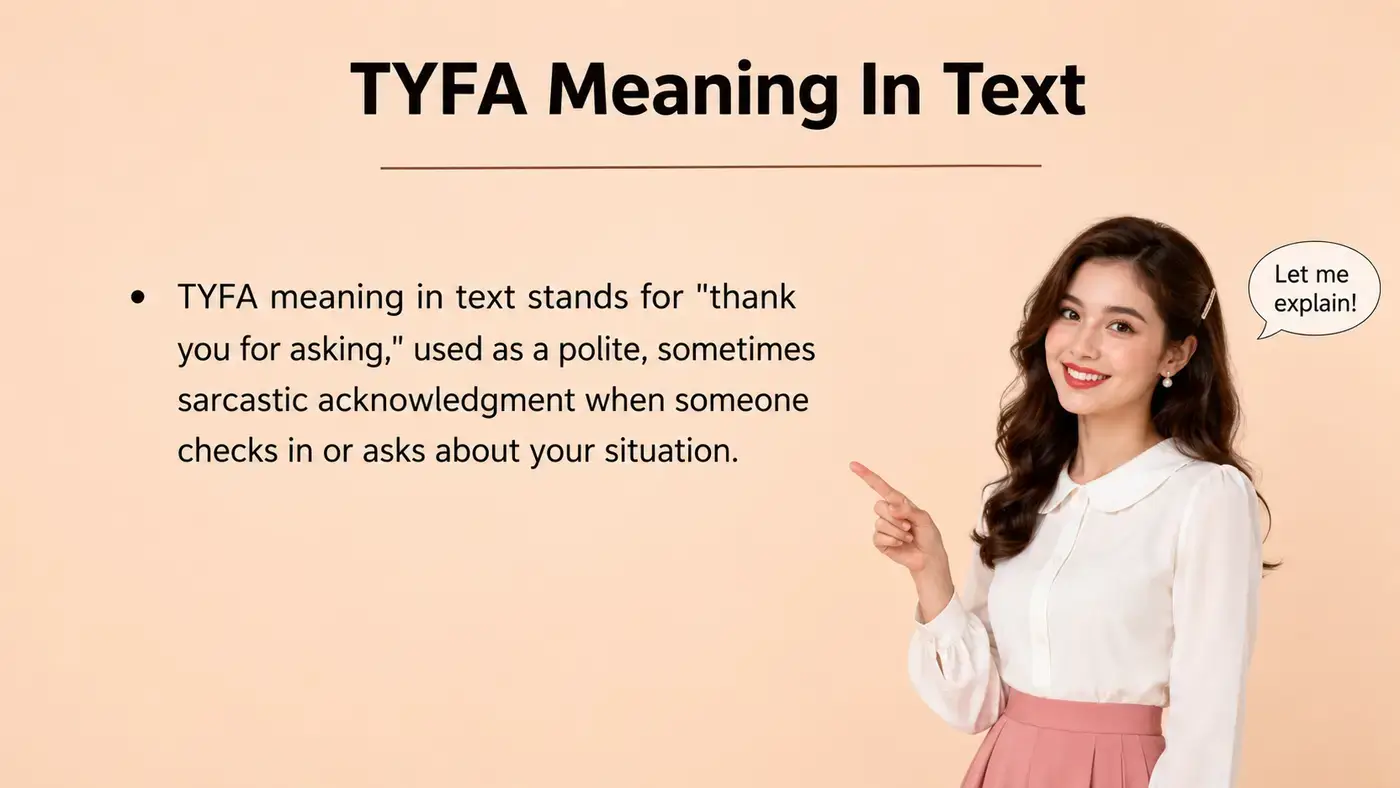
TYFA meaning in text stands for “thank you for asking,” used as a polite, sometimes sarcastic acknowledgment when someone checks in or asks about your situation.
It lands differently depending on tone. Genuine warmth in one conversation. Sharp sarcasm in the next. Same four letters, completely opposite feelings depending on who sent them.
Origin and Cultural Footprints
TYFA meaning in text developed naturally from formal email and professional communication culture, where “thank you for asking” was a standard courtesy phrase used in customer service and business correspondence.
As that phrasing moved into casual texting it kept the same structure but lost the formality entirely.
By the mid-2010s TYFA had started appearing in social media replies and group chats, picked up primarily by users who enjoyed repurposing formal language in informal settings for ironic or humorous effect.
Other All Meanings of TYFA
TYFA doesn’t carry a wide range of competing meanings, but a couple of alternate readings exist in specific spaces worth knowing about.
- TYFA = Thank You For Asking — The dominant meaning across all casual texting and social media platforms. Both sincere and sarcastic depending entirely on context.
- TYFA = The Youth For Action — An organizational acronym used by youth advocacy and community development groups. Lives entirely in nonprofit and social justice spaces.
In some online communities TYFA also appears as a gaming clan tag or forum username shorthand with no attached semantic meaning. That use is cosmetic only and carries zero conversational weight.
Why Does TYFA Have So Many Different Definitions
Short abbreviations get claimed independently by communities that never consult each other. TYFA got pulled in different directions by professional courtesy culture, youth advocacy organizations, and casual internet humor all at roughly the same time.
The texting meaning wins in everyday conversation because volume always dominates. When millions of people use TYFA daily as a casual acknowledgment or sarcastic deflection, the organizational acronym simply doesn’t compete outside its own specific context.
Who Uses It Most
TYFA circulates across specific groups, each deploying it with a slightly different energy and intent.
| Group | Common Meaning | Typical Context |
|---|---|---|
| Gen Z texters | Thank you for asking | DMs, group chats, social replies |
| Millennials | Polite or ironic acknowledgment | Personal texts and Twitter replies |
| Content creators | Audience engagement response | Comment replies and caption humor |
| Customer service culture | Formal courtesy phrase | Professional emails and support chats |
Gen Z carries the ironic version hardest. Millennials split more evenly between genuine and sarcastic use. Both generations use it with full awareness of the dual register it operates in.
Real Conversation Examples Using TYFA
1. Genuine warm response to a friend checking in
Between two friends over iMessage after one had a rough week
A: “Hey, how are you actually doing? Not the fine version.” B: “TYFA for real. I’ve been struggling a little but I’m getting through it.” A: “I’m glad you said something. I’m here if you need to talk.”
Context: A sincere, emotionally open use of TYFA between close friends. The person checking in asked with real care and the response matched that energy. How to reply: Don’t pivot away from the vulnerability they just shared. Stay in the moment and follow up with a real question.
2. Sarcastic deflection in a group chat
Between friends after someone asks an intrusive question
A: “So are you two actually dating or what’s the situation.” B: “TYFA for your concern. We’re just friends.” A: “That was not a yes or no answer.” B: “No it wasn’t.”
Context: Classic sarcastic TYFA as a soft wall. The person answered without answering and everyone in the chat knew exactly what was happening. How to reply: Read the deflection and back off. They gave you what they wanted to give. Pushing harder rarely works.
3. Creator responding to a fan question publicly
Instagram comment section under a lifestyle post
A: “Are you okay? You’ve seemed a little off lately.” B: “TYFA, genuinely. I’ve been taking some time for myself and it’s been needed.”
Context: Public acknowledgment of genuine audience concern. The creator used TYFA to honor the question while keeping the response personal but not overly revealing. How to reply: Respect the boundary they set. Engage warmly without pressing for more than they offered.
Usage of TYFA in Different Contexts
In personal texting TYFA signals that someone noticed you asked and they appreciated it, even if the full answer isn’t coming right now. It buys emotional time without closing the door on the conversation entirely.
That’s a useful function in close relationships where people sometimes need acknowledgment before they’re ready to talk.
In public social media spaces TYFA shifts into a performance. Creators and public figures drop it in comments to appear accessible and warm while controlling exactly how much they actually share. It manages audience expectations with four letters and zero friction.
How Gen Z Uses TYFA Today
Gen Z has made TYFA one of their cleaner tools for managing unwanted questions without outright rudeness. The formality borrowed from professional communication creates just enough ironic distance to deflect without offending.
That combination of politeness and deflection is a very deliberate Gen Z social skill. They learned early that you can close a conversation gracefully without ever saying “mind your business.”
There’s also a genuinely warm use of TYFA that surfaces regularly in vulnerability-forward Gen Z spaces. When someone actually means it, TYFA carries real gratitude and signals that being checked on mattered. The sincerity hits harder precisely because the sarcastic version exists alongside it.
Does TYFA Mean the Same as TYA
Some people encounter both TYFA and TYA and assume they’re interchangeable shortcuts for the same phrase. They’re not quite the same thing.
TYA most commonly stands for “thank you again” rather than “thank you for asking.” The difference in meaning is significant because one acknowledges a question and the other acknowledges repeated generosity or help.
Using TYA when you mean TYFA changes the entire emotional direction of your message. One responds to someone’s curiosity. The other responds to someone’s actions. Always check the abbreviation you’re actually using before sending.
Meaning Across Social Media
| Platform | TYFA Meaning | How It’s Used |
|---|---|---|
| iMessage / SMS | Thank you for asking | Personal acknowledgment in direct texts |
| Twitter/X | Polite or sarcastic reply | Public responses to questions and comments |
| Warm audience acknowledgment | Comment section and DM replies | |
| TikTok | Ironic or genuine response | Video comment replies and duet responses |
| Snapchat | Casual deflection or thanks | Story replies and personal conversations |
| Sarcastic thread reply | Comment sections and discussion threads |
Reddit carries the most sarcastic version of TYFA. Instagram and iMessage split more evenly between genuine and ironic use depending on the relationship and conversation tone.
Common Confusions and Wrong Interpretations
TYFA causes a few specific misreads that come up consistently enough to address directly.
- TYFA vs. TYA — TYA typically means “thank you again” while TYFA specifically acknowledges a question. Swapping them changes the meaning of your message entirely.
- TYFA as always sarcastic — A lot of people default to reading TYFA as ironic because the formal phrase sounds out of place in casual texting. It’s equally capable of being completely sincere. Read the surrounding tone first.
- TYFA as dismissive — Some people feel shut down when they receive TYFA because it can signal the conversation is over. It’s not always a door closing. Sometimes it’s just someone buying a moment before they open up properly.
Related Slang Terms
- TYA — Thank you again (response to repeated help, not a question)
- TY — Thank you (simple, universal gratitude abbreviation)
- NP — No problem (common reply to any form of thanks)
- ILY — I love you (warmer close often used after a genuine TYFA exchange)
- NGL — Not gonna lie (honesty signal, sometimes precedes a TYFA response)
- TBH — To be honest (personal take qualifier, often follows TYFA in vulnerable conversations)
- ICL — I can’t lie (similar honesty signal, pairs naturally with sincere TYFA use)
- ISTG — I swear to God (used when emphasizing the sincerity behind a TYFA)
How to Reply When Someone Says TYFA
When someone sends you a genuine TYFA, don’t pivot immediately to something else. They acknowledged your care and that moment deserves a beat. A simple “of course, I’m always going to ask” or “I meant it, I’m here” keeps the warmth alive without forcing a bigger conversation than they’re ready for.
Give them the space they signaled they needed and let them come to you.
If TYFA came with a sarcastic edge, read the deflection and respect it. They answered in the way they chose to answer and pressing harder is rarely the right move. A light “fair enough, whenever you’re ready” keeps the door open without making them feel cornered by their own response.
Conclusion
TYFA meaning in text is one of those phrases that carries real emotional intelligence inside four letters. It acknowledges, deflects, or warms a conversation depending entirely on who’s using it and why.
Read the tone, trust the context, and TYFA will never catch you off guard again.
FAQs
TYFA stands for thank you for asking. It is used to show appreciation in conversations.
TYFF can mean thank you for following or similar phrases. The meaning depends on context and platform.
TFG can have different meanings in texting and online slang. Its meaning changes based on the conversation.
TY means thank you in slang and texting. It is a short and casual way to show gratitude.
TYVM stands for thank you very much. It is used to express stronger appreciation.
No, TYFA is not rude. It is a polite and casual way to say thank you for asking.

GenZ Slang Writer & Internet Culture Expert Layla Brooks has spent 2+ years tracking how GenZ slang evolves across TikTok, Twitter, and everyday conversations. From decoding viral phrases to explaining what words actually mean in real life, Layla writes content that feels native to the culture, not forced. If a word is trending, Layla already knows what it means and why it matters.