PSH Meaning in Text: Everything in Detail 2026
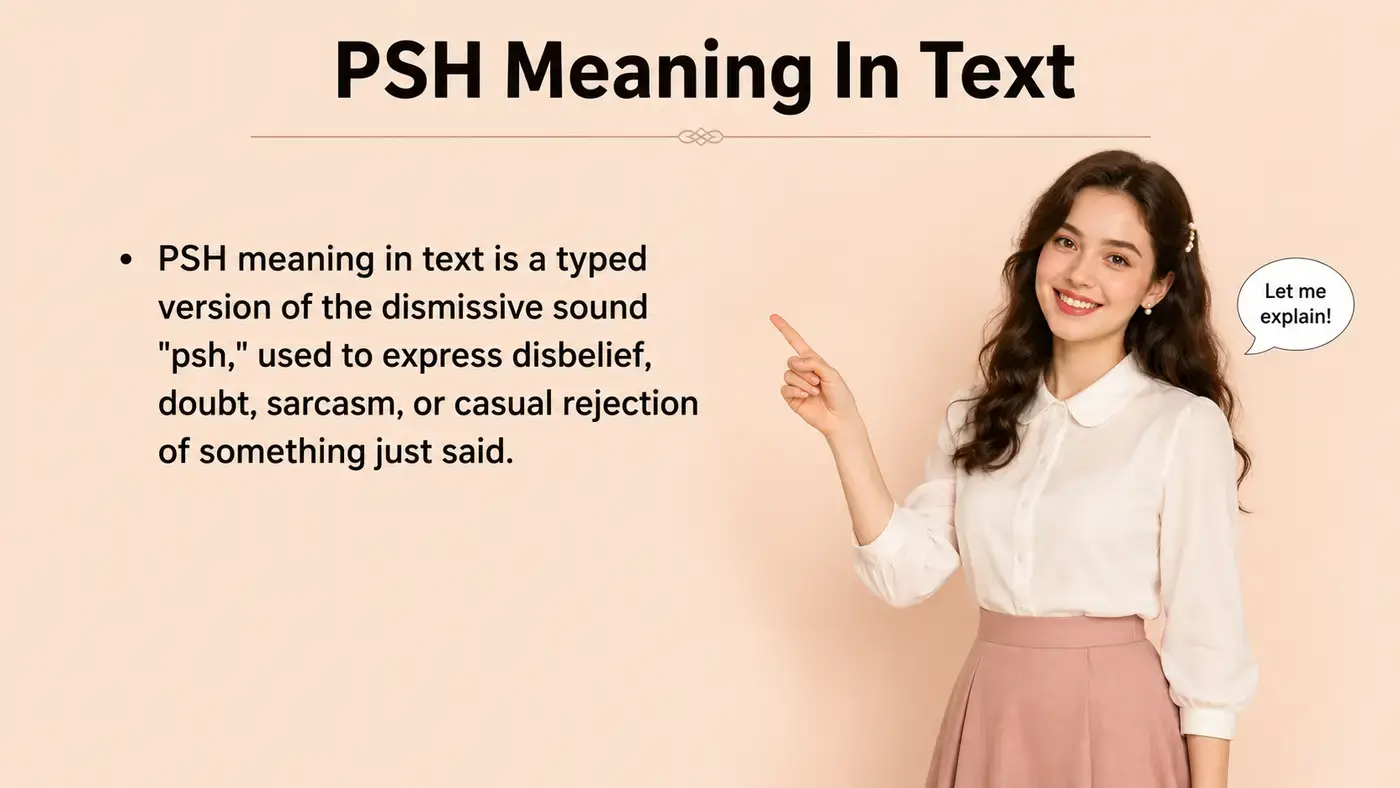
PSH meaning in text is a typed version of the dismissive sound “psh,” used to express disbelief, doubt, sarcasm, or casual rejection of something just said.
It’s not really a word. It’s a sound someone makes with their mouth when they’re not impressed, and texting culture turned it into a three-letter reaction that lands with surprising precision.
Origin and Cultural Footprints
PSH meaning in text traces directly back to spoken American English, where the exhaled “psh” or “pfft” sound has been a natural dismissal reflex for generations. Long before smartphones existed, people were making this sound in conversations when something struck them as ridiculous or unbelievable.
When chat culture took off in the early 2000s, people started typing their vocal reactions. PSH joined a long list of phonetic expressions that crossed from speech into text.
By the 2010s PSH had spread through social media comment sections, group chats, and Twitter replies as a quick, low-effort way to signal skepticism or mock-indignation without typing a full response. It stuck because it worked.
Other All Meanings of PSH
PSH doesn’t carry dramatically different meanings across communities, but a few variations are worth understanding before you use or respond to it.
- PSH = Dismissal or disbelief — The dominant texting meaning. A quick reaction signaling that something said was unconvincing, ridiculous, or not worth taking seriously.
- PSH = Playful brush-off — Used between close friends as a light, affectionate way of waving something away. No real negativity behind it, just banter energy.
In some technical and professional spaces PSH appears as an acronym for things like “Public Sector Housing” or “Pressure-Sensitive Housing,” but those meanings live entirely in industry documents and have zero crossover with casual digital communication.
Why Does PSH Have So Many Different Definitions
PSH is a phonetic spelling rather than a true abbreviation, which means its meaning comes entirely from the sound it represents and the tone surrounding it.
Sounds don’t come with fixed dictionaries. They carry meaning through context, relationship, and delivery, and text strips all of that away instantly, which is exactly why PSH can read as friendly mockery in one message and genuine dismissal in the next.
The same three letters do completely different emotional work depending on the conversation they land in. That flexibility is why PSH has survived as a reaction across multiple platforms and communication styles for over two decades.
Who Uses It Most
PSH travels across age groups but certain communities reach for it more consistently than others.
| Group | Common Meaning | Typical Context |
|---|---|---|
| Gen Z texters | Sarcastic or playful dismissal | DMs, group chats, TikTok comments |
| Millennials | Genuine skepticism or disbelief | Personal texts and Twitter replies |
| Close friend groups | Affectionate banter reaction | Group chats and casual conversations |
| Social media users | Public mock-dismissal | Comment sections and reply threads |
Millennials and Gen Z both carry PSH regularly but with slightly different energy. Millennials tend to mean it more literally. Gen Z wraps it in irony almost every time.
Real Conversation Examples Using PSH
1. Playful disbelief between close friends
Between two friends after one makes an obvious brag over iMessage
A: “I finished the whole project in like two hours, it was nothing.” B: “Psh, sure you did. You texted me three times saying you were stressed.” A: “Okay fine, it took a little longer than two hours.”
Context: Affectionate call-out between friends who know each other’s patterns well. PSH signals “I know you” rather than genuine hostility. How to reply: Laugh it off and own the exaggeration. They’re not attacking, they’re just paying attention.
2. Skeptical reaction to a questionable claim online
Twitter reply thread under a viral self-improvement post
A: “I wake up at 4am every day and it changed my entire life.” B: “Psh, I tried that for a week and all it changed was my mood.” A: “Takes time to adjust.”
Context: Public skepticism about a popular claim. PSH here is mild, not hostile, and invites a counter-response. How to reply: Either defend the claim with specifics or acknowledge the humor. Escalating is rarely worth it in a public thread.
3. Sarcastic self-dismissal in a personal text
Someone texting a close friend after a small personal win
A: “I actually cooked a real meal tonight, not just cereal.” B: “Okay honestly that’s growth.” A: “Psh, took me long enough.”
Context: PSH used as self-deprecating humor. The person dismisses their own achievement before anyone else can, which is a very relatable communication habit. How to reply: Push back on the self-dismissal warmly. Tell them it counts. They probably need to hear it.
Usage of PSH in Different Contexts
In personal texting PSH reads as an eyeroll in letter form. It signals that something was said and the person receiving it isn’t fully buying it, whether that’s a brag, an excuse, or a claim that doesn’t quite add up.
That function makes PSH genuinely useful in close friendships where calling someone out directly might feel too heavy for the moment.
In public social media spaces PSH becomes a performance. Dropping a “psh” in a comment section signals to everyone reading that you’re unimpressed, and that public skepticism sometimes carries more social weight than a longer, more detailed response ever could.
How Gen Z Uses PSH Today
Gen Z uses PSH with a dry, almost theatrical energy that makes it land harder than the letters suggest. It’s their written version of a raised eyebrow, and they deploy it with the same casual precision they bring to most reaction slang.
What makes PSH distinctly Gen Z is the irony layer. They’ll drop a PSH before agreeing with something, after admitting they’re wrong, or in response to their own statement. That self-aware use of dismissal language is very much their communication signature.
There’s also a warmth underneath it in the right context. Between best friends, a PSH is often a term of affection. It says “I know you well enough to call this out” and that familiarity is the whole point of the message.
Does PSH Mean the Same as PFF or PFFT
This is the most common comparison people make when they encounter PSH, and it’s worth addressing clearly. PFFT and PFF represent a slightly breather, more exasperated version of the same dismissal sound.
PSH is sharper and quicker. PFFT carries more air and tends to signal stronger exasperation or disbelief. They’re cousins, not twins, and the emotional difference between them is subtle but real in actual conversation.
If someone sends you PFFT they’re probably more genuinely frustrated or shocked than someone who sends PSH. The extra letters signal extra feeling, and that distinction matters when you’re deciding how to respond.
Meaning Across Social Media
| Platform | PSH Meaning | How It’s Used |
|---|---|---|
| iMessage / SMS | Dismissal or playful doubt | Personal reactions in direct conversations |
| Twitter/X | Public skepticism | Reply threads and quote tweet reactions |
| TikTok | Mock disbelief or banter | Comment section reactions to videos |
| Playful brush-off | DM banter and comment replies | |
| Snapchat | Casual eyeroll reaction | Friend conversations and story replies |
| Skepticism or mild mockery | Comment threads and debate responses |
Twitter is where PSH carries the most public weight as a signal of unimpressed skepticism. Snapchat and iMessage are where it lives most comfortably as playful friend banter.
Common Confusions and Wrong Interpretations
PSH creates a few specific misreads that surface regularly enough to address directly.
- PSH vs. PFFT — PFFT signals stronger exasperation. PSH is lighter and more casual. They’re related but not identical in emotional weight.
- PSH as always negative — A lot of people read PSH as rude or dismissive by default. Between close friends it’s almost always playful. Read the relationship before assuming hostility.
- PSH as agreement — Some people use PSH sarcastically before agreeing with something, which throws readers off. If PSH is followed by agreement, the dismissal was ironic, not genuine.
Related Slang Terms
- PFFT — Exasperated dismissal sound, slightly stronger than PSH
- SMH — Shaking my head, disappointment or disbelief reaction
- NGL — Not gonna lie, honesty signal before an admission
- IKR — I know right, agreement after a shared reaction
- LOL — Laughing out loud, often paired with PSH in playful exchanges
- TBH — To be honest, personal take qualifier
- FR — For real, sincerity signal that sometimes follows a PSH
- WELP — Resigned acceptance, similar energy to a deflated PSH
How to Reply When Someone Says PSH
When PSH comes from a close friend in a playful context, match the energy without overthinking it. A laugh, a comeback, or a self-aware acknowledgment that they caught you keeps the banter moving naturally.
They’re not looking for a serious response. They’re playing.
If PSH came in a more serious or public context and felt genuinely dismissive, don’t inflate it into a bigger moment than it needs to be. Address the substance of whatever they were responding to rather than the PSH itself. Reacting to the sound instead of the content rarely moves a conversation forward productively.
Conclusion
PSH meaning in text is one of the most human sounds in digital communication, a dismissal, a laugh, and an eyeroll all compressed into three letters. It says what needs saying without wasting a single extra character.
Know the tone, read the relationship, and PSH will never catch you off guard.
FAQs
PSH is an expression used to show disbelief, dismissal, or sarcasm. It sounds similar to brushing something off.
PSHH is an extended version of PSH for extra emphasis. It is often used jokingly or playfully in chats.
PHS can have different meanings depending on context. It is not a fixed slang term in texting.
On Instagram, PSH is used in comments or captions to show sarcasm, confidence, or disbelief. The tone depends on context.
PHT is not a widely recognized slang term. Its meaning usually depends on personal or community usage.

GenZ Slang Writer & Internet Culture Expert Layla Brooks has spent 2+ years tracking how GenZ slang evolves across TikTok, Twitter, and everyday conversations. From decoding viral phrases to explaining what words actually mean in real life, Layla writes content that feels native to the culture, not forced. If a word is trending, Layla already knows what it means and why it matters.