DPMO Meaning in Text: Origin, Confusions, And Similar Terms
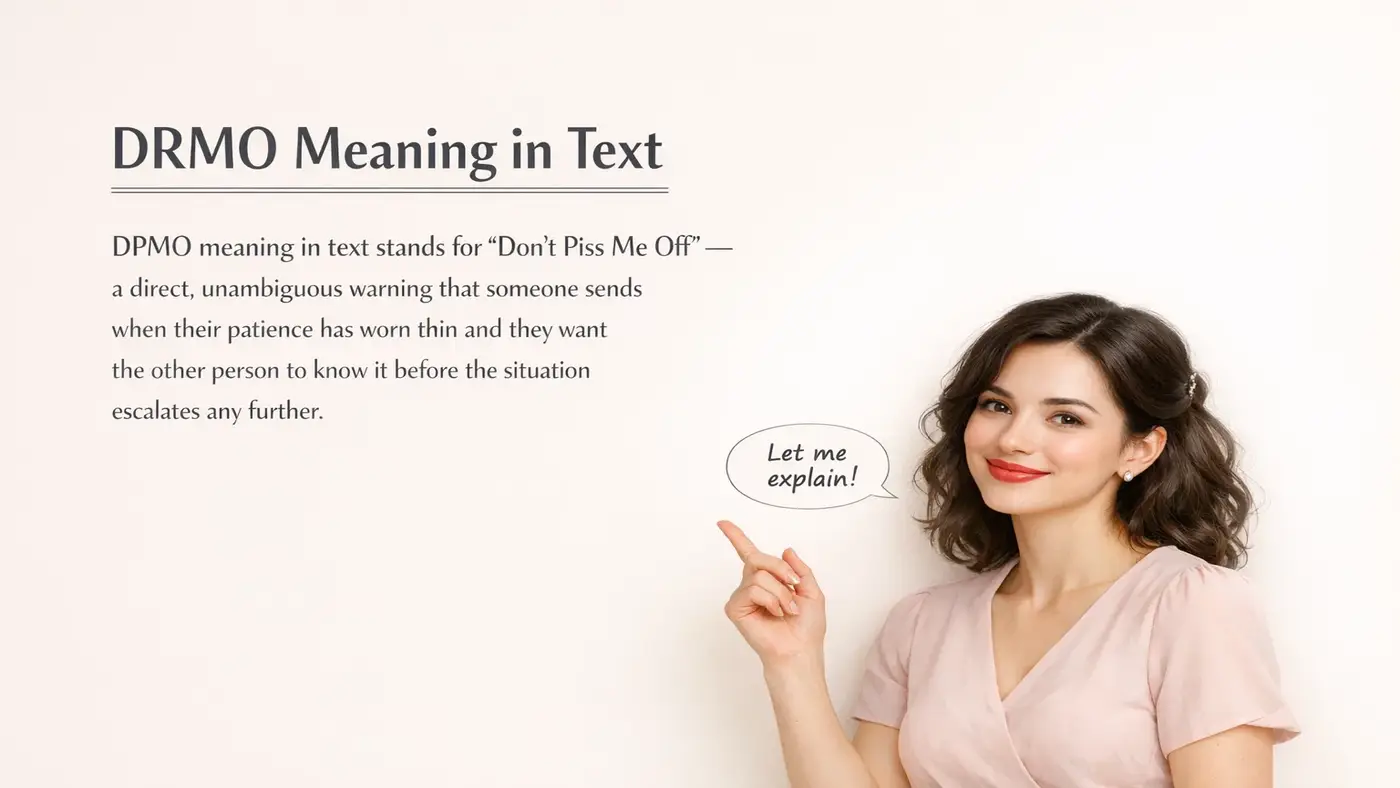
DPMO meaning in text stands for “Don’t Piss Me Off” — a direct, unambiguous warning that someone sends when their patience has worn thin and they want the other person to know it before the situation escalates any further. It is a boundary, compressed into four letters.
You will see it after repeated irritations, ignored requests, or conversations that have pushed someone past the point of casual annoyance. DPMO does not ask for anything. It warns. And most people who receive it understand immediately that they need to adjust.
Origin and Cultural Footprints
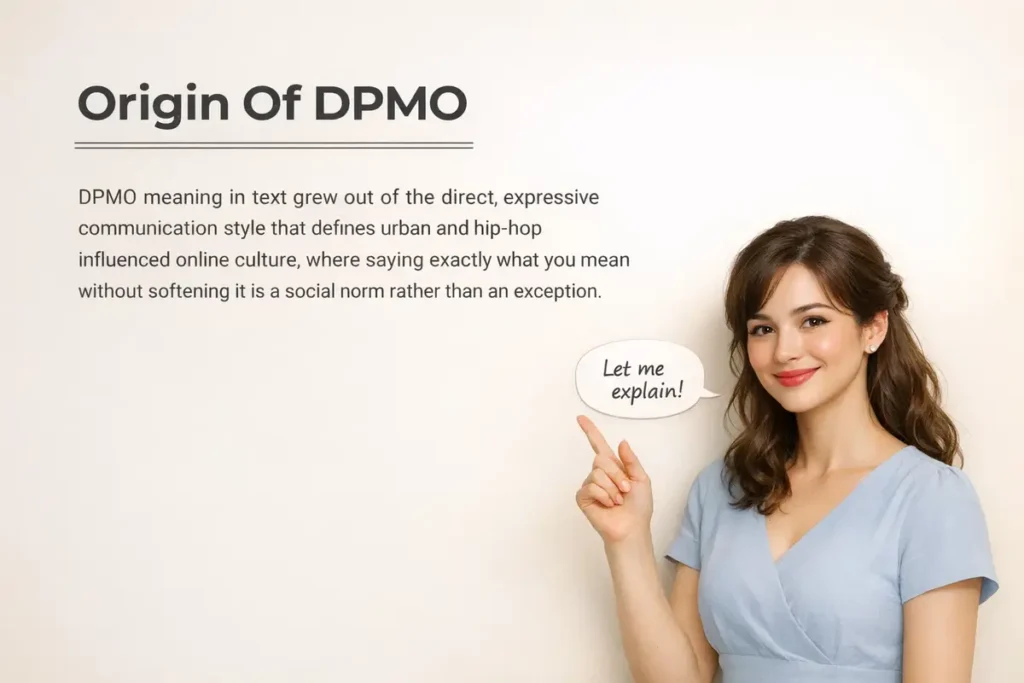
DPMO meaning in text grew out of the direct, expressive communication style that defines urban and hip-hop influenced online culture, where saying exactly what you mean without softening it is a social norm rather than an exception. The abbreviation captures a spoken warning in text form and delivers it with the same weight it would carry out loud.
The term spread through Twitter, Snapchat, and group chat culture where emotional directness is valued and where abbreviated expressions of frustration travel fast. DPMO arrived alongside similar boundary-setting abbreviations and stuck because it filled a specific gap — a warning that sits between mild frustration and full confrontation, holding a clear line without crossing into aggression.
Other Definitions of DPMO
Outside of its warning usage, DPMO appears in a few professional and technical contexts worth knowing:
- Defects Per Million Opportunities — A quality management and manufacturing metric used in Six Sigma methodology to measure process quality and error rates. Appears in engineering, operations management, and business process improvement documentation. Entirely institutional and separate from any casual texting usage.
- Don’t Play Me Out — An alternate slang expansion used in some communities where the phrase “play me out” means to embarrass, disrespect, or undermine someone publicly. The warning register stays the same but the specific grievance shifts from general irritation to social reputation.
- Decisions Per Management Objective — An occasional abbreviation in strategic planning and organizational behavior academic contexts. Rare outside of formal documentation and business school discussions.
Who Uses It Most?
DPMO belongs to people who set clear limits in communication and want those limits stated explicitly rather than implied. The groups that reach for it most tend to communicate directly and value honesty over diplomatic softening.
Here is a clear breakdown of which groups use DPMO most and how it functions for each:
| Group | How They Use DPMO | Why It Works |
|---|---|---|
| Gen Z | Sending clear warnings in personal and group chat conflicts | Direct, fast, and leaves no room for misinterpretation |
| Teenagers | Responding to repeated annoying behavior from friends | Sets a clear line without requiring a long explanation |
| Twitter / X users | Warning accounts or individuals who are pushing boundaries | Carries clear weight in public and semi-public exchanges |
| Close friend groups | Playful or serious boundary-setting depending on the situation | Familiarity means the recipient reads the tone accurately |
Usage of DPMO in Different Contexts
In personal texting between close contacts, DPMO can land as either a genuine warning or a playful one depending entirely on the relationship and the surrounding conversation. Someone who has been teased relentlessly all afternoon sends DPMO and the friend on the receiving end immediately knows whether to stop or laugh. That dual function is part of what makes it so useful between people who know each other well.
In social media and public-facing contexts, DPMO carries its full warning weight without any softening. Posting DPMO in response to repeated comments that cross a line communicates clearly to everyone watching that the person has reached their limit. The message is public, the warning is clear, and the audience understands the stakes without any further explanation needed.
How Gen Z Uses DPMO Today
Gen Z treats DPMO as a graduated warning on a frustration scale rather than an automatic sign of serious conflict. Sending DPMO with a laughing emoji reads as playful. Sending it alone with no punctuation reads as serious. That tonal calibration through surrounding context rather than word choice is a Gen Z communication signature that most people within those circles read automatically.
The dpmo meaning in text also gets ironic treatment in Gen Z spaces where the warning goes out for completely minor transgressions. “You put milk in before the cereal. dpmo.” applies serious boundary-setting language to a zero-stakes preference debate and the humor lands exactly because the gap between the warning and the offense is so obvious. Everyone reading it knows it is a joke, which makes it funny rather than threatening.
Does DPMO Mean “Don’t Play Me Out”?
This alternate expansion exists and circulates in specific communities where “play me out” is already part of the active vocabulary. The warning register stays consistent across both readings — both versions tell someone to stop what they are doing before it gets worse. But the specific grievance differs.
“Don’t Piss Me Off” is about general irritation reaching a limit. “Don’t Play Me Out” is about social reputation, public embarrassment, and disrespect specifically. In most mainstream text conversations, DPMO means the former. The “Don’t Play Me Out” reading belongs to communities where that phrase already carries recognized meaning. Context and the sender’s usual communication style separate the two cleanly.
Meaning Across Social Media
| Platform | DPMO Meaning | How It’s Used |
|---|---|---|
| Twitter / X | Don’t Piss Me Off | Public warnings to accounts or individuals crossing a clear line |
| Snapchat | Don’t Piss Me Off | Personal DM warnings after repeated irritating behavior |
| Don’t Piss Me Off | Comment section warnings and DM boundary-setting messages | |
| Don’t Piss Me Off | Personal and group chat frustration warnings between close contacts | |
| TikTok | Don’t Piss Me Off | Comment reactions to content or behavior that pushed past a limit |
| Discord | Don’t Piss Me Off | Server and DM warnings in communities where direct communication is the norm |
Common Confusions & Wrong Interpretations
- DPMO read as more aggressive than intended: Between close friends, DPMO often carries a playful edge rather than genuine anger. Recipients who do not know the sender well sometimes read it as a serious threat when the sender meant it as a light warning. Relationship context and surrounding messages clarify the intent every time.
- DPMO confused with DMO: DMO means “Direct Message Only” and is a completely different abbreviation. Both appear in casual online communication but serve entirely different functions. Swapping them produces a response that confuses the sender immediately.
- Defects Per Million Opportunities confusion: Someone with a manufacturing or quality management background might briefly process the professional meaning before context resolves it. A personal text conversation using DPMO has nothing to do with Six Sigma methodology. The setting makes the correct reading obvious within seconds.
- DPMO read as a joke when it is serious: In some cases the recipient assumes DPMO is being used ironically when the sender is genuinely frustrated. Reading the rest of the conversation before deciding whether to laugh or take it seriously prevents an awkward misfire in response.
Similar Terms, Alternatives & Related Slang
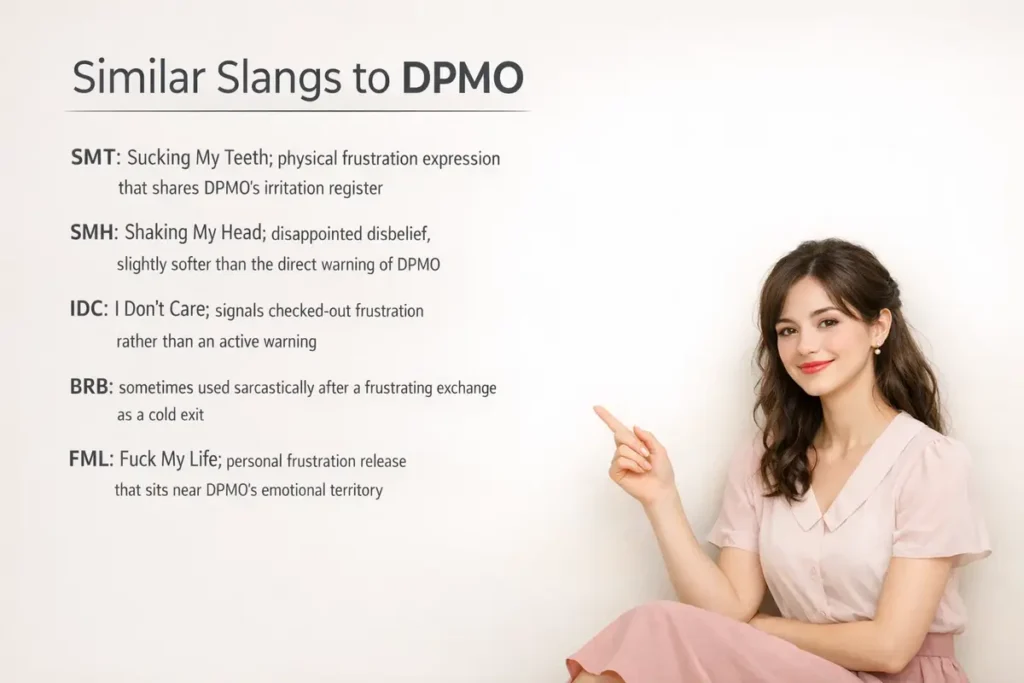
- SMT: Sucking My Teeth; physical frustration expression that shares DPMO’s irritation register
- SMH: Shaking My Head; disappointed disbelief, slightly softer than the direct warning of DPMO
- IDC: I Don’t Care; signals checked-out frustration rather than an active warning
- BRB: sometimes used sarcastically after a frustrating exchange as a cold exit
- FML: F*** My Life; personal frustration release that sits near DPMO’s emotional territory
- Leave me alone: Written-out version of the same boundary that DPMO sets in four letters
- TF: The heck; sharp, fast frustration signal that escalates beyond DPMO’s warning level
- Chill: Ironic directive used when someone wants to say they are close to their limit without stating it directly
How to Reply When Someone Sends You DPMO
If someone sends you DPMO and you were genuinely pushing too far, the cleanest response is a simple acknowledgment and a shift in behavior. “Okay okay, my bad” or “alright, pulling back” tells them you read the warning, you took it seriously, and you are adjusting without making it into a bigger conversation than the moment requires. Most people who send DPMO want the behavior to stop, not a lengthy apology.
If you received DPMO and genuinely did not realize you were crossing a line, a short honest reply opens the door to clarification. “Wait, did I actually annoy you or are you playing?” keeps things light if the relationship supports that, while “I did not mean to, what did I do?” handles it more seriously if the situation calls for it. Reading whether the DPMO was playful or genuine takes one look at the full conversation.
Conclusion
DPMO meaning in text is a four-letter warning that says everything it needs to say without a single extra word. It means someone has reached their limit and they want you to know it before things go further. Direct, clear, and impossible to misread when the context supports it.
Four letters. One clear warning. Act accordingly.
FAQs
“DPMO” usually means “Don’t Piss Me Off”. It is used to show irritation or a warning when someone is getting annoyed.
It is generally negative because it expresses frustration or anger. Sometimes it is said jokingly between friends, but the tone matters.
People use “DPMO” when someone is bothering them or pushing limits. It can be serious or playful depending on the situation.
On Instagram, “DPMO” has the same meaning “Don’t Piss Me Off”. It is often used in captions, comments, or DMs to show attitude or annoyance.
No, in texting “DPMO” does not mean “Defect Per Million Opportunities”. That meaning belongs to business or quality control, while in chats it means “Don’t Piss Me Off”.

GenZ Slang Writer & Internet Culture Expert Layla Brooks has spent 2+ years tracking how GenZ slang evolves across TikTok, Twitter, and everyday conversations. From decoding viral phrases to explaining what words actually mean in real life, Layla writes content that feels native to the culture, not forced. If a word is trending, Layla already knows what it means and why it matters.