IDM Meaning in Text
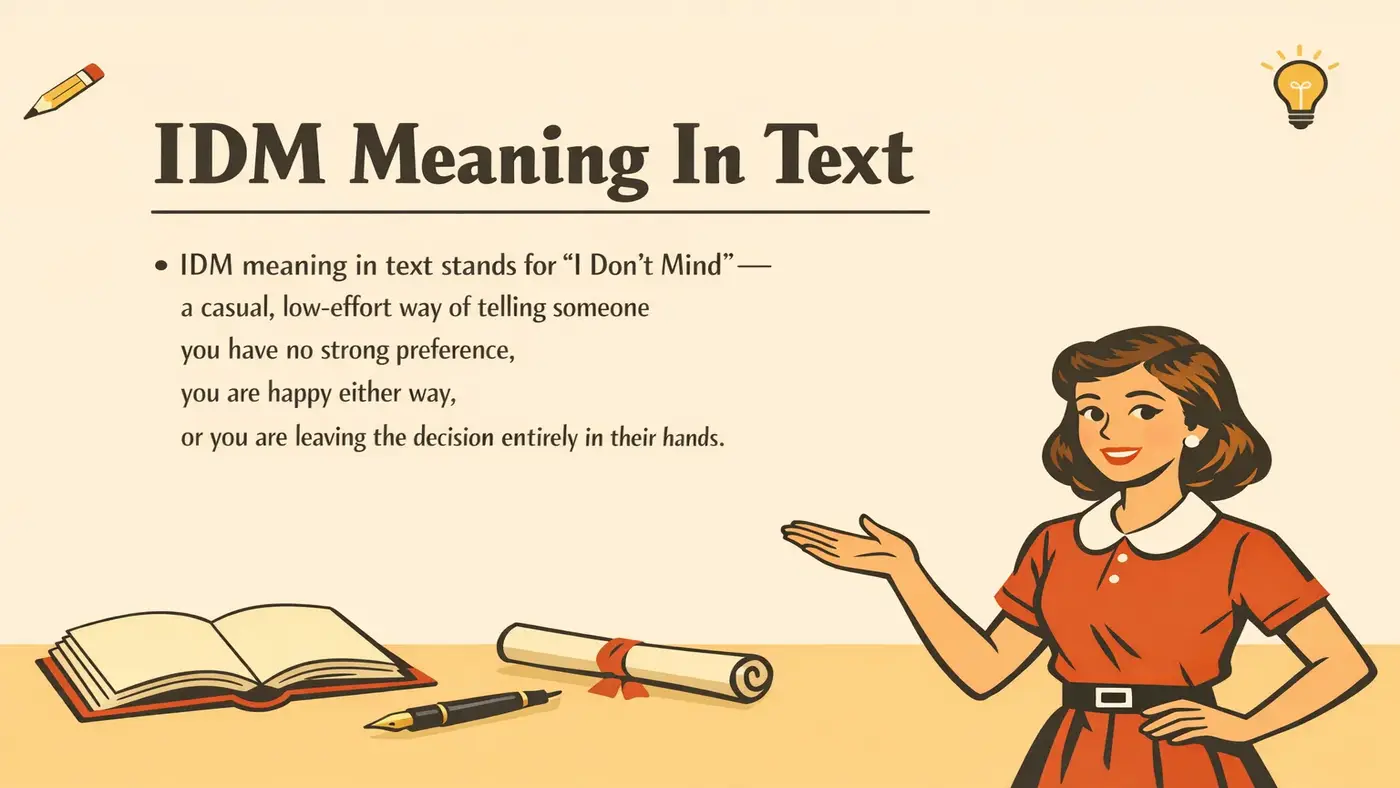
IDM meaning in text stands for “I Don’t Mind” — a casual, low-effort way of telling someone you have no strong preference, you are happy either way, or you are leaving the decision entirely in their hands. It closes debates before they start.
You will see it when someone asks where to eat, what to watch, or what time to meet. Three letters that say “whatever works for you works for me.” Efficient, relaxed, and completely unambiguous.
Origin and Cultural Footprints
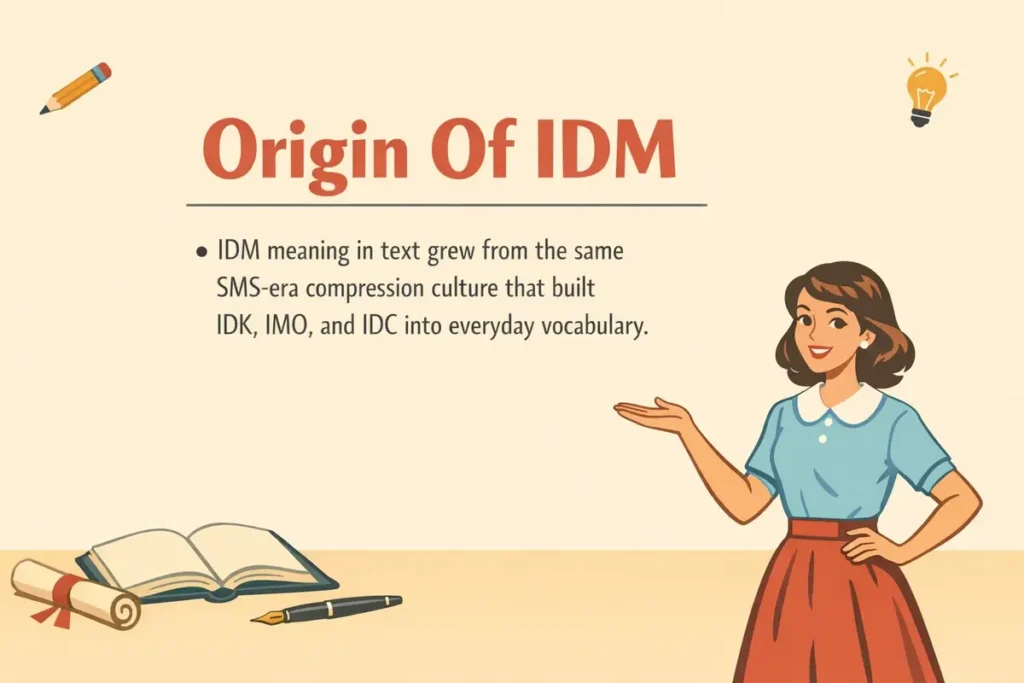
IDM meaning in text grew from the same SMS-era compression culture that built IDK, IMO, and IDC into everyday vocabulary. As mobile texting became the default mode of daily decision-making between friends, couples, and colleagues, people needed fast ways to signal their flexibility without writing a paragraph about it.
IDM filled that specific gap. It traveled through WhatsApp, iMessage, and Snapchat because it solved a problem every group chat faces constantly: someone has to say they have no preference before a decision can move forward. IDM became that someone in three keystrokes.
Other Definitions of IDM
Outside of casual texting, IDM carries a few distinct alternate meanings worth knowing:
- Intelligent Dance Music — A genre of electronic music characterized by complex rhythms, abstract sound design, and experimental structure. Artists like Aphex Twin and Autechre helped define IDM as a recognized genre label in music journalism, online music communities, and streaming platform categorization.
- Internet Direct Mail — Used in digital marketing and email campaign contexts to describe targeted electronic correspondence sent directly to a curated audience. Appears in marketing documentation, campaign reports, and business communication strategy discussions.
- Integrated Development Model — An organizational and project management framework used in software development and business planning contexts. Entirely institutional and professional in application.
Who Uses It Most?
IDM belongs to people who genuinely do not mind, or who want to signal flexibility as a social courtesy. The groups that reach for it most tend to value low-friction communication where decisions happen fast.
Here is a clear breakdown of which groups use IDM most and how it works for each:
| Group | How They Use IDM | Why It Works |
|---|---|---|
| Couples and close friends | Settling plans, locations, and timing disputes quickly | Removes decision deadlock without creating conflict |
| Gen Z | Casual indifference signals in group chats | Fits their low-effort, high-efficiency communication style |
| Remote workers | Informal Slack or Teams responses to scheduling questions | Keeps professional decisions moving without formal language |
| Teenagers | Responding to social plans and activity suggestions | Fast and familiar without requiring any explanation |
Usage of IDM in Different Contexts
In personal texting, IDM functions as a genuine green light wrapped in three letters. Someone asks which film to watch and the reply is IDM. That single response hands the decision over completely and signals that the sender is comfortable with any outcome. No negotiation needed. No hidden preference lurking behind the answer.
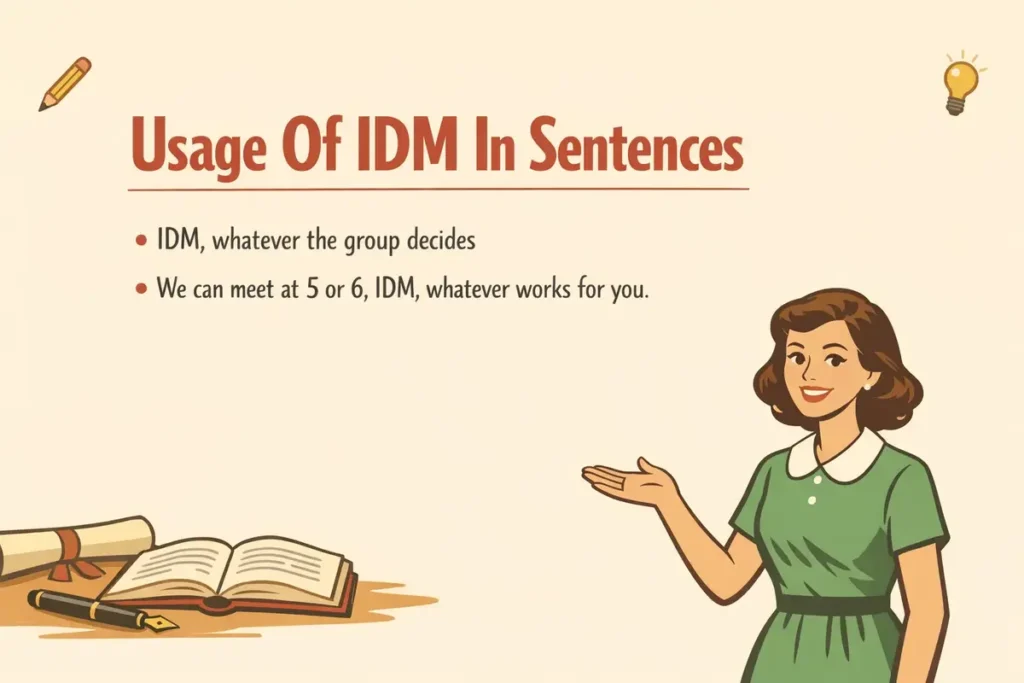
In group chat coordination, IDM serves a slightly different purpose. When multiple people need to agree on something and one person sends IDM, it reduces the decision pool by one and moves the group closer to a conclusion. “IDM, whatever the group decides” in a planning thread is a small but genuinely useful contribution that keeps things moving forward.
How Gen Z Uses IDM Today
Gen Z uses IDM with full awareness that it communicates more than just flexibility. Sending IDM in a conversation signals emotional ease, low-maintenance energy, and a deliberate choice not to add friction to a situation. In a generation that values chill as a social quality, IDM reads as a personality trait as much as a simple response.
The idm meaning in text also picks up ironic shading in Gen Z exchanges where someone says IDM but clearly does mind. Responding IDM to a suggestion you obviously have opinions about, then pivoting immediately to those opinions, is a well-recognized conversational pattern that Gen Z runs constantly and finds genuinely funny when timed right.
Does IDM Mean “I Don’t Care”?
This is the most common mix-up and it deserves a direct correction. IDM and IDC sit close to each other in meaning but land differently in tone. IDC means “I Don’t Care” and carries a harder, more dismissive edge. IDM means “I Don’t Mind” and reads as warmer, more accommodating, and socially softer.
Sending IDC when you mean IDM can make a genuinely flexible response sound cold or disinterested. The two letters make a real difference. IDM says you are easy to be around. IDC says you have checked out of the conversation. Knowing which one fits the moment keeps the communication exactly where you want it.
Meaning Across Social Media
| Platform | IDM Meaning | How It’s Used |
|---|---|---|
| I Don’t Mind | Group chat decision-making and personal plan coordination | |
| Snapchat | I Don’t Mind | Quick DM replies to activity or hangout suggestions |
| I Don’t Mind | DM responses to plans, timing, or preference questions | |
| Twitter / X | Intelligent Dance Music | Music community discussions, genre labeling, and artist categorization |
| Discord | I Don’t Mind | Server coordination and personal DM responses to activity suggestions |
| iMessage | I Don’t Mind | Standard casual reply in personal text decision conversations |
Common Confusions & Wrong Interpretations
- IDM confused with IDC — As covered above, these two carry meaningfully different tones. IDC dismisses. IDM accommodates. Swapping them sends the wrong social signal and can make a perfectly cooperative response sound unnecessarily cold.
- IDM confused with IDK — IDK means “I Don’t Know” and signals genuine uncertainty. IDM signals flexible preference, not lack of knowledge. Someone asking “what time works?” deserves IDM if you have no preference, not IDK if you actually do not have information about your own schedule.
- Intelligent Dance Music confusion in casual contexts — Music fans familiar with the IDM genre label might briefly double-take when they see it in a non-music conversation. Context resolves this immediately, but the potential for a split-second misread exists in ambiguous messages.
- IDM read as passive or disengaged — Some people interpret IDM as a lack of investment in the relationship or decision. Most of the time it signals genuine flexibility rather than disinterest. The tone of the broader conversation usually makes clear which reading applies.
Similar Terms, Alternatives & Related Slang
- IDC — I Don’t Care; similar meaning but harder and more dismissive in tone than IDM
- IDK — I Don’t Know; signals uncertainty rather than flexible preference
- Up to you — Written-out version of the same flexibility signal IDM carries
- Either works — Explicit confirmation that both options are acceptable, covers the same ground as IDM
- No preference — Direct statement of the same position without using an abbreviation
- Whatever you want — Warmer and more relationship-focused version of the same IDM sentiment
- Fine by me — Casual agreement with a slight positive lean, close to IDM in register
- Works for me — Confirms acceptance of a specific option rather than blanket flexibility
How to Reply When Someone Sends You IDM
If someone sends IDM in response to a question you asked, take the decision and make it. They handed it to you clearly. A quick “okay, going with X then” or “cool, let’s do Y” moves things forward without turning their flexibility into another round of back-and-forth. Most people who send IDM genuinely want you to just pick something.
If the IDM feels more passive than genuine and you suspect they actually have a preference, ask directly. “You sure? No preference at all?” gives them one more chance to say what they actually want without forcing anything. Some people default to IDM out of politeness rather than real indifference, and a gentle follow-up often brings out the honest answer.
Conclusion
IDM meaning in text is one of the cleanest social signals in casual communication. It means you have no strong preference, you trust the other person to decide, and you are happy with whatever lands. Short, warm, and genuinely useful.
Three letters that end a debate before it starts. That is IDM doing exactly what it was built for.
FAQs
IDM meaning in text stands for “I Don’t Mind” — a casual way of saying you have no preference and are happy either way.
Gen Z uses IDM to signal easy-going, low-drama energy in conversations. It basically means “your call, I am good either way.”
She genuinely has no preference and wants you to decide without overthinking it. Simple as that.
It signals flexibility and a relaxed attitude — she is easy to be around and not adding pressure to the decision.
On iMessage, IDM means “I Don’t Mind” — a quick way to hand over a decision and keep the conversation moving.

GenZ Slang Writer & Internet Culture Expert Layla Brooks has spent 2+ years tracking how GenZ slang evolves across TikTok, Twitter, and everyday conversations. From decoding viral phrases to explaining what words actually mean in real life, Layla writes content that feels native to the culture, not forced. If a word is trending, Layla already knows what it means and why it matters.