NSFW Meaning in Text: Who Uses It, and How to Reply
What Does NSFW Mean in Text?
NSFW meaning in text stands for “Not Safe For Work,” a content warning label people attach to links, images, videos, or messages that contain material inappropriate to open in a professional, public, or family-friendly environment. It is a heads-up before the content, not a description of it.
You will see it before links that lead somewhere explicit, videos that contain graphic content, and conversations that shift into territory better kept private. Four letters that give the recipient a choice before they click, open, or read further.
Origin and Cultural Footprints
NSFW meaning in text originated in early internet culture, specifically on forums, email chains, and workplace computer networks where people shared links without knowing what environment the recipient was in when they opened them. The abbreviation developed as a courtesy warning system that traveled ahead of potentially problematic content.
The label spread from email and forum culture into social media, Reddit, Twitter, and eventually everyday texting as platforms grew and content sharing became a central part of how people communicate. Reddit communities formalized NSFW as an official content tag in the mid-2000s, which gave the abbreviation institutional weight that helped cement it as a universally recognized standard across the entire internet.
Other Meanings of NSFW
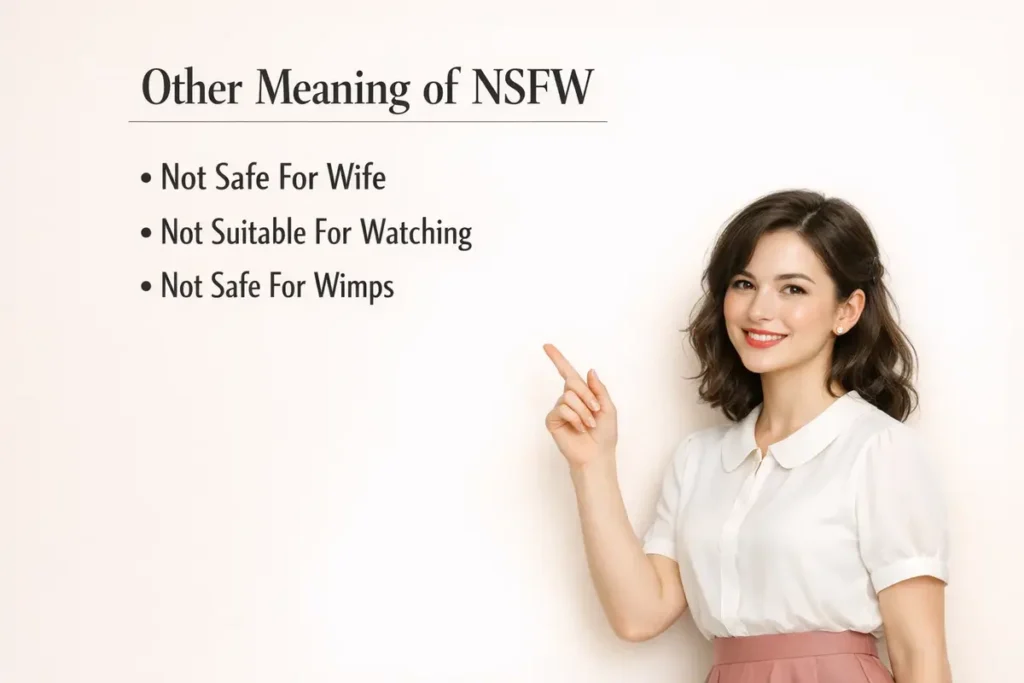
NSFW carries a few alternate meanings worth knowing in specific communities:
Why Does NSFW Have Multiple Meanings?
NSFW sits in a category where the original meaning dominates so completely that the alternate readings function as jokes or community-specific variations rather than genuine competing definitions. The “Not Safe For Work” reading covers the vast majority of real-world NSFW usage across every platform and demographic.
The variations exist because internet culture enjoys playing with established formats, and NSFW as a structure is familiar enough that swapping the last word becomes a recognizable comedic pattern. None of the variations create genuine confusion in context because the tone, platform, and surrounding message make clear whether someone is warning about explicit content or making a joke about it.
Who Uses It Most?
NSFW belongs to anyone who shares content online and wants to give their audience a fair warning before that content lands. The groups that reach for it most tend to be those who share links, images, and videos regularly across platforms with diverse audiences.
Here is a clear breakdown of which groups use NSFW most and how each group deploys it:
| Group | How They Use NSFW | Why It Works |
|---|---|---|
| Reddit users | Tagging posts and comments containing explicit or graphic content | Platform norms make NSFW tagging a standard community expectation |
| Content creators | Warning audiences before sharing mature or graphic material | Protects audience trust and platform standing simultaneously |
| Gen Z | Prefacing links and content shares in group chats | Fast, universally understood warning that requires zero explanation |
| Gaming communities | Flagging content with graphic violence or mature themes | Gaming content ranges widely in intensity and warnings prevent surprises |
Real Conversation Examples Using NSFW
- Warning before a graphic video link Context: A friend shares a link in a group chat that contains disturbing content. Sender: “NSFW but this documentary clip is genuinely shocking.” Reply: “Noted, opening this at home not at work.” How to respond: Watch the content when in an appropriate setting and respond to it properly.
- Flagging an explicit image before sending Context: Someone is about to send a photo that is not appropriate for all audiences. Sender: “NSFW incoming, do not open this at the office.” Reply: “Got it, saving for later.” How to respond: Acknowledge the warning and open the content when appropriate.
- Reddit post warning Context: A Reddit post gets tagged NSFW before readers can see the content. Sender: “Posted the clip but had to mark it NSFW because of the language.” Reply: “Makes sense, better safe than getting the account flagged.” How to respond: Confirm understanding of the platform requirement and move on.
- Warning in a professional adjacent context Context: A colleague shares something in a work-adjacent group chat. Sender: “This is hilarious but NSFW, read it when you are not at your desk.” Reply: “Bookmarking it for after hours.” How to respond: Appreciate the warning and follow through on reading it privately.
- Humorous NSFW variation Context: Two friends joking around in a personal chat. Sender: “NSFW for wimps, this horror clip is not for the faint-hearted.” Reply: “Challenge accepted, sending it to me.” How to respond: Watch it and report back on whether the warning was justified.
Usage of NSFW in Different Contexts
In personal messaging, NSFW functions as a courtesy that tells the recipient to choose their moment before opening something. Sending a link with NSFW attached gives the other person agency over when and where they encounter the content. That small act of consideration keeps trust intact in close relationships and prevents awkward situations in professional ones.
In online communities and social media, NSFW serves a more formal content moderation function. Platforms use it as a filter that hides content behind a confirmation screen, protecting users who have not opted into mature material from encountering it unexpectedly. That protective function makes NSFW one of the few slang abbreviations that platforms themselves have institutionalized as official policy.
How Gen Z Uses NSFW Today
Gen Z treats NSFW as a standard content label that carries both genuine warning function and comedic potential depending on the context. Using NSFW correctly before sharing something genuinely explicit signals digital responsibility and awareness of audience. That awareness reads as socially intelligent in online spaces where oversharing without warning is considered inconsiderate.
The nsfw meaning in text also gets ironic treatment in Gen Z communication where the label gets attached to something completely inoffensive for humorous effect. “NSFW but I just ate the best sandwich of my life” uses the content warning format to signal that the following information is extremely personal and important to the sender. The joke works because everyone knows what NSFW actually warns about.
Does NSFW Mean Illegal Content?
No. NSFW does not mean illegal content and treating it as a synonym for anything unlawful misrepresents what the label actually communicates. NSFW flags content that is inappropriate for certain contexts, particularly professional or public settings, not content that violates any law.
Legal adult content, graphic violence in journalism, strong language, and other mature but entirely legal material all fall under NSFW. The label is about audience and context appropriateness, not legality. Content that is actually illegal does not get an NSFW tag. It gets removed. Understanding that distinction matters because conflating the two creates unnecessary alarm around content that is simply mature rather than unlawful.
Meaning Across Social Media
| Platform | NSFW Meaning | How It’s Used |
|---|---|---|
| Not Safe For Work | Official content tag that hides posts behind a confirmation screen | |
| Twitter / X | Not Safe For Work | Content warning label on tweets containing explicit or sensitive material |
| Tumblr | Not Safe For Work | Post tags for mature content in communities with mixed-age audiences |
| Discord | Not Safe For Work | Channel designation that restricts access to users who have enabled adult content |
| Telegram | Not Safe For Work | Warning label attached to links and media in group and personal chats |
| TikTok | Not Safe For Work | Comment and caption warning before directing viewers to content on other platforms |
Common Confusions and Wrong Interpretations
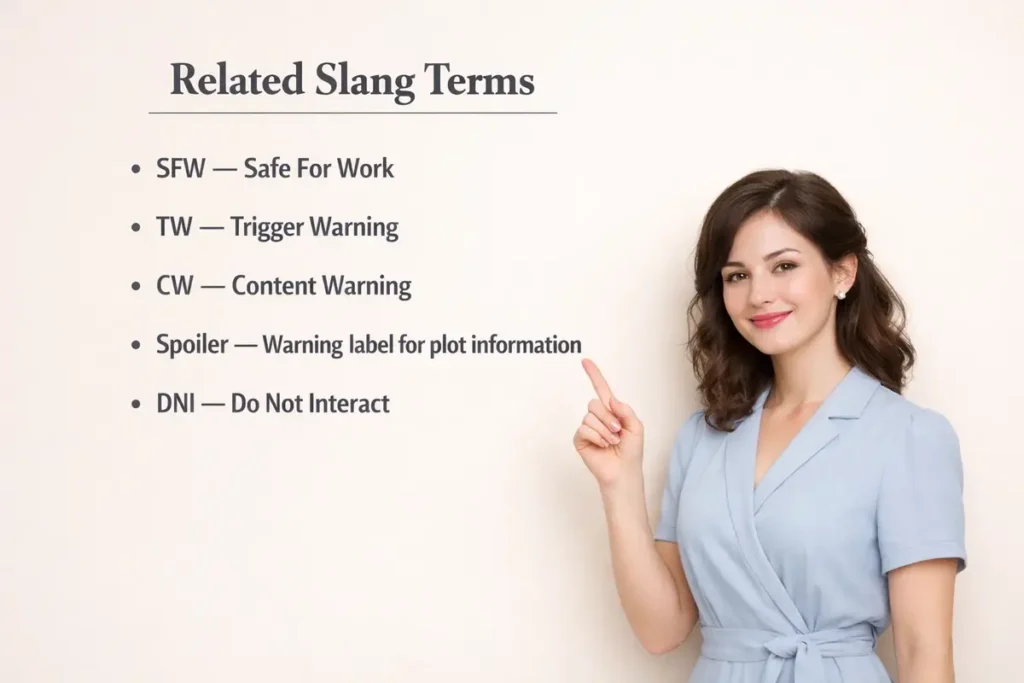
Related Slang Terms
How to Reply When Someone Says NSFW
If someone sends you an NSFW warning before sharing content, acknowledge it and open the material when you are actually in an appropriate setting. A quick “noted, opening later” tells them the warning registered and removes any pressure to respond immediately. Most people who attach NSFW to content appreciate knowing the recipient will engage with it properly rather than opening it in the wrong environment.
If the NSFW content turns out to be more graphic or disturbing than expected, a simple honest reaction works better than pretending otherwise. “That was more intense than I expected, appreciate the heads-up though” gives the sender genuine feedback without making it dramatic. NSFW is a warning, not a guarantee about exactly what level of intensity to expect, and calibrating expectations after the fact keeps communication honest.
Conclusion
NSFW meaning in text is a four-letter content warning that gives recipients agency over when and where they encounter material that does not belong in every setting. It started as an email courtesy, became a platform standard, and now functions as a universally understood communication tool across every online space. Simple, practical, and impossible to misread when used correctly.
Four letters. One clear warning. Always better sent than left out.
FAQs
NSFW means “Not Safe For Work”, a warning that content is inappropriate to open in public or professional settings.
Not always. NSFW covers graphic violence and strong language too, not just explicit content.
Only if they have clearly consented to receiving it. Always warn first, never assume.
A content label platforms use to hide mature material behind a confirmation screen before users can view it.
Any material inappropriate for public or professional viewing, including explicit images, graphic violence, or strong language.

GenZ Slang Writer & Internet Culture Expert Layla Brooks has spent 2+ years tracking how GenZ slang evolves across TikTok, Twitter, and everyday conversations. From decoding viral phrases to explaining what words actually mean in real life, Layla writes content that feels native to the culture, not forced. If a word is trending, Layla already knows what it means and why it matters.