SM Meaning in Text: Origin, Doubts, And How GenZ Use It
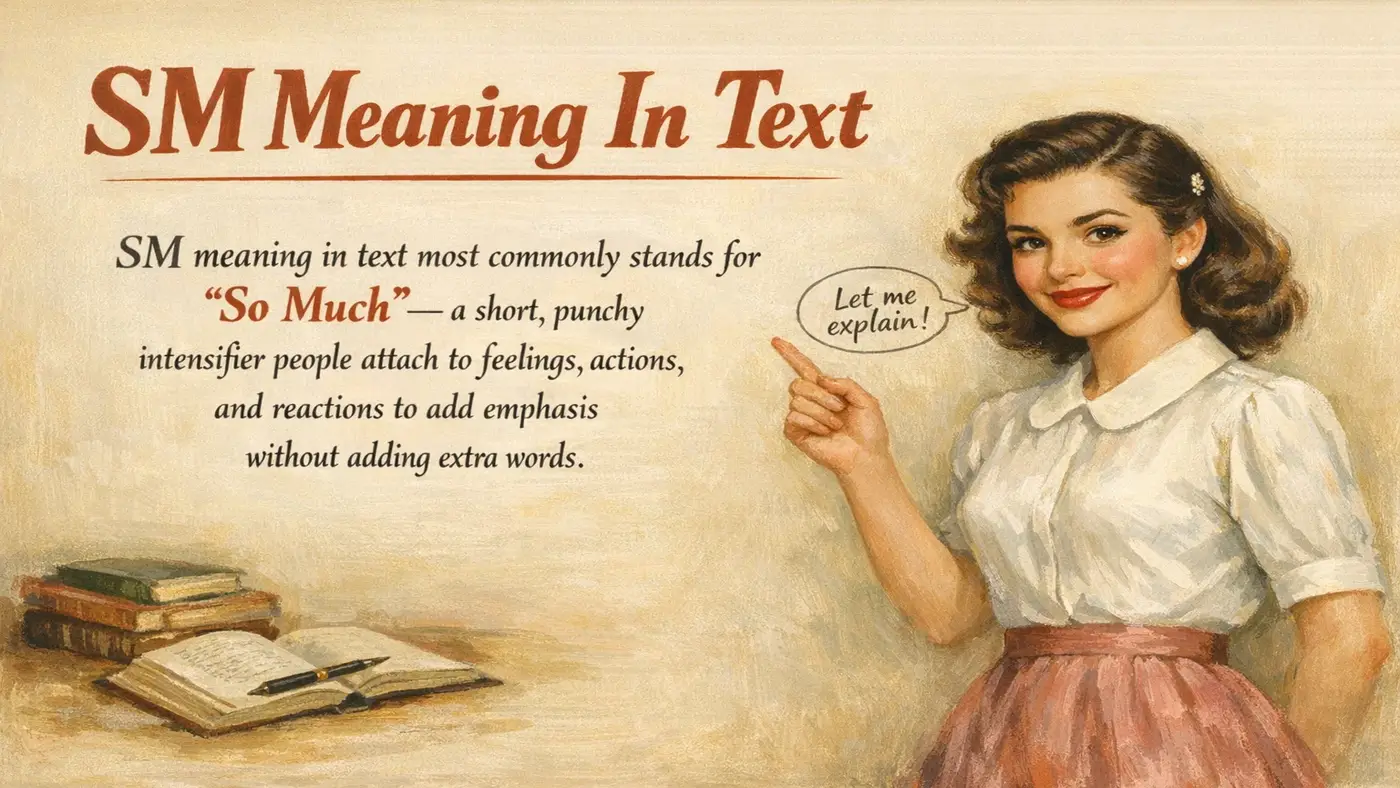
SM meaning in text most commonly stands for “So Much” — a short, punchy intensifier people attach to feelings, actions, and reactions to add emphasis without adding extra words. It turns “I like this” into “I like this sm” and the difference lands immediately.
You will also see it used as shorthand for “social media” depending on the context. Same two letters, completely different conversations. The surrounding message tells you which one arrived in your chat within seconds.
Origin and Cultural Footprints
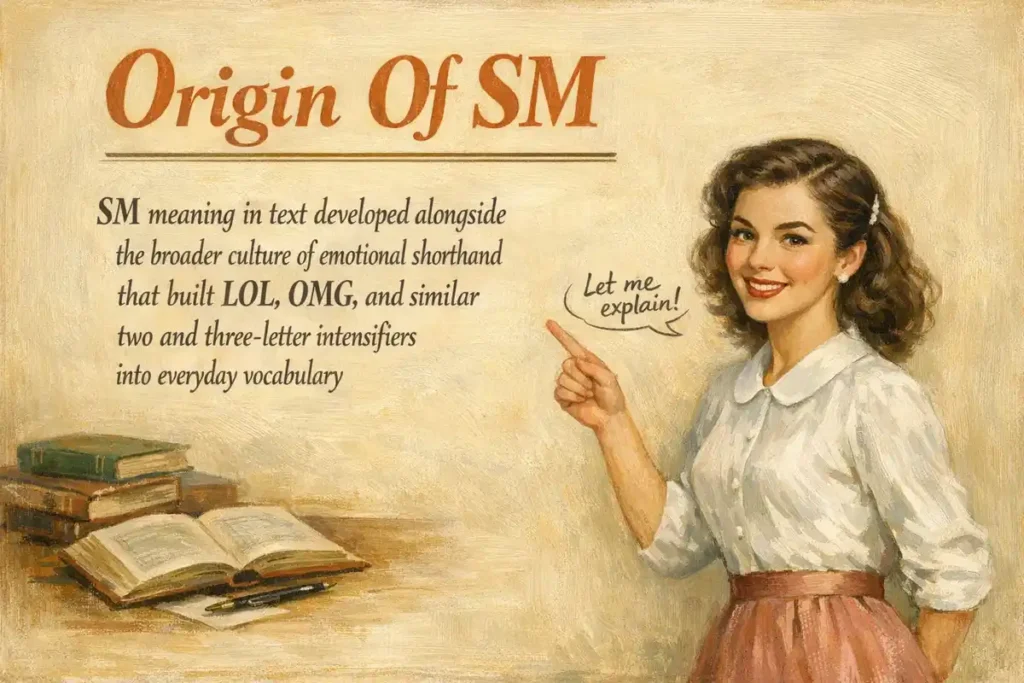
SM meaning in text developed alongside the broader culture of emotional shorthand that built LOL, OMG, and similar two and three-letter intensifiers into everyday vocabulary. As texting replaced phone calls for emotional communication, people needed faster ways to express the intensity of what they felt without typing full sentences about it.
“So much” became SM the same way “as hell” became ASL and “by the way” became BTW. The compression served a real communicative need, and it stuck. SM spread through Twitter, Tumblr, and Instagram caption culture in the early 2010s before landing firmly in everyday group chat and DM vocabulary across every platform that followed.
Other Definitions of SM
SM carries a few distinct alternate meanings depending on where you encounter it:
- Social Media — The most widely recognized alternate meaning. SM as an abbreviation for social media appears in marketing discussions, business strategy conversations, journalism, and academic writing. Anyone working in content creation, digital marketing, or brand management uses SM in this context constantly.
- Stage Manager — In theater, film production, and live event management, SM refers to the stage manager who coordinates all technical and performance elements of a production. Specific, professional, and immediately clear in any entertainment industry context.
- Sadism and Masochism — An adult-content abbreviation that appears in specific online communities and discussions. Entirely context-dependent and never the default reading in casual everyday texting.
Who Uses It Most?
SM as “So Much” belongs to people who communicate with emotional intensity and want a fast way to express it. The groups that reach for it most tend to be those whose conversations already run high in warmth, enthusiasm, or affection.
Here is a clear breakdown of which groups use SM most and what drives each group toward it:
| Group | How They Use SM | Why It Works |
|---|---|---|
| Gen Z | Intensifying feelings in DMs and captions | Punchy, fast, and expressive without extra words |
| Teenagers | Expressing excitement or affection in personal texts | Familiar and low-effort for high-emotion moments |
| Content creators | Engaging followers with warm, enthusiastic replies | Signals genuine feeling without sounding scripted |
| K-pop and fan communities | Reacting to releases, edits, and fandom moments | High-emotion spaces where SM lands naturally and constantly |
Usage of SM in Different Contexts
In personal texting, SM functions as an emotional amplifier that makes a simple statement hit harder. Telling a friend “I missed you sm” after time apart carries the full weight of genuine feeling in four words. The SM does not just add emphasis — it tells the other person the feeling was significant enough to deserve more than a plain statement.
In social media captions and comment sections, SM gets paired with reactions to content that genuinely moved someone. A creator posts something vulnerable and the top comment is “this hit sm.” That two-letter addition transforms a standard positive reaction into something that reads as personal and felt. The SM makes the engagement feel real rather than automated.
How Gen Z Uses SM Today
Gen Z treats SM as a standard emotional qualifier that slots into almost any sentence naturally. “I love this sm,” “I needed this sm,” “this annoyed me sm” — the intensifier works across positive, negative, and neutral emotional registers without changing form. That flexibility is exactly what keeps it useful across wildly different conversational moments.
The sm meaning in text also picks up ironic usage in Gen Z spaces where the intensity gets applied to something completely mundane. “I love my coffee sm today” after a particularly good cup uses the intensifier for gentle humor. The gap between the weight of “so much” and the triviality of the subject creates a small, recognizable comedic beat that Gen Z runs constantly and finds genuinely charming.
Does SM Meaning in text “Shaking My Head”?
No. SMH means “Shaking My Head” — SM and SMH are different abbreviations that serve completely different functions. SMH expresses disappointment or disbelief. SM intensifies a feeling or labels social media. Confusing them produces responses that make no sense to the sender.
The mix-up happens because both start with S and M and both appear frequently in casual texting. Reading carefully rather than scanning quickly separates them every time. If the SM appears mid-sentence after an emotion or reaction, it means “so much.” If it stands alone or follows a disappointing observation, you might be looking at a typo of SMH rather than SM on its own.
Meaning Across Social Media
| Platform | SM Meaning | How It’s Used |
|---|---|---|
| So Much or Social Media | Caption intensifiers and comment reactions; marketing discussions in bio and story content | |
| Twitter / X | So Much or Social Media | Tweet reactions and fan posts; industry discussions about platform strategy |
| Snapchat | So Much | Personal DM emotional intensifier between close contacts |
| TikTok | So Much | Comment reactions to emotional or relatable content from creators |
| So Much | Personal message emotional emphasis in close friendship and relationship chats | |
| Discord | So Much or Social Media | Community reactions in servers; marketing channel discussions in professional servers |
Common Confusions & Wrong Interpretations
- SM confused with SMH — SMH means “Shaking My Head” and expresses a specific reaction. SM intensifies or abbreviates. Swapping them produces a response that confuses the sender immediately and derails the conversation.
- So Much versus Social Media in mixed contexts — Someone who works in marketing and receives SM in a personal message might briefly process both meanings. A warm personal message using SM has nothing to do with brand strategy. Context resolves the ambiguity within one second of reading the surrounding text.
- SM read as aggressive or sarcastic when sincere — “This bothered me sm” reads as genuine frustration to most people. Some recipients interpret any intensity as sarcasm, especially in text form where vocal tone does not exist. The broader conversation almost always clarifies whether the emotion behind SM is real or ironic.
- SM confused with S/M in adult content spaces — In most everyday texting environments, SM never carries this reading. Platform, relationship, and conversational context make the correct interpretation obvious immediately. This misread almost exclusively happens when someone pulls the abbreviation out of all context entirely.
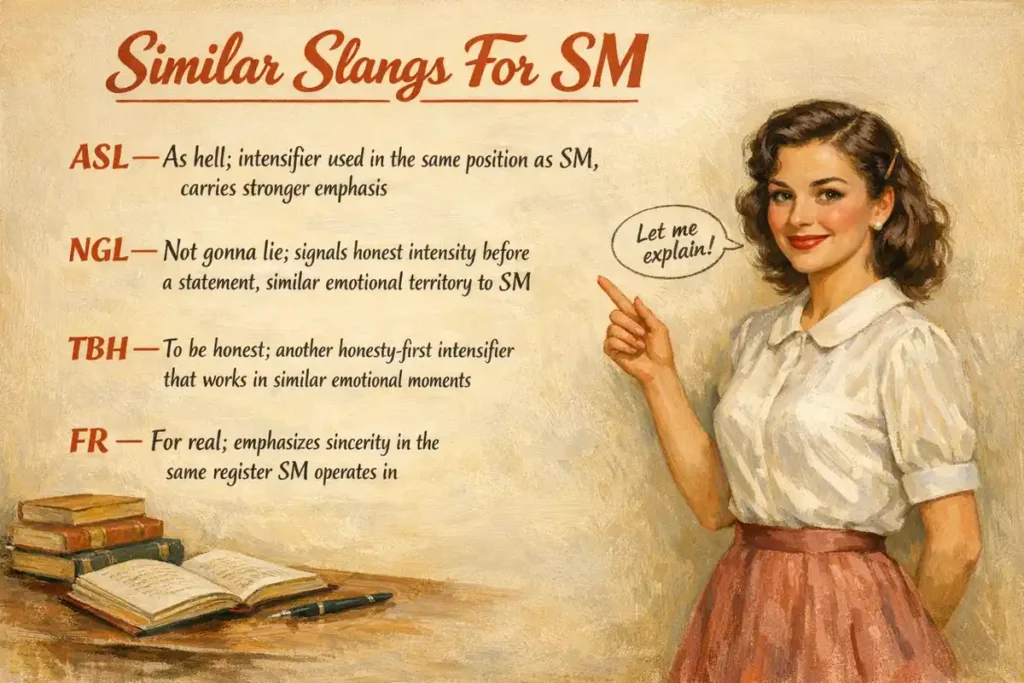
Similar Terms, Alternatives & Related Slang
- ASL — As hell; intensifier used in the same position as SM, carries stronger emphasis
- NGL — Not gonna lie; signals honest intensity before a statement, similar emotional territory to SM
- TBH — To be honest; another honesty-first intensifier that works in similar emotional moments
- FR — For real; emphasizes sincerity in the same register SM operates in
- Lowkey — Understated intensifier; the quieter opposite of SM in emotional emphasis
- Highkey — Openly enthusiastic intensifier; more committed than SM and less subtle
- RN — Right now; urgency marker that sometimes pairs with SM to add time pressure to a feeling
- Dead — Gen Z reaction word for something funny or overwhelming; similar emotional intensity to SM
How to Reply When Someone Says SM
If someone tells you they love, miss, or appreciate you sm, match the warmth without overthinking it. “Same, genuinely” or “I needed to hear that sm too” reflects the feeling back at the same register they set. Most people who send SM in an affectionate context want the emotion acknowledged, not analyzed.
If SM shows up in a frustration or complaint context — “this stressed me sm” or “I needed that sm” after something went wrong — the best response acknowledges the feeling before anything else. “That makes total sense, what happened?” or “sounds like a rough one, talk to me” opens the conversation rather than jumping straight to solutions. SM signals the feeling was strong. Responding to the feeling first is always the right move.
Conclusion
SM meaning in text is two letters doing the work of two words with none of the extra typing. It means “so much” and it means it with full sincerity every time someone reaches for it in a genuine moment. Small word. Big emotional range.
Two letters that always land when the feeling behind them is real.
FAQs
What does “sm” mean in text?
“SM” usually means “So Much”. People use it to add emphasis, like saying they like something a lot or miss someone a lot.
In slang, “SM” most often stands for “So Much”. Depending on context, it can also mean “Social Media”, but texting conversations usually lean toward “So Much”.
In a relationship, “SM” typically means “So Much”, like in “I love you SM”. It is just a short, sweet way to express strong feelings.
Among Gen Z, “SM” still mainly means “So Much”. It fits their fast texting style where shorter words keep conversations quick and casual.
For girls, “SM” does not have a separate meaning. It still usually means “So Much”, used the same way anyone would use it in chats or texts.

GenZ Slang Writer & Internet Culture Expert Layla Brooks has spent 2+ years tracking how GenZ slang evolves across TikTok, Twitter, and everyday conversations. From decoding viral phrases to explaining what words actually mean in real life, Layla writes content that feels native to the culture, not forced. If a word is trending, Layla already knows what it means and why it matters.