ASL Meaning in Text: Origin, Common Confusions And Usage
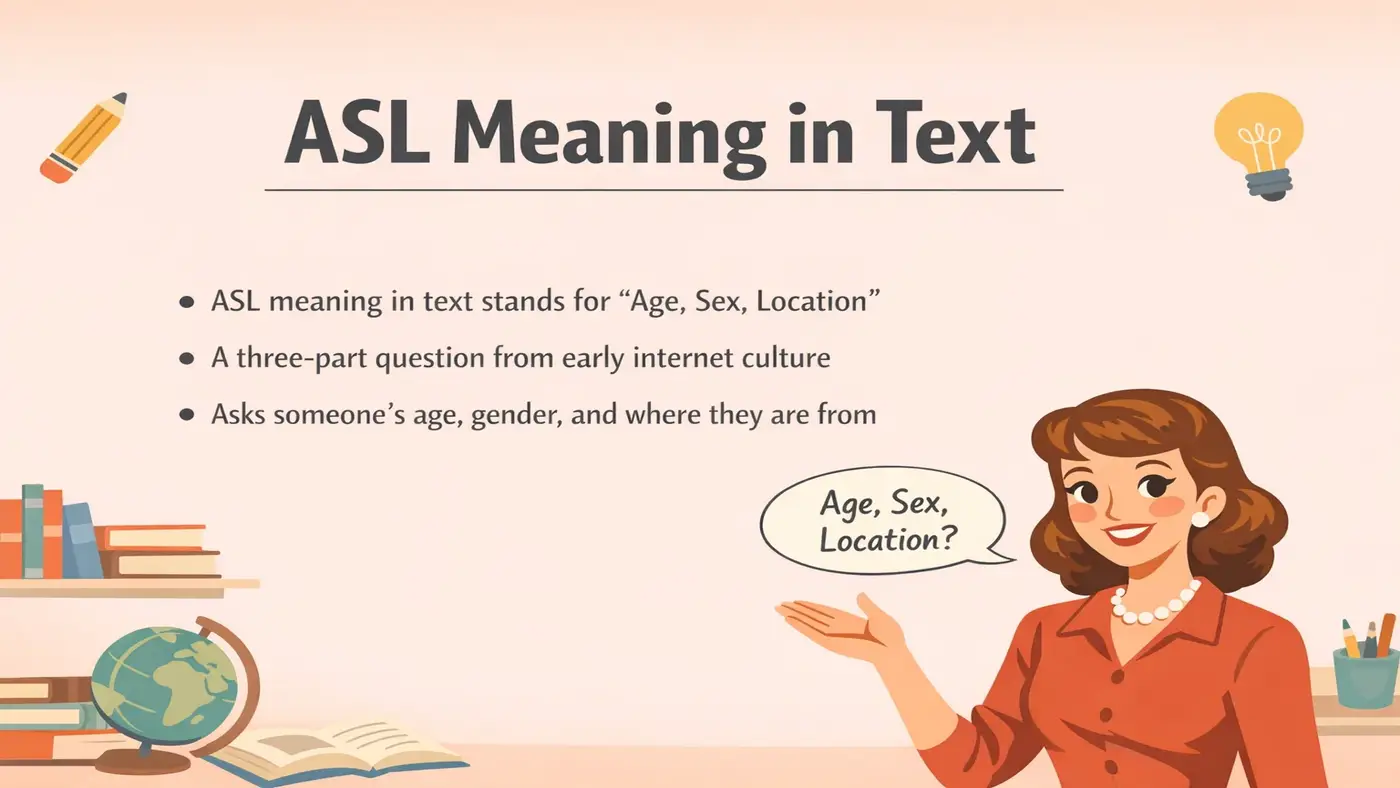
ASL meaning in text stands for “Age, Sex, Location” — a three-part question that became one of the most recognizable phrases of early internet culture, asking someone their age, gender, and where they are from in a single, quick abbreviation. It packs three personal questions into three letters.
You will still see it today, though it lands differently depending on who sends it and where. In some contexts it reads as a nostalgic internet callback. In others it reads as a genuine opener. And in a few spaces it signals something more specific about the person asking.
Origin and Cultural Footprints
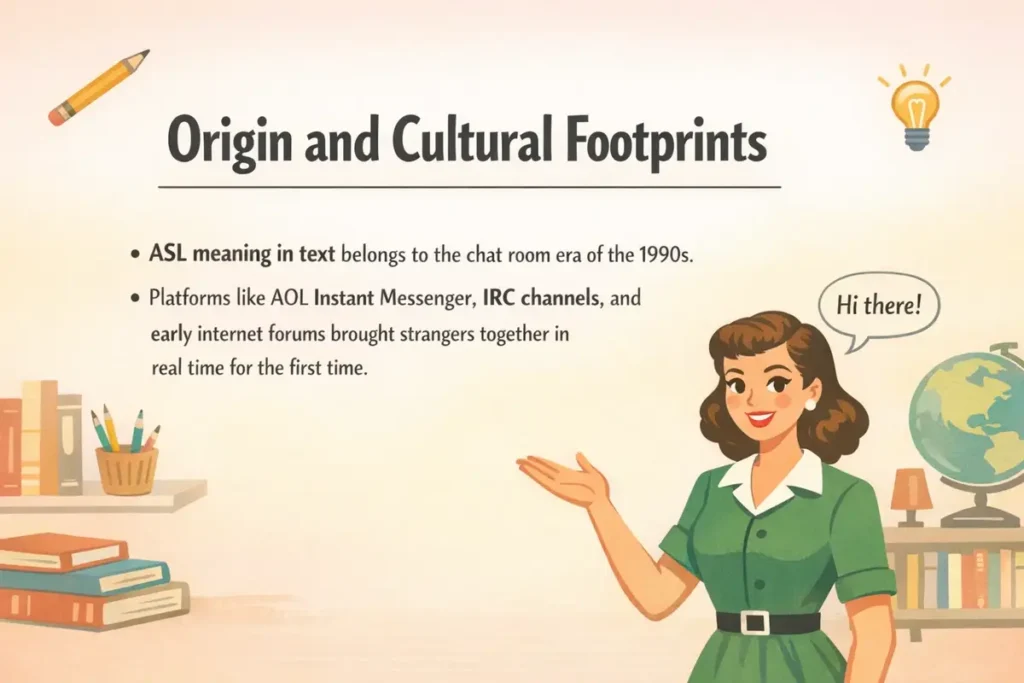
ASL meaning in text belongs to the chat room era of the 1990s, where platforms like AOL Instant Messenger, IRC channels, and early internet forums brought strangers together in real time for the first time. Nobody had profile pages. Nobody had bios. The fastest way to establish basic context about the person you were talking to was to ask ASL, and the question became so universal that it practically defined that era of online interaction.
The phrase carried through every platform shift that followed. MSN Messenger, early social networks, and eventually mobile texting all inherited ASL as part of the internet’s shared vocabulary. By the time TikTok revived it ironically in the early 2020s, an entire generation too young to remember AOL chat rooms encountered the phrase as a retro reference rather than a practical question. That revival gave it a second cultural life with a completely different emotional register attached to it.
Other Definitions of ASL
Outside of text slang, ASL carries a few important alternate meanings that exist in completely separate contexts:
- American Sign Language — The most significant alternate meaning. ASL refers to the visual language used by the Deaf community and people with hearing loss in the United States and Canada. This meaning predates the internet slang version entirely and carries far more institutional weight in academic, medical, and accessibility contexts.
- Age, Sex, Location (alternate order) — Some users expand the letters slightly differently, placing sex before location or age last, but all variations point to the same three-part personal question. The core meaning stays consistent regardless of which order someone mentally assigns the letters.
- Accelerated Service Learning — An educational abbreviation used in academic and nonprofit program documentation. Specific, institutional, and entirely disconnected from any casual text usage.
Who Uses It Most?
ASL today sits at an interesting crossroads between genuine use and nostalgic irony. The people who use it fall into distinct camps, and understanding which camp someone belongs to tells you a lot about how to read the question.
Here is a clear breakdown of which groups reach for ASL and what drives each group toward it:
| Group | How They Use ASL | Why It Works |
|---|---|---|
| Millennials | Nostalgic reference to early internet culture | Recognizing it signals shared generational memory |
| Gen Z | Ironic opener or retro callback in DMs and comments | Using old internet language self-awarely signals cultural fluency |
| Online gaming communities | Quick shorthand to establish basic context with new players | Efficient way to know who you are playing with |
| Anonymous chat platform users | Genuine opener on platforms like Omegle or random chat apps | Still functions as a practical first question in faceless conversations |
| TikTok creators and commenters | Ironic use in content referencing early internet aesthetics | Plays into nostalgia content that performs well with broad audiences |
| Dating app users (occasionally) | Quick shorthand when profiles lack basic information | Rare but still surfaces in less profile-heavy messaging contexts |
Usage of ASL in Different Contexts
In anonymous online spaces where people connect without prior context, ASL still functions as a practical first question. Someone entering a random chat platform or joining a new gaming server with no profile information attached sends ASL because it gets three pieces of useful context in one message. The efficiency that made it popular in 1997 still holds in any context where two strangers start talking without a profile to reference.
In social media and modern texting between younger users, ASL carries an entirely different weight. A Gen Z user sending “asl?” in a TikTok comment or a DM uses it as a self-aware nod to older internet culture rather than a genuine request for demographic information. The person asking already knows it sounds dated and uses that datedness deliberately as a personality signal. That distinction between sincere and ironic use changes the entire conversational dynamic the question creates.
How Gen Z Uses ASL Today
Gen Z picked up ASL from the same wave of early internet nostalgia that brought back MySpace aesthetics, Y2K fashion, and flip phone culture. Using ASL unironically would read as out of touch. Using it with full awareness of how old it sounds turns it into a comedic or affectionate callback. That gap between sincerity and self-awareness is exactly where Gen Z operates most comfortably in language.
The asl meaning in text also gets stretched in Gen Z usage to function as a general “tell me about yourself” prompt rather than a literal three-part question. Sending “asl lol” to someone new in a DM reads more like “who even are you?” than a genuine request for age, gender, and location. The literal meaning fades into the background. The social signal that someone knows their internet history and finds it funny takes over. That shift from functional to cultural is how most vintage slang survives into new generations.
Does ASL Mean American Sign Language?
Yes, and that meaning carries more institutional importance than the text slang version. American Sign Language is a complete, rule-governed visual language serving millions of people, and the abbreviation ASL belongs to that community in any formal, educational, medical, or accessibility context. Confusing the two meanings in the wrong setting causes real problems.
The practical rule is simple: platform and context separate the two every time. ASL appearing in a group chat at midnight after someone new joins a conversation means Age, Sex, Location. ASL appearing in an educational document, a healthcare setting, or a Deaf community space means American Sign Language. Nobody in a late-night Discord server is asking about your signing ability. Nobody in a linguistics classroom is asking your age. Context does all the work and it does it cleanly.
Meaning Across Social Media
| Platform | ASL Meaning | How It’s Used |
|---|---|---|
| TikTok | Age, Sex, Location (ironic) | Retro internet callback in comments and DMs, nostalgia content |
| Twitter / X | Age, Sex, Location or American Sign Language | Context-dependent; slang in casual replies, formal meaning in advocacy content |
| Snapchat | Age, Sex, Location | Genuine opener in new conversations with unfamiliar contacts |
| Discord | Age, Sex, Location | New member introductions in servers where profiles lack personal detail |
| Age, Sex, Location (ironic or genuine) | DM openers, occasionally ironic in comments under nostalgia posts | |
| Omegle and random chat platforms | Age, Sex, Location (genuine) | Still functions as the standard first question in anonymous chat environments |
| American Sign Language or Age, Sex, Location | Depends entirely on the subreddit context |
Common Confusions & Wrong Interpretations
- ASL confused with American Sign Language in casual contexts — Sending ASL to someone who works in Deaf education or accessibility advocacy and meaning the text slang version creates an immediate and avoidable misunderstanding. Knowing the audience matters more with this abbreviation than with most.
- ASL read as intrusive or inappropriate — In modern contexts outside of anonymous chat platforms, asking someone their age, sex, and location upfront reads as overly personal to some recipients. What felt like a standard opener in 1999 carries different social weight in a 2024 DM conversation between people who already have profile information available.
- ASL mistaken for a newer abbreviation — Younger users who encounter ASL for the first time sometimes try to decode it as a modern acronym rather than recognizing it as vintage internet slang. This produces creative but incorrect interpretations that miss the original meaning entirely.
- Using ASL seriously when the context calls for irony — Sending ASL as a genuine question in a space where everyone reads it as a nostalgic joke makes the sender look out of sync with the room. And sending it ironically in a space where someone needs genuine information creates the same mismatch in the other direction.
Similar Terms, Alternatives & Related Slang
- Wyll — What You Look Like; the modern visual equivalent of part of what ASL asks
- WYO — What You On; checks availability rather than identity, but similar casual opener energy
- HMU — Hit Me Up; invites contact without asking for personal information upfront
- NGL — Not Gonna Lie; shares ASL’s directness in a completely different application
- DTF — Down To (something); shares ASL’s roots in early internet flirtation culture
- Intro — Casual request for a self-introduction; modern replacement for ASL in some spaces
- Sup — Casual greeting that opens conversation without demanding any information
- IYKYK — If You Know You Know; another abbreviation that rewards internet cultural literacy
How to Reply When Someone Sends You ASL
If the question reads as genuine and the conversation context makes it appropriate, a short direct answer keeps things moving. Replying with your age, a gender identifier you are comfortable sharing, and a general location like a city or country name answers the question without oversharing. Keep it at the same casual register the sender set and let the conversation find its own direction from there.
If the ASL reads more ironic or nostalgic than genuine, matching the energy works better than answering literally. “omg are we in an AOL chat right now” or “lol haven’t seen that since 2006” acknowledges the reference, signals that you get it, and turns the opener into a shared moment rather than a data exchange. That response tells the sender you speak the same internet language, which was probably the point of sending ASL in the first place.
Conclusion
ASL meaning in text carries two lives at once: a practical question from the internet’s earliest social spaces and a cultural reference that younger generations rediscovered with affectionate irony. Both versions of the word reward knowing exactly which one you are dealing with. Read the room and the answer becomes obvious.
Three letters. Thirty years of history. Still showing up in conversations today.
FAQs
Here ASL works as an intensifier meaning “as hell,” so “pretty asl” means extremely or very pretty. It is a Gen Z way of adding emphasis without writing out the full phrase.
Gen Z uses ASL in two ways: as a retro callback to old internet chat culture, and as an intensifier meaning “as hell” in phrases like “tired asl” or “funny asl.” Context tells you which one they mean instantly.
This one uses ASL as “as hell,” so the person is saying they are extremely tired. It is a casual, punchy way to express exhaustion without typing out the full words.
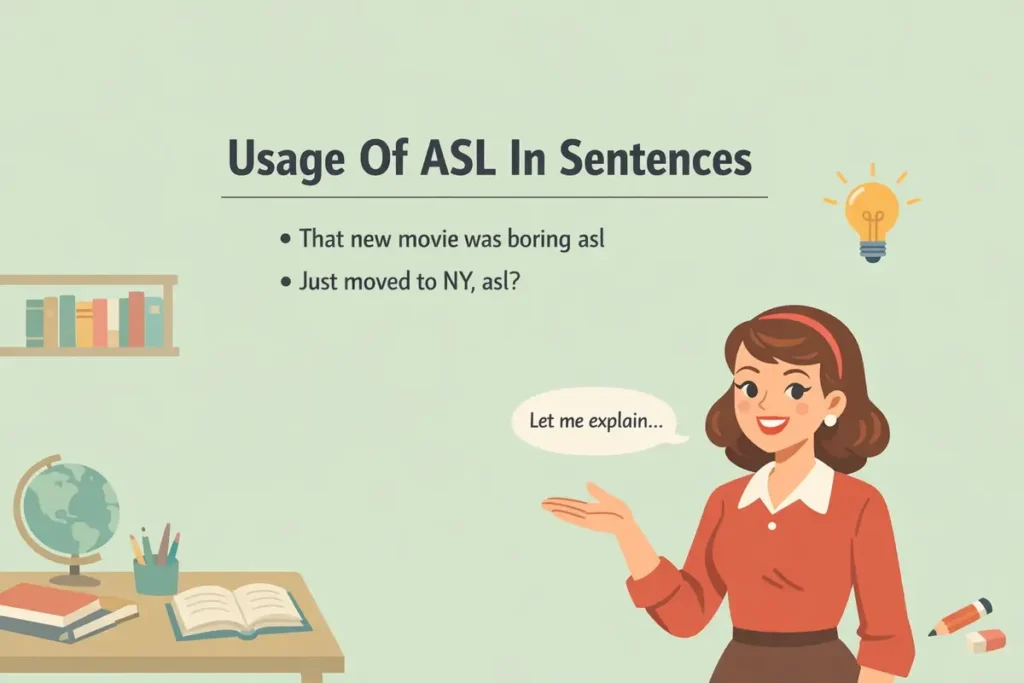
“Boring asl” means something is incredibly boring, with ASL acting as an intensifier meaning “as hell.” People drop it in captions, texts, and comments to dramatize how dull something feels.
ASL carries two slang meanings: the classic “Age, Sex, Location” from early internet chat culture, and the newer intensifier use meaning “as hell.” Which meaning applies depends entirely on how it appears in the sentence.

GenZ Slang Writer & Internet Culture Expert Layla Brooks has spent 2+ years tracking how GenZ slang evolves across TikTok, Twitter, and everyday conversations. From decoding viral phrases to explaining what words actually mean in real life, Layla writes content that feels native to the culture, not forced. If a word is trending, Layla already knows what it means and why it matters.