TMP Meaning in Text: Best Slang To Ask Secret
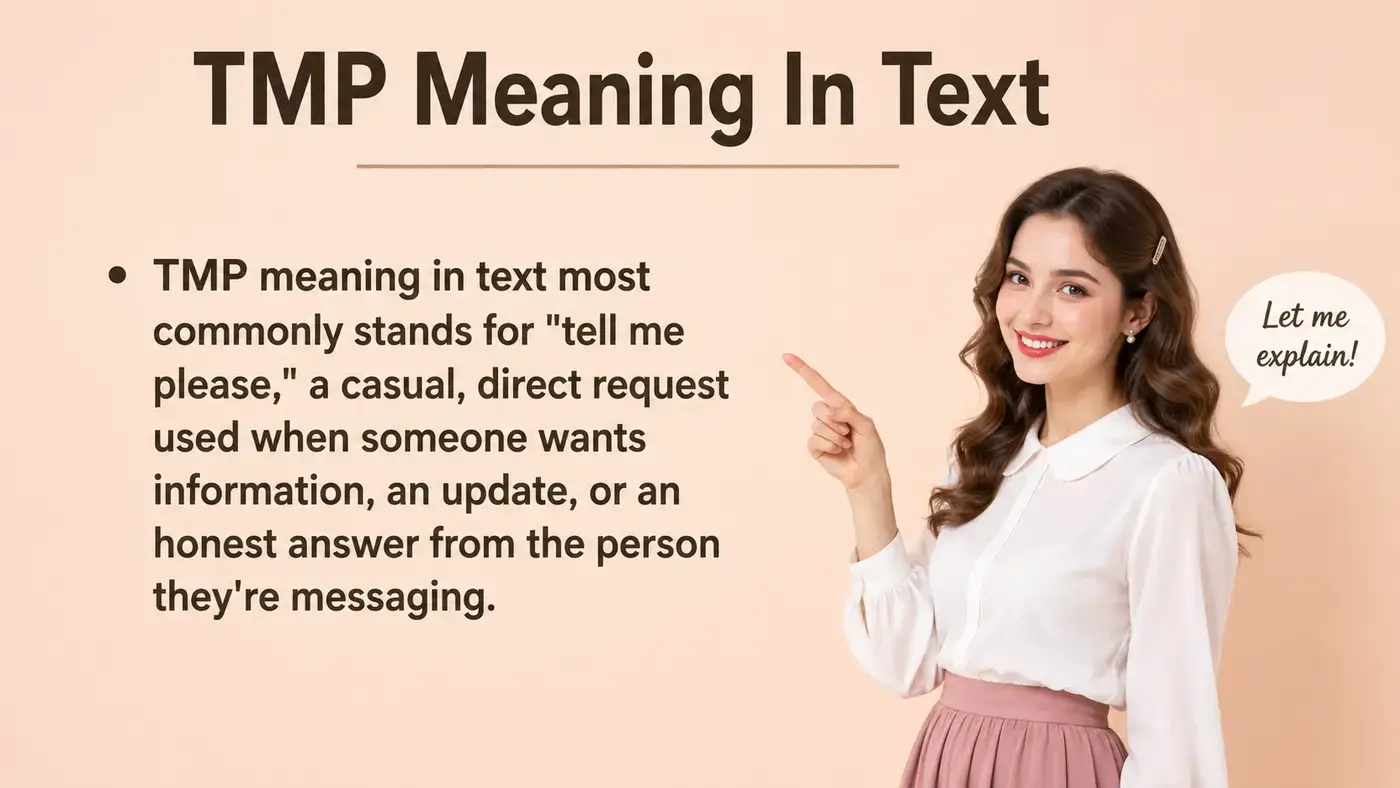
TMP meaning in text most commonly stands for “tell me please,” a casual, direct request used when someone wants information, an update, or an honest answer from the person they’re messaging.
It’s short. Slightly urgent. And it carries just enough warmth to not feel demanding while still making clear that you actually want a real response.
Origin and Cultural Footprints
TMP meaning in text grew out of the same wave of request-based abbreviations that produced HMU, LMK, and similar shorthand from early 2000s SMS and instant messaging culture.
As texting replaced phone calls for most everyday communication, people needed faster ways to ask for information without writing full sentences every time.
By the mid-2010s TMP had started circulating in personal texts and group chats, picked up primarily by users who wanted to signal genuine curiosity or urgency without sounding aggressive or impatient.
Other All Meanings of TMP
TMP carries genuinely different meanings across completely separate communities, and knowing which one applies requires reading the full conversation first.
- TMP = Temporary — In tech, coding, and professional contexts, TMP almost always refers to something temporary, a file, a folder, a fix, or a state that isn’t meant to last. Developers see this constantly in file paths and system documentation.
- TMP = The Multiplayer — In gaming communities, TMP appears as shorthand for multiplayer modes, game titles, or server names across various platforms and genres.
In some music communities TMP also surfaces as an abbreviation for specific album titles, track names, or artist projects. That use is entirely context-specific and carries no consistent meaning outside the community that created it.
Why Does TMP Have So Many Different Definitions
Three letters get claimed fast. Developers needed a quick label for temporary files and grabbed TMP decades before texting culture even existed. Gaming communities built their own meaning independently. Texters created the “tell me please” use entirely separately.
None of these communities checked with the others, and that’s exactly how abbreviation collisions happen. The same three letters doing completely different jobs in completely different rooms at the same time.
Context resolves everything but you have to read the full message before assuming which room you’re in.
Who Uses It Most
TMP circulates across very different groups, each with a specific and consistent relationship to what it means when they type it.
| Group | Common Meaning | Typical Context |
|---|---|---|
| Gen Z texters | Tell me please | Personal DMs and group chat requests |
| Developers and tech professionals | Temporary file or state | Code comments, file systems, documentation |
| Gamers | Multiplayer or game-specific shorthand | Discord servers and gaming chats |
| General texters | Tell me please | Everyday personal conversations |
Tech professionals and developers carry the “temporary” meaning with almost zero competition in their spaces. Gen Z and general texters own the “tell me please” meaning in casual conversation just as firmly.
Real Conversation Examples Using TMP
1. Asking for relationship update between close friends
Two friends texting after one went on a first date the night before
A: “I saw you got home late last night.” B: “I did.” A: “TMP everything, I’ve been waiting all morning.”
Context: Genuine curiosity between close friends. TMP here signals impatience mixed with excitement. How to reply: Give them the full story. They’ve been waiting and they actually care about the answer.
2. Developer communication in a work Slack channel
Between two developers troubleshooting a file issue
A: “The build keeps failing, not sure why.” B: “Check if there’s a TMP file from the last session still locked in the directory.” A: “Found it, that was exactly the issue.”
Context: Pure technical use of TMP as “temporary” in a professional coding environment. How to reply: Confirm the fix worked and document it for the team.
3. Friend asking for a direct honest answer
Two people texting about a situation that’s been left vague
A: “You’ve been weird with me all week.” B: “I haven’t been weird.” A: “TMP what’s actually going on because I’d rather just know.”
Context: TMP used as a gentle but direct request for honesty in a personal situation. How to reply: This is the moment to be honest. They asked directly and they deserve a real answer.
Usage of TMP in Different Contexts
In personal texting TMP lands as a soft but clear signal that someone is ready to listen and wants a real answer. It removes the ambiguity from “let me know” and gives the request a slightly more immediate energy without tipping into demanding territory.
“TMP how you’re actually feeling about all of this” tells someone you’re present, you’re paying attention, and you actually want to know.
In tech and professional spaces TMP shifts entirely into its technical meaning with no emotional layer attached. A TMP file is a temporary system file, a placeholder that exists for a specific purpose and gets cleared when its job is done. That use is precise, functional, and completely separate from how texters deploy the same letters.
How Gen Z Uses TMP Today
Gen Z uses TMP as a quick emotional check-in tool that sits between a casual question and a direct demand. It signals investment without pressure, which fits perfectly into their communication style of being honest without being overbearing.
Dropping TMP in a conversation tells the other person you’re genuinely curious and you’re ready to receive whatever they have to say. That combination of openness and directness is very much a Gen Z communication signature.
There’s also a playful layer that surfaces between close friends. TMP before something lighthearted, like gossip or a funny update, carries the same excitement energy as “tell me everything” without requiring three extra words to get there.
Does TMP Mean the Same as LMK
Some people treat TMP and LMK as interchangeable request signals because both ask for information in a casual way. They’re close but they operate differently in practice.
LMK means “let me know” and is open-ended about timing. It signals interest without urgency. TMP means “tell me please” and carries a slightly more immediate energy, closer to “I want to know now” than “whenever you get a chance.”
Using LMK when you mean TMP suggests patience you might not actually have. The emotional difference is subtle but real in close personal conversations where tone carries weight.
Meaning Across Social Media
| Platform | TMP Meaning | How It’s Used |
|---|---|---|
| iMessage / SMS | Tell me please | Personal requests and check-ins |
| Twitter/X | Tell me please or tech reference | Replies and curiosity-driven comments |
| Discord | Temporary or multiplayer gaming | Tech channels and gaming servers |
| Temporary file or tell me please | Tech threads and casual conversation | |
| Snapchat | Tell me please | Direct personal conversations |
| Slack / Work tools | Temporary file or state | Developer channels and team messages |
Discord splits most evenly between the gaming and technical meanings. iMessage and Snapchat carry the personal “tell me please” use almost exclusively.
Common Confusions and Wrong Interpretations
TMP creates specific misreads that surface consistently enough to address directly.
- TMP vs. LMK — LMK is open-ended about timing. TMP carries slightly more urgency and directness. They’re not exact substitutes and using them interchangeably changes the emotional register of your request.
- TMP as always technical — People from developer or tech backgrounds automatically read TMP as “temporary” even in clearly personal emotional conversations. Always read the surrounding message before defaulting to the technical meaning.
- TMP vs. TMI — TMI means “too much information” and is a reaction to receiving more than you wanted. TMP is a request for information. They do opposite conversational jobs and mixing them up creates genuine confusion.
Related Slang Terms
- LMK — Let me know (open-ended information request, less urgent than TMP)
- HMU — Hit me up (invitation to make contact rather than a request for specific information)
- NGL — Not gonna lie (honesty signal, often precedes a TMP response)
- TBH — To be honest (personal take qualifier, often follows a TMP request)
- ISTG — I swear to God (emphasis signal used when someone finally answers after a TMP)
- FR — For real (sincerity check, sometimes follows TMP to confirm you mean it)
- WYD — What you doing (casual opener that sometimes leads into a TMP follow-up)
- ICL — I can’t lie (honesty marker that pairs naturally with responding to a TMP request)
How to Reply When Someone Says TMP
When someone sends you TMP in a personal context, they’ve signaled they’re ready to listen and they want a real answer. The cleanest reply is honesty delivered at the same energy level they brought. No performance, no deflection, just the actual answer.
If you’re not ready to answer yet, say that directly. “Give me a minute” or “I’ll tell you later tonight” respects the request without shutting it down entirely.
If TMP appeared in a technical context from a developer or colleague, respond with the specific information they need as quickly and clearly as possible. They’re troubleshooting, not making small talk. Precision and speed are what the situation requires.
Conclusion
TMP meaning in text shifts completely depending on who sent it and what world they’re operating in. Read the context and the right meaning becomes obvious immediately.
Three letters, multiple lives, one rule: always check the conversation before you decide what they mean.
FAQs
TMP stands for tell me please. It is used in texting when someone wants information or an answer quickly.
On Snapchat, TMP means tell me please. People use it in chats when asking for details or gossip.
TPM can have different slang meanings online. Its meaning depends on the conversation and social platform.
From a girl, TMP usually means tell me please. It is often used in a curious or playful way.
In chat, TMP stands for tell me please. It is a casual texting abbreviation used in conversations.

GenZ Slang Writer & Internet Culture Expert Layla Brooks has spent 2+ years tracking how GenZ slang evolves across TikTok, Twitter, and everyday conversations. From decoding viral phrases to explaining what words actually mean in real life, Layla writes content that feels native to the culture, not forced. If a word is trending, Layla already knows what it means and why it matters.