TSS Meaning in Text: Who Uses It, and How to Reply
What Does TSS Mean in Text?
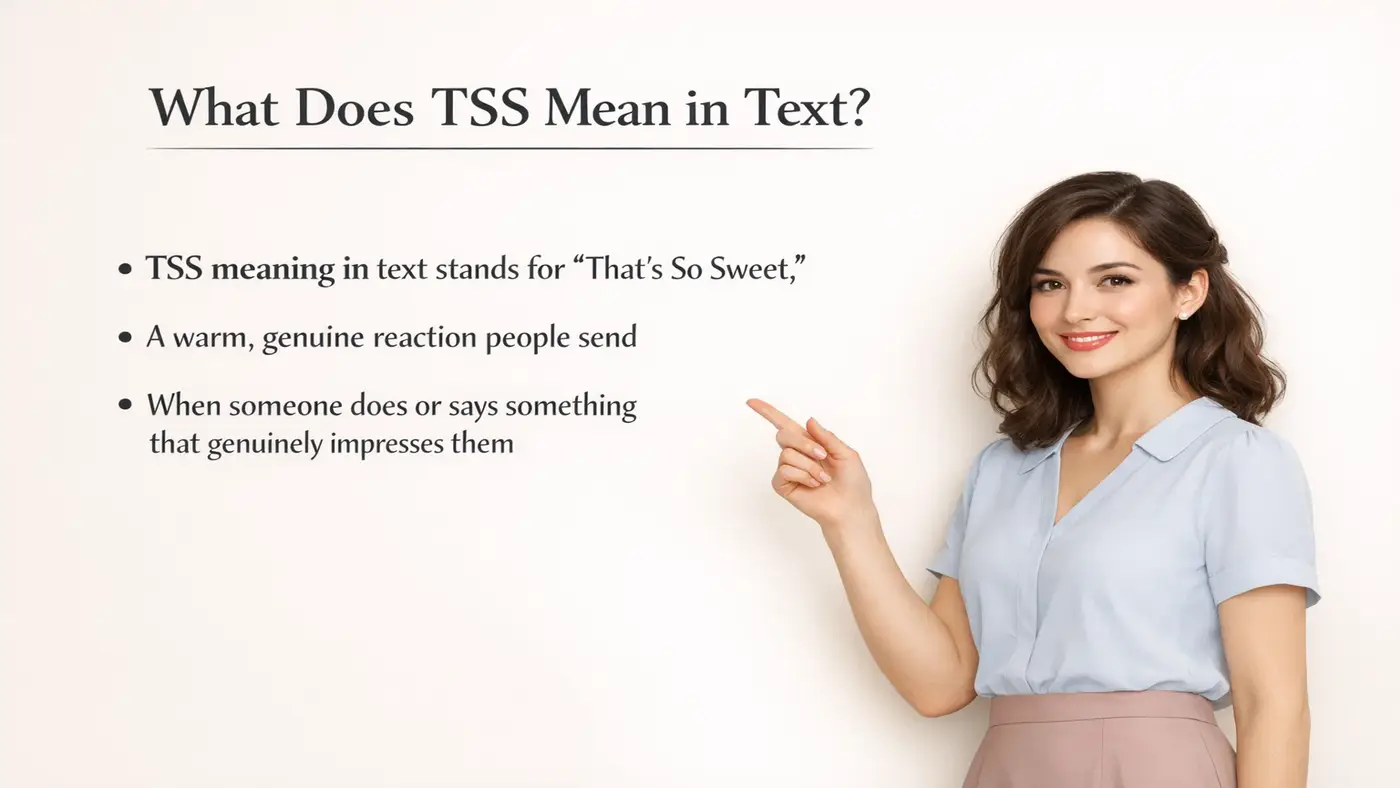
TSS meaning in text stands for “That’s So Sweet,” a warm, genuine reaction people send when someone does or says something that genuinely touches them, impresses them, or makes them feel cared for. Three letters that deliver a full emotional response in under a second.
You will also see TSS used as “That’s So Sad” in heavier conversations where the emotional direction flips entirely. Same letters, completely opposite feeling. The surrounding message tells you which one landed in your chat before you finish reading the sentence.
Origin and Cultural Footprints
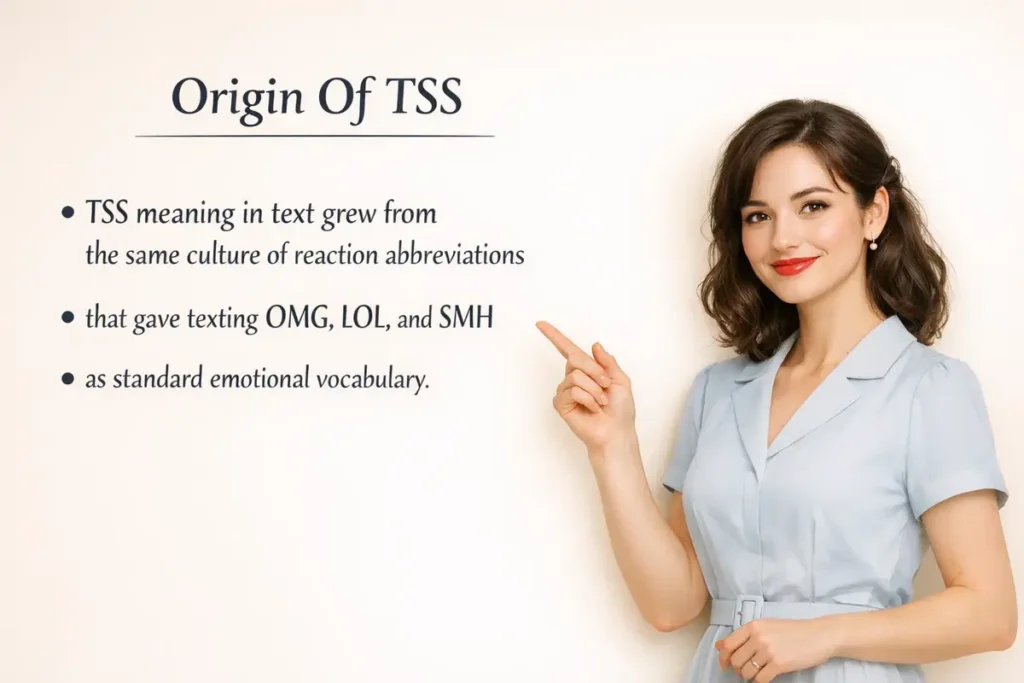
TSS meaning in text grew from the same culture of reaction abbreviations that gave texting OMG, LOL, and SMH as standard emotional vocabulary. As digital communication compressed feelings into shorter and shorter formats, people needed fast ways to express warmth, sympathy, and affection without writing paragraphs about it.
TSS filled that gap for two specific emotional registers simultaneously. The sweet reading travels through romantic conversations, close friendships, and warm exchanges between people who genuinely care about each other. The sad reading surfaces in support conversations, emotional check-ins, and moments where someone shares difficult news and the other person wants to acknowledge it without over-responding.
Other Meanings of TSS
TSS carries a few alternate meanings worth knowing depending on the context and community:
- Toxic Shock Syndrome — A serious medical condition abbreviated TSS in healthcare documentation, medical journalism, and public health discussions. Appears in clinical settings, pharmaceutical warnings, and health education materials with no connection to casual texting contexts.
- The Shade Station — Used in beauty, makeup, and cosmetics communities to refer to a popular online retailer. Appears in product reviews, beauty influencer content, and makeup community discussions across YouTube and Instagram.
- Time Shift Substitution — A technical broadcasting and telecommunications abbreviation used in media production and transmission scheduling documentation. Institutional, specific, and entirely separate from casual messaging environments.
Why Does TSS Have Multiple Meanings?
TSS sits in the category of abbreviations where different communities independently assigned the same letters to different phrases without any awareness of each other. A nurse reading TSS in a clinical document sees a medical condition. A teenager receiving TSS after sharing something kind sees an expression of warmth. Neither reading is wrong in its own context.
The sweet and sad readings dominate in personal texting because they fill emotional gaps that people encounter constantly in daily conversation. Both land in contexts that announce themselves immediately through the surrounding message. The other meanings belong to specialized professional and commercial spaces that never overlap with personal conversation in any meaningful way.
Who Uses It Most?
TSS belongs to people who respond to emotional moments quickly and want their reactions to carry warmth or empathy without requiring a long reply. The groups that reach for it most tend to be those whose conversations already operate in a high-emotional register.
Here is a clear breakdown of which groups use TSS most and how each group deploys it:
| Group | How They Use TSS | Why It Works |
|---|---|---|
| Couples and romantic partners | Reacting to kind gestures and thoughtful messages | Delivers genuine warmth efficiently without over-explaining |
| Close friend groups | Responding to vulnerable shares and emotional moments | Acknowledges the feeling without making it heavier than needed |
| Gen Z | Quick emotional reactions in DMs and group chats | Fits their direct, fast-moving communication style naturally |
| Teenagers | Reacting to sweet or sad stories shared by friends | Low-effort response that still signals genuine emotional presence |
Real Conversation Examples Using TSS
- Reacting to a kind gesture Context: A partner describes something thoughtful they did for someone. Sender: “I stayed late at work to help my colleague finish their project even though I was exhausted.” Reply: “TSS, you are genuinely one of the good ones.” How to respond: Accept the compliment and acknowledge the effort felt worth it.
- Responding to sad news Context: A friend shares news about a difficult situation they are going through. Sender: “My dog has been really unwell lately and the vet visits are not going well.” Reply: “TSS, I am so sorry, how are you holding up?” How to respond: Share what is actually happening and let them know whether support is needed.
- Reacting to a sweet memory someone shared Context: Someone shares a warm childhood memory in a group chat. Sender: “My grandmother used to wait at the window for me every day after school.” Reply: “TSS, that image is everything.” How to respond: Share the appreciation for the memory and keep the warmth going.
- Responding to a romantic message Context: A partner sends a thoughtful message about their relationship. Sender: “I was just thinking about our first trip together and how happy I was that whole time.” Reply: “TSS, that trip is one of my favorite memories too.” How to respond: Build on the warmth by sharing a specific detail from that memory.
- Reacting to a story about an animal Context: Someone shares a video or story about an animal that is either adorable or unfortunate. Sender: “This little dog waited at the shelter for three years before someone finally adopted him.” Reply: “TSS I cannot handle this, please tell me he is okay now.” How to respond: Confirm the happy ending if there is one and let them sit in the feeling together.
Usage of TSS in Different Contexts
In romantic and close personal conversations, TSS works as a warm acknowledgment that what the other person said or did registered as genuinely kind and meaningful. It tells them their effort was noticed without turning the response into an essay about appreciation. That efficiency is what makes it feel natural rather than lazy.
In support and empathy contexts, TSS takes on the sad reading and functions as an emotional acknowledgment before any advice or follow-up. Someone shares painful news and receiving TSS tells them their pain registered with the other person immediately. That quick acknowledgment matters more than a carefully constructed response in the first moment after difficult news lands.
How Gen Z Uses TSS Today
Gen Z treats TSS as a genuine emotional signal rather than a hollow filler response. Sending TSS in reaction to something kind or sad tells the other person that their message actually moved the sender enough to react immediately. In a communication environment where people sometimes respond with minimal effort, TSS still carries real warmth because it names the specific emotional quality of the moment.
The tss meaning in text also picks up ironic treatment in Gen Z spaces where the sweet reading gets applied to something objectively not sweet at all. “I stayed awake for forty hours studying. TSS honestly” uses the warm reaction format as self-directed humor about a genuinely unpleasant situation. The joke lands because the mismatch between TSS and suffering is obvious and relatable.
Meaning Across Social Media
| Platform | TSS Meaning | How It’s Used |
|---|---|---|
| iMessage | That’s So Sweet or That’s So Sad | Personal emotional reactions in close relationship and friendship conversations |
| Snapchat | That’s So Sweet or That’s So Sad | DM reactions to stories, photos, and personal updates from close contacts |
| Telegram | That’s So Sweet | Group chat warm reactions to kind gestures and thoughtful shares |
| Tumblr | That’s So Sad | Reaction posts and reblog commentary on emotional or difficult content |
| BeReal | That’s So Sweet | Comment reactions to genuine real-time moments shared with close friends |
| That’s So Sad | Comment thread empathy reactions in personal story and relationship subreddits |
Common Confusions and Wrong Interpretations
- TSS sweet versus sad misread — This is the most consequential confusion. Someone shares painful news, receives TSS, and reads it as “That’s So Sweet” rather than “That’s So Sad.” The surrounding message almost always prevents this misread but in ambiguous situations a clarifying follow-up prevents any emotional mismatch.
- TSS confused with SMH — SMH means “Shaking My Head” and signals disappointed disbelief. TSS signals warmth or empathy. Both appear in emotional conversation contexts but they point in completely different directions and serve different communicative purposes.
- Toxic Shock Syndrome confusion — Someone with a medical background who sees TSS in a personal conversation might briefly process the clinical meaning before context overrides it. A warm personal message using TSS has nothing to do with medical conditions.
- TSS read as sarcastic when sincere — Some recipients assume emotional abbreviations carry irony, especially from people whose usual communication style tends toward humor. A genuinely meant TSS deserves a genuine response rather than a defensive one.
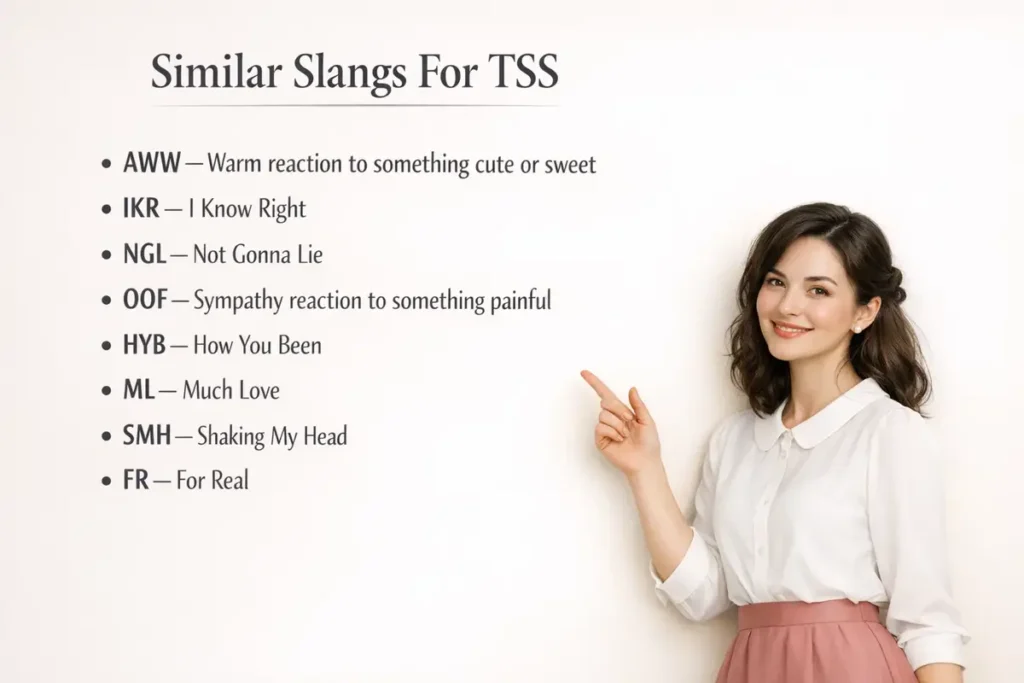
Related Slang Terms
How to Reply When Someone Says TSS
If someone sends you TSS after something kind you said or did, accept the warmth and let it land. A simple “aw thank you, that means a lot” or “glad it came across that way” keeps the exchange genuine without deflecting the compliment. Most people who send TSS want their warmth acknowledged rather than redirected.
If TSS arrives in response to something difficult you shared, the person sending it is signaling empathy and opening the door to more conversation. “Yeah it has been a lot lately” or “thanks, it helped just saying it” keeps the exchange honest and lets the support do what it was meant to do. TSS in that context is an invitation to keep talking if you need to.
Conclusion
TSS meaning in text covers two of the most human emotional responses in three letters and delivers both with complete clarity when the context does its job. It means sweet when the moment calls for warmth and sad when the moment calls for empathy. Precise, efficient, and genuinely felt every time.
Three letters. Two feelings. Always clear when the message around them tells the full story.
FAQs
TSS means “That’s So Sweet” or “That’s So Sad” depending on the conversation. Context tells you which one instantly.
TSSS is just TSS with an extra S for added emphasis or dramatic effect. Same meaning, stronger reaction.
TSS also stands for Toxic Shock Syndrome in medical contexts and The Shade Station in beauty communities.
No standard definition exists for a “TSS person.” The term TSS refers to a reaction, not a personality type.
She either finds something genuinely sweet or feels genuinely sad about it. Read the conversation to know which one.

GenZ Slang Writer & Internet Culture Expert Layla Brooks has spent 2+ years tracking how GenZ slang evolves across TikTok, Twitter, and everyday conversations. From decoding viral phrases to explaining what words actually mean in real life, Layla writes content that feels native to the culture, not forced. If a word is trending, Layla already knows what it means and why it matters.