SMT Meaning in Text: Origin, Confusions, And Similar Terms
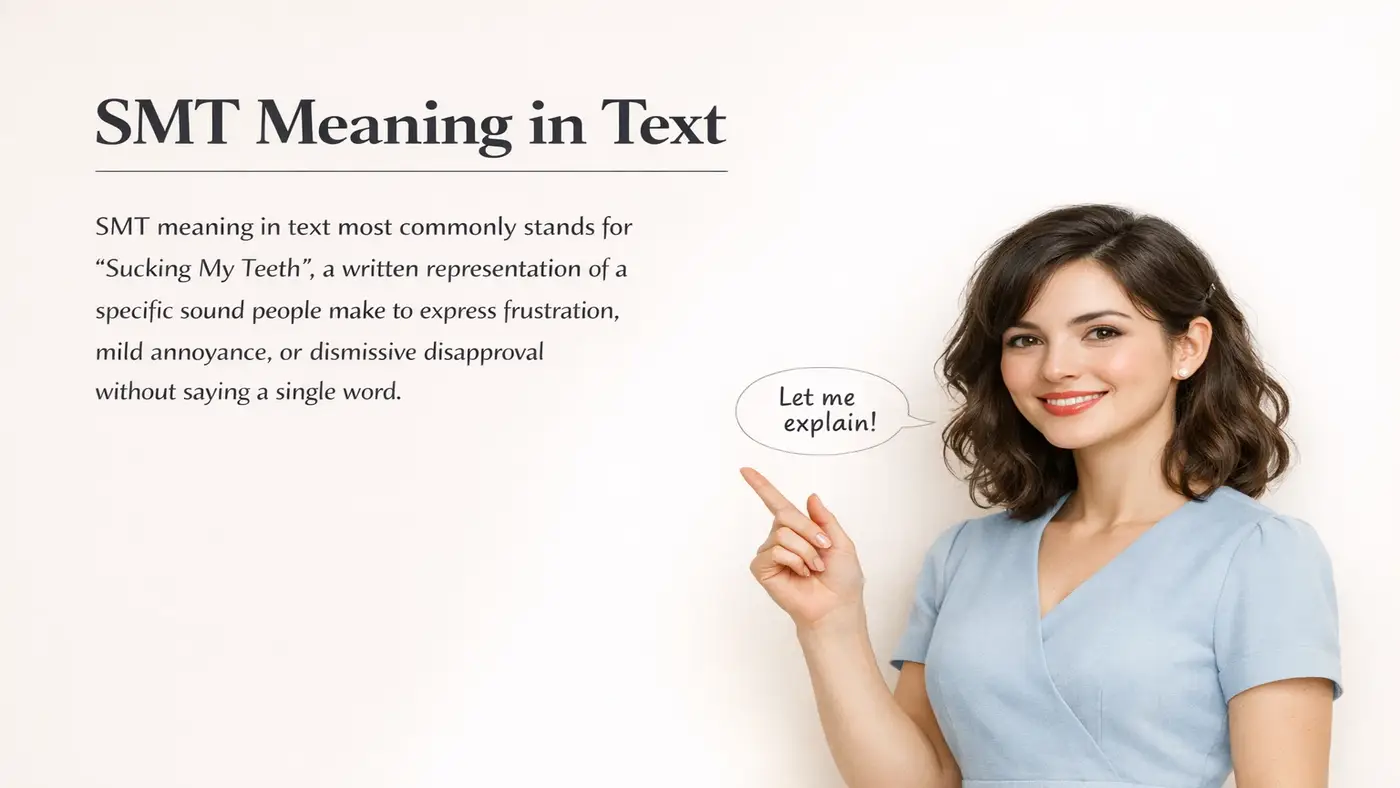
SMT meaning in text most commonly stands for “Sucking My Teeth”, a written representation of a specific sound people make to express frustration, mild annoyance, or dismissive disapproval without saying a single word. It is a physical reaction turned into a typed abbreviation.
You will also see SMT used as “Something” in casual shorthand texting. Same three letters, completely different contexts. The surrounding message tells you which one landed in your chat within seconds of reading it.

Origin and Cultural Footprints
SMT meaning in text as “Sucking My Teeth” has deep roots in Caribbean and African American communicative traditions, where the teeth-sucking sound carries well-recognized social meaning. The gesture signals disapproval, impatience, or exasperation without requiring words. Digital communication needed a way to capture that sound in text form, and SMT became that bridge.
The abbreviation spread through Black Twitter, Snapchat, and urban online communities before crossing into mainstream Gen Z vocabulary. That crossover pattern is consistent with how most AAVE-influenced expressions travel online. They start in specific cultural spaces, gain recognition through social media, and eventually land in everyday group chats everywhere.
Other Definitions of SMT
SMT carries a few distinct alternate meanings depending on where you encounter it:
- Something — A common shorthand in casual texting where someone compresses the word “something” into three letters for speed. “Do SMT fun tonight” reads naturally in any message thread where informal abbreviation is the norm between close contacts.
- Surface Mount Technology — A professional electronics and engineering abbreviation referring to the method of producing electronic circuits where components mount directly onto the surface of printed circuit boards. Specific, technical, and entirely disconnected from casual texting contexts.
- So Much Trouble — An occasional variation used in specific online communities to express that a situation has gone sideways or someone is facing significant consequences. Less common than the primary meanings but surfaces in certain forums and community spaces.
Who Uses It Most?
SMT as “Sucking My Teeth” belongs to people who express emotion efficiently and want a written representation of a physical reaction they would make in person. The groups that reach for it most tend to be those whose communication style bridges spoken and written expression naturally.
Here is a clear breakdown of which groups use SMT most and what drives each group toward it:
| Group | How They Use SMT | Why It Works |
|---|---|---|
| Gen Z | Reacting to frustrating situations and annoying behavior | Captures a specific emotional register faster than any full sentence |
| Black and Caribbean communities | Expressing disapproval or exasperation in digital conversation | The teeth-sucking sound already carries clear meaning in spoken culture |
| Teenagers | Reacting to inconvenient news and mildly irritating situations | Relatable, fast, and universally understood among peer groups |
| Twitter / X users | Responding to takes and posts that trigger mild annoyance | Efficient reaction that adds personality without requiring extra words |
Usage of SMT in Different Contexts
In personal texting between close friends, SMT lands as a relatable frustration signal that needs no follow-up explanation. Someone shares that their plans fell through again and the reply is “smt, this always happens” — three letters that say “I am annoyed on your behalf” without making it bigger than the moment requires.
In social media comment sections and reply threads, SMT gets dropped under posts that irritate or disappoint. A creator posts something contradictory to what they said before, or a public figure says something tone-deaf, and the comment section fills with SMT reactions. The abbreviation communicates collective disapproval cleanly and immediately.
How Gen Z Uses SMT Today
Gen Z treats SMT as a precision frustration tool rather than a general complaint. It lands differently from a plain “ugh” or “smh” because the teeth-sucking imagery is specific — it carries cultural weight, a particular register, and a level of expressive authenticity that generic frustration abbreviations do not match.
The smt meaning in text also picks up layered irony in Gen Z usage where the frustration gets directed at completely minor inconveniences. “The playlist shuffled to the worst song. smt.” applies serious exasperation language to a trivial problem and the humor comes from that gap. Gen Z runs that format constantly and the audience reads it correctly every time.
Does SMT Mean “Shaking My Head”?
No. SMH means “Shaking My Head” and SMT is a different abbreviation entirely. This mix-up happens because both start with SM and both express negative reactions to frustrating situations. But they are not the same. SMH signals disappointed disbelief. SMT signals active, physical exasperation.
The distinction matters because the two reactions carry different emotional registers. Someone who receives SMT and reads it as SMH misses the specific cultural texture the sender put into that message. Reading both letters carefully rather than scanning the first two resolves the confusion instantly.
Meaning Across Social Media
| Platform | SMT Meaning | How It’s Used |
|---|---|---|
| Twitter / X | Sucking My Teeth | Reactions to frustrating posts, takes, and public behavior |
| Snapchat | Sucking My Teeth or Something | Personal frustration reactions in DMs and story replies |
| Sucking My Teeth | Comment section reactions to disappointing or irritating content | |
| TikTok | Sucking My Teeth | Video comment reactions to relatable frustration content |
| Sucking My Teeth or Something | Personal chat frustration signals and casual shorthand | |
| Discord | Something or Sucking My Teeth | Community server reactions depending on the server culture |
Common Confusions & Wrong Interpretations
- SMT confused with SMH — SMH means “Shaking My Head” and expresses disappointed disbelief. SMT expresses active physical exasperation through a specific cultural sound. They occupy similar emotional territory but are not interchangeable, and swapping them loses the precision the sender intended.
- Something versus Sucking My Teeth in the same conversation — When SMT appears mid-sentence in a neutral message, it almost always means “something.” When it appears as a standalone reaction after frustrating news, it almost always means “Sucking My Teeth.” The position in the sentence does most of the disambiguation.
- SMT read as aggressive when it is mild — Some recipients interpret any frustration abbreviation as hostile. SMT almost always signals mild to moderate annoyance rather than serious anger. The broader conversation confirms the intensity level every time.
- Cultural context misread — Recipients unfamiliar with the teeth-sucking gesture and its cultural roots sometimes read SMT as a random string of letters rather than a recognized expressive sound. Knowing the cultural origin helps the abbreviation land with its full intended meaning.
Similar Terms, Alternatives & Related Slang
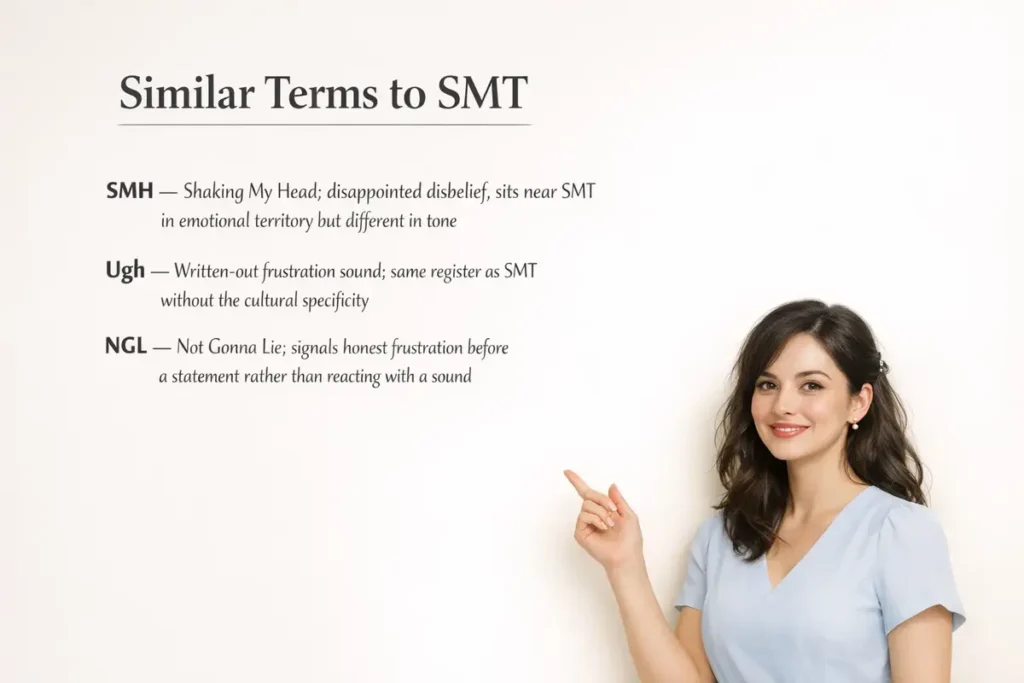
- SMH — Shaking My Head; disappointed disbelief, sits near SMT in emotional territory but different in tone
- Ugh — Written-out frustration sound; same register as SMT without the cultural specificity
- NGL — Not Gonna Lie; signals honest frustration before a statement rather than reacting with a sound
- Bruh — Disbelieving reaction to frustrating situations; shares SMT’s exasperated energy
- TF — The heck; stronger frustration signal that escalates beyond the mild annoyance of SMT
- Oof — Reaction to secondhand or personal pain and frustration; softer than SMT
- Deadass — Signals complete seriousness about a frustrating claim or situation
- FR — For Real; emphasizes genuine frustration or disbelief, often pairs naturally with SMT
How to Reply When Someone Sends You SMT
If someone sends SMT after you shared something frustrating that happened to you, they are validating your exasperation and expressing that they feel it too. A quick “right?? so annoying” or “exactly, I cannot believe it” matches their energy and keeps the venting session going naturally. Most people who send SMT want you to know they get it.
If you receive SMT after something you said or did caused the frustration, read the context carefully before responding. A calm “what happened, talk to me” or “I hear you, what is going on” opens the conversation without escalating the irritation. SMT is a mild to moderate frustration signal and a gentle, curious response almost always resolves it faster than a defensive one.
Conclusion
SMT meaning in text captures a specific physical and cultural expression of frustration in three letters and delivers it with full emotional accuracy. It means “Sucking My Teeth,” it signals exasperation, and everyone who receives it in the right context knows exactly what the sender felt in that moment. Precise, expressive, and culturally grounded.
Three letters. One very specific reaction. That is everything SMT needs to be.
FAQs
“SMT” can mean “Sucking My Teeth”, a sound used to show annoyance or frustration. In some chats, people also use it as a short form for “something”.
On Snapchat, “SMT” usually carries the same meanings, either “Sucking My Teeth” for attitude or “something” when typing fast. The meaning depends on the tone of the message.
“SMT” does not have a different meaning for females. It is used the same way by anyone, usually to show irritation or to shorten “something”.
“SMTH” simply means “something”. It is a common shortcut people use to type faster in casual conversations.
Yes, “SMT” is used on social media, especially in quick chats or comments. It is not as common as “SMTH”, but people still use it for speed or expression.

GenZ Slang Writer & Internet Culture Expert Layla Brooks has spent 2+ years tracking how GenZ slang evolves across TikTok, Twitter, and everyday conversations. From decoding viral phrases to explaining what words actually mean in real life, Layla writes content that feels native to the culture, not forced. If a word is trending, Layla already knows what it means and why it matters.